

Phryne Revealed Before The Areopagus: A Study in Classical Drama
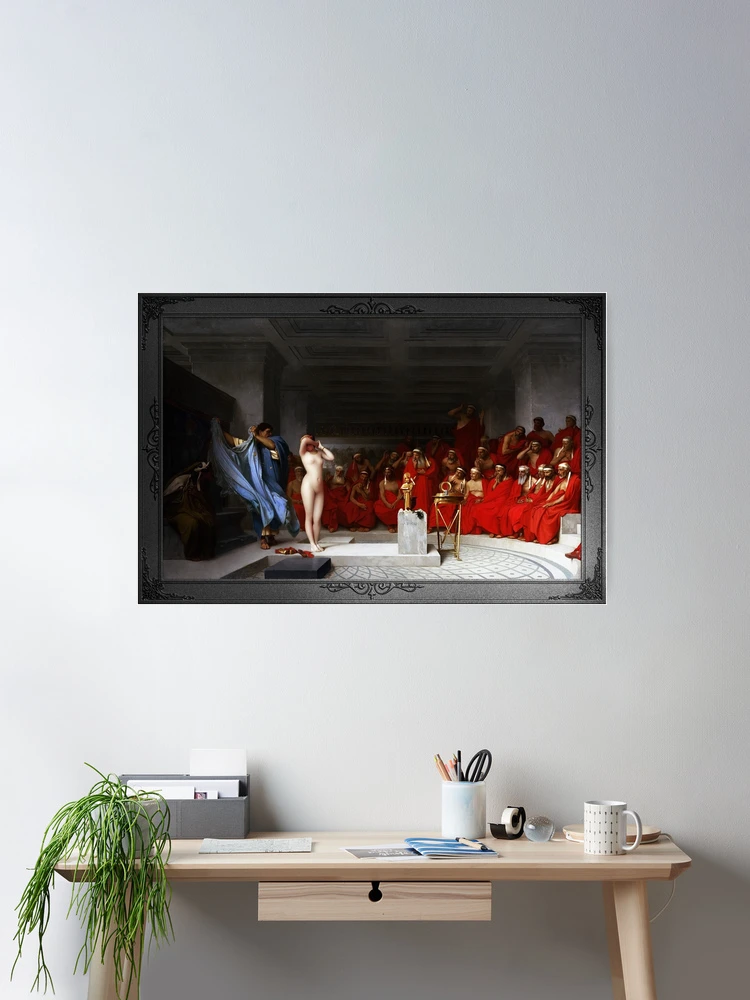
장 레옹 제롬’s “Phryne Revealed Before the Areopagus,”그 주위에 페인트 1861, is a compelling work of historical genre painting that draws heavily from classical antiquity. It depicts a dramatic scene rooted in ancient Greek legal proceedings, specifically the trial of Phryne, a celebrated courtesan of Athens. Gérôme was renowned for his meticulous attention to detail and his ability to recreate historical settings with remarkable accuracy, and this piece exemplifies those qualities. The painting is not merely an illustration of a story; it’s a carefully constructed tableau designed to evoke a sense of tension, anticipation, and the weight of societal judgment.
목차
구성 구조 & 환경
The composition is meticulously structured, guiding the viewer’s eye through the unfolding drama. The scene unfolds within a grand hall, likely representing the Areopagus, the ancient Athenian court known for its gravity and importance. Architectural elements dominate the background: tall columns with ornate capitals support a coffered ceiling, suggesting a space of considerable authority and permanence. Light streams in from an unseen source on the left, illuminating the central figures while casting long shadows that heighten the sense of drama. The hall is filled with seated men, all clad in similar crimson robes, forming a dense audience observing the proceedings. Their uniformity emphasizes their role as collective judges, representing Athenian society’s scrutiny.
Phryne: 중심 인물
At the heart of the composition stands Phryne herself. She is depicted nude, her body rendered with anatomical precision and a classical idealization reminiscent of ancient Greek sculpture. Her pose is one of vulnerability and exposure; she appears to be in the process of disrobing, perhaps as part of an attempt at legal maneuvering or a demonstration of innocence. Her expression is difficult to definitively interpret – it could suggest defiance, resignation, or even a hint of melancholy. The artist avoids any overt display of emotion, instead opting for a subtle and restrained portrayal that allows viewers to project their own interpretations onto her character.
The Legal Processors & Supporting Characters
To Phryne’s left stands a man in Roman attire, likely an advocate or legal representative. He is actively engaged in the scene, holding back a drape of fabric as if revealing Phryne to the court. His posture suggests a degree of authority and control over the unfolding events. Further back, seated figures form the Areopagus itself. Their faces are largely obscured by shadow and their expressions are difficult to discern, contributing to an atmosphere of solemnity and impartiality. A small altar or pedestal stands in the foreground, upon which rests a bronze statue – possibly representing Athena, the goddess of wisdom and justice, subtly alluding to the divine sanction underpinning Athenian law.
Gérôme’s Technical Skill & 예술적 영향
Gérôme’s mastery of realism is evident throughout the painting. The textures of the fabrics, the smoothness of Phryne’s skin, and the cool marble of the architectural elements are rendered with remarkable fidelity. His use of chiaroscuro – the dramatic contrast between light and shadow – enhances the sense of depth and creates a theatrical atmosphere. The work reflects Gérôme’s deep interest in classical antiquity and his desire to recreate historical scenes with accuracy and authenticity. He was influenced by earlier masters such as Jacques-Louis David, but he developed his own distinctive style characterized by meticulous detail and a focus on narrative clarity. The painting’s composition also draws inspiration from theatrical staging, creating a sense of dramatic tension that engages the viewer directly.
역사적 맥락 & 해석
The story behind “Phryne Revealed Before the Areopagus” is rooted in ancient Greek history. Phryne was a renowned courtesan known for her beauty and wealth. She was accused of impiety and brought before the Areopagus. According to accounts, she offered a substantial bribe to the court officials, which was then used to fund the construction of a statue of Hermes at the Temple of Ares. The painting captures this moment of legal drama, focusing on the tension between Phryne’s vulnerability and the power of the Athenian court. While Gérôme’s work is based on historical accounts, it also transcends mere illustration; it explores themes of justice, societal judgment, and the complexities of human relationships within a specific cultural context.
유산 & 중요성
“Phryne Revealed Before the Areopagus” remains one of Jean-Léon Gérôme’s most celebrated works. It exemplifies his skill as a historical genre painter and his ability to create compelling narratives through meticulous detail and dramatic composition. The painting has been admired for its technical virtuosity, 그 감동적인 분위기, and its exploration of timeless themes related to law, 도덕, and the human condition. It continues to be studied by art historians and appreciated by audiences for its enduring power and historical significance.
이 작품에 사용된 장식 악센트는 다음에서 구입할 수 있습니다. 유산 유형
유래 된 아티스트 바이오 Wikipedia.org
장 레옹 제롬 (11 할 수있다 1824 – 10 1 월 1904) 아카데미즘으로 알려진 스타일의 프랑스 화가이자 조각가였습니다.. 그의 그림은 너무 광범위하게 복제되어 “틀림없이 1880년까지 세계에서 가장 유명한 살아있는 예술가.”[1] 그의 작품 범위에는 역사적 그림이 포함됩니다., 그리스 신화, 동양풍, 초상화, 및 기타 과목, 학문적 회화 전통을 예술적 절정으로 끌어올리다. 그는 이 학문적 시기의 가장 중요한 화가 중 한 사람으로 여겨진다..
에 1840 그는 파리에 갔다, 그가 Paul Delaroche 밑에서 공부한 곳, 그가 이탈리아에 동행한 1843. 그는 피렌체를 방문했다, 로마, 바티칸과 폼페이. 그가 파리로 돌아오면서 1844, Delaroche의 많은 학생들처럼, 그는 Charles Gleyre의 아틀리에에 합류하여 잠시 동안 그곳에서 공부했습니다.. 그 후 그는 미술 학교에 다녔다.. 에 1846 그는 권위 있는 Prix de Rome에 참가하려고 했습니다., 하지만 그의 피규어 드로잉이 미흡하여 최종 단계에서 실패했습니다..
그의 그림 수탉 싸움 (1846) 누드 젊은 남자와 두 개의 싸우는 자지를 가진 매우 얇은 옷을 입은 젊은 여자를 묘사하는 학문적 운동입니다., 나폴리만을 배경으로. 그는 이 그림을 파리의 살롱에 보냈습니다. 1847, 3등 메달을 획득한 곳. 이 작품은 Gleyre의 스튜디오에서 형성된 Neo-Grec 운동의 전형으로 여겨졌습니다. (앙리 피에르 피쿠, 장 루이 하몽 등), 영향력 있는 프랑스 비평가 테오필 고티에(Théophile Gautier)가 옹호했습니다., 그의 리뷰를 통해 Gérôme을 유명하게 만들고 그의 경력을 효과적으로 시작했습니다..
Gérôme은 Prix de Rome 우승의 꿈을 포기하고 그의 갑작스러운 성공을 이용했습니다.. 그의 그림 The Virgin, 아기 예수와 성 요한과 아나크레온, Bacchus와 Eros는 파리 살롱에서 2등 메달을 획득했습니다. 1848. 에 1849, 그는 미켈란젤로의 그림을 그렸습니다. (In his Studio라고도 함) 그리고 여인의 초상.
에 1851, 그는 나중에 프랑스의 황제 나폴레옹 3세가 알베르 왕자에게 제공한 꽃병을 장식했습니다., 이제 세인트 로얄 컬렉션의 일부. 제임스의 궁전, 런던. 그는 그리스 인테리어를 전시했습니다., 이탈리아에서 온 기념품, 박카스와 사랑, 술에 취해 1851; 파에스툼에서 1852; 그리고 짧은 서사시 1853
에 1852, 제롬은 자신이 선택한 우화적인 주제의 대형 벽화를 그려달라는 의뢰를 받았습니다.. 아우구스투스 시대, 그리스도의 탄생, 그것은 그리스도의 탄생과 아우구스투스에게 경의를 표하는 정복된 국가들을 결합할 것입니다., 나폴레옹 3세를 아첨하기 위한 것일 수 있습니다., 누구의 정부가 벽화를 의뢰했고 누구로 확인되었는지 “새로운 아우구스투스.
상당한 계약금으로 Gérôme은 여행과 연구를 할 수 있었습니다., 먼저 1853 콘스탄티노플로, 배우 에드먼드 갓과 함께, 그리고 1854 그리스와 터키, 다뉴브 강 기슭까지, 그는 채찍질의 위협을 받고 음악을 만드는 러시아 징집병의 콘서트에 참석했습니다..
에 1853, Gérôme은 Tea Box로 이사했습니다., Rue Notre-Dame-des-Champs에 있는 스튜디오 그룹, 파리. 예술가들의 만남의 장소가 될 것입니다., 작가와 배우, George Sand가 작곡가 Hector Berlioz를 즐겁게 했던 곳, 요하네스 브람스와 조아키노 로시니와 소설가 테오필 고티에와 이반 투르게네프.
에 1854, 그는 또 다른 중요한 임무를 완료했습니다, 성 예배당 장식하기. 성 교회의 제롬. 파리의 세베랭. 그의 마지막 성찬 영성체. 이 예배당의 제롬은 그의 종교 작품에 대한 잉그르 학교의 영향을 반영합니다..
만국박람회에 1855 그는 피페라로를 공헌했다, 목자, 그리고 아우구스투스 시대, 그리스도의 탄생, 그러나 가장 주목을 받은 것은 소박한 그림인 Recreation in a Russia Camp…
Phryne Revealed Before The Areopagus is a retouched digital art old masters reproduction of a public domain image.