

Phryne Revealed Before The Areopagus: A Study in Classical Drama
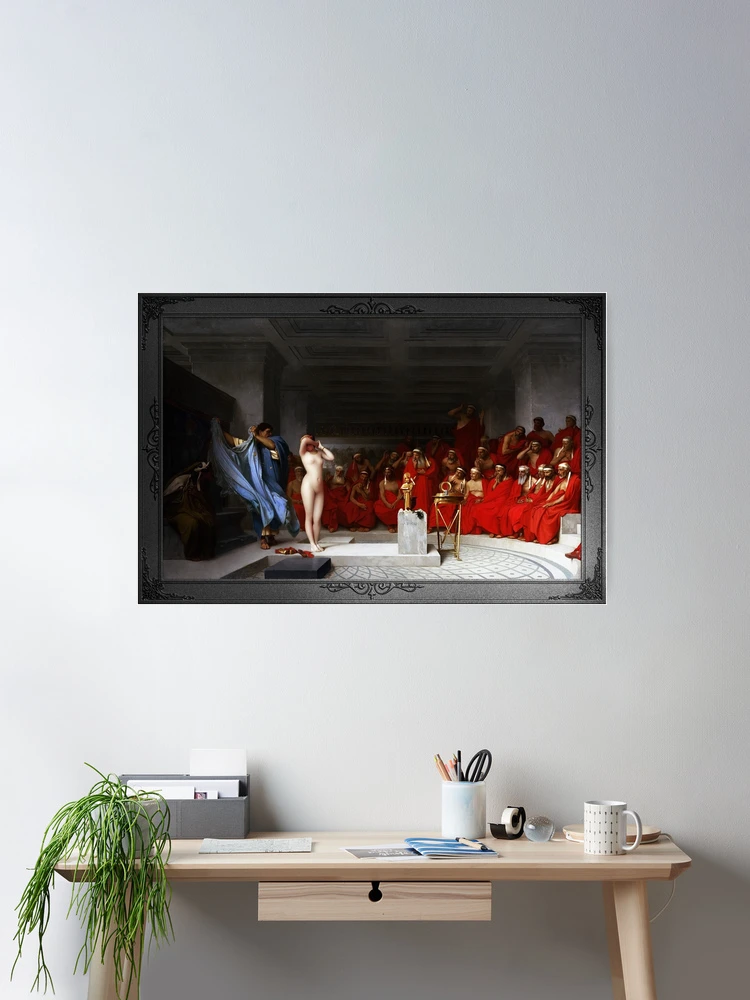
Jean-Léon Gérôme’s “Phryne Revealed Before the Areopagus,'omheen geschilderd 1861, is a compelling work of historical genre painting that draws heavily from classical antiquity. It depicts a dramatic scene rooted in ancient Greek legal proceedings, specifically the trial of Phryne, a celebrated courtesan of Athens. Gérôme was renowned for his meticulous attention to detail and his ability to recreate historical settings with remarkable accuracy, and this piece exemplifies those qualities. The painting is not merely an illustration of a story; it’s a carefully constructed tableau designed to evoke a sense of tension, anticipation, and the weight of societal judgment.
Inhoudsopgave
Compositorische structuur & Instelling
The composition is meticulously structured, guiding the viewer’s eye through the unfolding drama. The scene unfolds within a grand hall, likely representing the Areopagus, the ancient Athenian court known for its gravity and importance. Architectural elements dominate the background: tall columns with ornate capitals support a coffered ceiling, suggesting a space of considerable authority and permanence. Light streams in from an unseen source on the left, illuminating the central figures while casting long shadows that heighten the sense of drama. The hall is filled with seated men, all clad in similar crimson robes, forming a dense audience observing the proceedings. Their uniformity emphasizes their role as collective judges, representing Athenian society’s scrutiny.
Phryne: De centrale figuur
At the heart of the composition stands Phryne herself. She is depicted nude, her body rendered with anatomical precision and a classical idealization reminiscent of ancient Greek sculpture. Her pose is one of vulnerability and exposure; she appears to be in the process of disrobing, perhaps as part of an attempt at legal maneuvering or a demonstration of innocence. Her expression is difficult to definitively interpret – it could suggest defiance, resignation, or even a hint of melancholy. The artist avoids any overt display of emotion, instead opting for a subtle and restrained portrayal that allows viewers to project their own interpretations onto her character.
The Legal Processors & Supporting Characters
To Phryne’s left stands a man in Roman attire, likely an advocate or legal representative. He is actively engaged in the scene, holding back a drape of fabric as if revealing Phryne to the court. His posture suggests a degree of authority and control over the unfolding events. Further back, seated figures form the Areopagus itself. Their faces are largely obscured by shadow and their expressions are difficult to discern, contributing to an atmosphere of solemnity and impartiality. A small altar or pedestal stands in the foreground, upon which rests a bronze statue – possibly representing Athena, the goddess of wisdom and justice, subtly alluding to the divine sanction underpinning Athenian law.
Gérôme’s Technical Skill & Artistieke invloeden
Gérôme’s mastery of realism is evident throughout the painting. The textures of the fabrics, the smoothness of Phryne’s skin, and the cool marble of the architectural elements are rendered with remarkable fidelity. His use of chiaroscuro – the dramatic contrast between light and shadow – enhances the sense of depth and creates a theatrical atmosphere. The work reflects Gérôme’s deep interest in classical antiquity and his desire to recreate historical scenes with accuracy and authenticity. He was influenced by earlier masters such as Jacques-Louis David, but he developed his own distinctive style characterized by meticulous detail and a focus on narrative clarity. The painting’s composition also draws inspiration from theatrical staging, creating a sense of dramatic tension that engages the viewer directly.
Historische context & Interpretatie
The story behind “Phryne Revealed Before the Areopagus” is rooted in ancient Greek history. Phryne was a renowned courtesan known for her beauty and wealth. She was accused of impiety and brought before the Areopagus. According to accounts, she offered a substantial bribe to the court officials, which was then used to fund the construction of a statue of Hermes at the Temple of Ares. The painting captures this moment of legal drama, focusing on the tension between Phryne’s vulnerability and the power of the Athenian court. While Gérôme’s work is based on historical accounts, it also transcends mere illustration; it explores themes of justice, societal judgment, and the complexities of human relationships within a specific cultural context.
Nalatenschap & Betekenis
“Phryne Revealed Before the Areopagus” remains one of Jean-Léon Gérôme’s most celebrated works. It exemplifies his skill as a historical genre painter and his ability to create compelling narratives through meticulous detail and dramatic composition. The painting has been admired for its technical virtuosity, its evocative atmosphere, and its exploration of timeless themes related to law, moraliteit, and the human condition. It continues to be studied by art historians and appreciated by audiences for its enduring power and historical significance.
een gelezen onderkledingstuk dat bedekt is met een blauwe topjurk en tot slot een donkergrijze mesh-sjaal over haar borst van schouder tot schouder een gelezen onderkledingstuk dat bedekt is met een blauwe topjurk en tot slot een donkergrijze mesh-sjaal over haar borst van schouder tot schouder
Bio van kunstenaar afgeleid van Wikipedia.org
Jean-Léon Gérôme (11 Kunnen 1824 – 10 Januari 1904) was een Franse schilder en beeldhouwer in de stijl die nu bekend staat als academisme. Zijn schilderijen werden zo wijdverbreid gereproduceerd dat hij... “misschien wel de beroemdste levende kunstenaar ter wereld in 1880.”[1] Het bereik van zijn oeuvre omvatte historische schilderkunst, Griekse mythologie, oriëntalisme, portretten, en andere onderwerpen, de academische schildertraditie naar een artistiek hoogtepunt brengen. Hij wordt beschouwd als een van de belangrijkste schilders uit deze academische periode.
In 1840 hij ging naar Parijs, waar hij studeerde onder Paul Delaroche, die hij vergezelde naar Italië in 1843. Hij bezocht Florence, Rome, het Vaticaan en Pompeii. Bij zijn terugkeer naar Parijs in 1844, zoals veel studenten van Delaroche, hij trad toe tot het atelier van Charles Gleyre en studeerde daar een korte tijd. Daarna ging hij naar de School of Fine Arts. In 1846 hij probeerde deel te nemen aan de prestigieuze Prix de Rome, maar faalde in de laatste fase omdat zijn figuurtekening onvoldoende was.
Zijn schilderij The Cock Fight (1846) is een academische oefening die een naakte jonge man en een zeer dun gedrapeerde jonge vrouw met twee vechthanen uitbeeldt, met de baai van Napels op de achtergrond. Hij stuurde dit schilderij naar de Parijse Salon van 1847, waar het hem een medaille van de derde klasse opleverde. Dit werk werd gezien als de belichaming van de Neo-Grec-beweging die was ontstaan uit de studio van Gleyre (waaronder Henri-Pierre Picou en Jean-Louis Hamon), en werd verdedigd door de invloedrijke Franse criticus Théophile Gautier, wiens recensie Gérôme beroemd maakte en zijn carrière effectief lanceerde.
Gérôme liet zijn droom om de Prix de Rome te winnen varen en profiteerde van zijn plotselinge succes. Zijn schilderijen De Maagd, het Kindje Jezus en Saint John en Anacreon, Bacchus en Eros wonnen een tweederangs medaille op de Parijse Salon in 1848. In 1849, hij maakte de schilderijen Michelangelo (ook wel In zijn Studio genoemd) en een portret van een dame.
In 1851, hij versierde een vaas die later door keizer Napoleon III van Frankrijk aan prins Albert werd aangeboden, nu onderdeel van de Royal Collection in St. James's Palace, Londen. Hij exposeerde Grieks interieur, Souvenir uit Italië, Bacchus en liefde, dronken 1851; in Paestum 1852; en een idylle in 1853
In 1852, Gérôme kreeg de opdracht om een grote muurschildering te schilderen van een allegorisch onderwerp naar keuze. Het tijdperk van Augustus, de geboorte van Christus, die de geboorte van Christus zou combineren met veroverde naties die hulde brengen aan Augustus, misschien bedoeld om Napoleon III te vleien, wiens regering opdracht gaf tot de muurschildering en die werd geïdentificeerd als een “nieuwe Augustus.
Een aanzienlijke aanbetaling stelde Gérôme in staat om te reizen en onderzoek te doen, eerst binnen 1853 naar Constantinopel, samen met de acteur Edmond Got, en in 1854 naar Griekenland en Turkije en de oevers van de Donau, waar hij aanwezig was bij een concert van Russische dienstplichtigen die muziek maakten onder dreiging van een zweep.
In 1853, Gérôme verhuisd naar de Tea Box, een groep studio's in de Rue Notre-Dame-des-Champs, Parijs. Dit zou een ontmoetingsplaats worden voor artiesten, schrijvers en acteurs, waar George Sand de componisten Hector Berlioz . vermaakte, Johannes Brahms en Gioachino Rossini en de romanschrijvers Théophile Gautier en Ivan Turgenev.
In 1854, hij voltooide nog een belangrijke opdracht, het verfraaien van de kapel van St. Hiëronymus in de kerk van St. Severin in Parijs. Zijn laatste communie van St. Hiëronymus in deze kapel weerspiegelt de invloed van de school van Ingres op zijn religieuze werken.
Naar de Wereldtentoonstelling van 1855 hij droeg Pifferaro . bij, herder, en het tijdperk van Augustus, de geboorte van Christus, maar het was het bescheiden schilderij Recreatie in een Russisch kamp dat de meeste aandacht trok...
Phryne Revealed Before The Areopagus is a retouched digital art old masters reproduction of a public domain image.