

Phryne Revealed Before The Areopagus: A Study in Classical Drama
Jean-Leon Gerome’s “Phryne Revealed Before the Areopagus,”pintado ao redor 1861, is a compelling work of historical genre painting that draws heavily from classical antiquity. It depicts a dramatic scene rooted in ancient Greek legal proceedings, specifically the trial of Phryne, a celebrated courtesan of Athens. Gérôme was renowned for his meticulous attention to detail and his ability to recreate historical settings with remarkable accuracy, and this piece exemplifies those qualities. The painting is not merely an illustration of a story; it’s a carefully constructed tableau designed to evoke a sense of tension, anticipation, and the weight of societal judgment.
Índice
Estrutura composicional & Setting
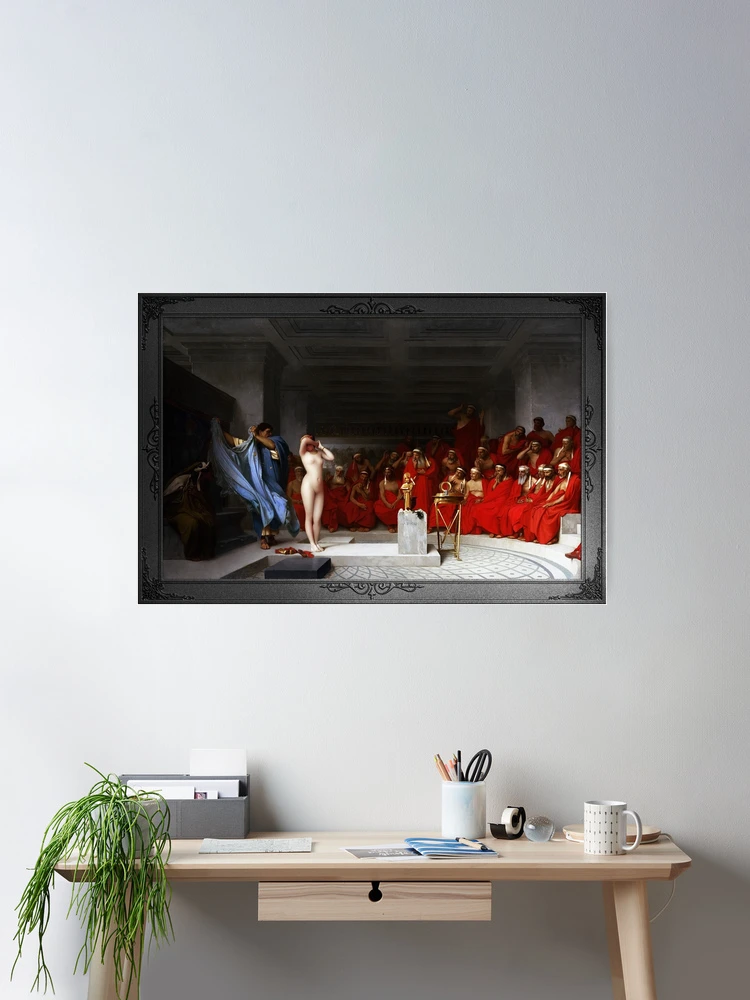
The composition is meticulously structured, guiding the viewer’s eye through the unfolding drama. The scene unfolds within a grand hall, likely representing the Areopagus, the ancient Athenian court known for its gravity and importance. Architectural elements dominate the background: tall columns with ornate capitals support a coffered ceiling, suggesting a space of considerable authority and permanence. Light streams in from an unseen source on the left, illuminating the central figures while casting long shadows that heighten the sense of drama. The hall is filled with seated men, all clad in similar crimson robes, forming a dense audience observing the proceedings. Their uniformity emphasizes their role as collective judges, representing Athenian society’s scrutiny.
Phryne: A figura central
At the heart of the composition stands Phryne herself. She is depicted nude, her body rendered with anatomical precision and a classical idealization reminiscent of ancient Greek sculpture. Her pose is one of vulnerability and exposure; she appears to be in the process of disrobing, perhaps as part of an attempt at legal maneuvering or a demonstration of innocence. Her expression is difficult to definitively interpret – it could suggest defiance, resignation, or even a hint of melancholy. The artist avoids any overt display of emotion, instead opting for a subtle and restrained portrayal that allows viewers to project their own interpretations onto her character.
The Legal Processors & Supporting Characters
To Phryne’s left stands a man in Roman attire, likely an advocate or legal representative. He is actively engaged in the scene, holding back a drape of fabric as if revealing Phryne to the court. His posture suggests a degree of authority and control over the unfolding events. Mais atrás, seated figures form the Areopagus itself. Their faces are largely obscured by shadow and their expressions are difficult to discern, contributing to an atmosphere of solemnity and impartiality. A small altar or pedestal stands in the foreground, upon which rests a bronze statue – possibly representing Athena, the goddess of wisdom and justice, subtly alluding to the divine sanction underpinning Athenian law.
Gérôme’s Technical Skill & Influências artísticas
Gérôme’s mastery of realism is evident throughout the painting. The textures of the fabrics, the smoothness of Phryne’s skin, and the cool marble of the architectural elements are rendered with remarkable fidelity. His use of chiaroscuro – the dramatic contrast between light and shadow – enhances the sense of depth and creates a theatrical atmosphere. The work reflects Gérôme’s deep interest in classical antiquity and his desire to recreate historical scenes with accuracy and authenticity. He was influenced by earlier masters such as Jacques-Louis David, but he developed his own distinctive style characterized by meticulous detail and a focus on narrative clarity. The painting’s composition also draws inspiration from theatrical staging, creating a sense of dramatic tension that engages the viewer directly.
Historical Context & Interpretação
The story behind “Phryne Revealed Before the Areopagus” is rooted in ancient Greek history. Phryne was a renowned courtesan known for her beauty and wealth. She was accused of impiety and brought before the Areopagus. According to accounts, she offered a substantial bribe to the court officials, which was then used to fund the construction of a statue of Hermes at the Temple of Ares. The painting captures this moment of legal drama, focusing on the tension between Phryne’s vulnerability and the power of the Athenian court. While Gérôme’s work is based on historical accounts, it also transcends mere illustration; it explores themes of justice, societal judgment, and the complexities of human relationships within a specific cultural context.
Legado & Significado
“Phryne Revealed Before the Areopagus” remains one of Jean-Léon Gérôme’s most celebrated works. It exemplifies his skill as a historical genre painter and his ability to create compelling narratives through meticulous detail and dramatic composition. The painting has been admired for its technical virtuosity, its evocative atmosphere, and its exploration of timeless themes related to law, morality, and the human condition. It continues to be studied by art historians and appreciated by audiences for its enduring power and historical significance.
Os detalhes decorativos usados nesta peça estão disponíveis em HeritageType
BIO do artista derivado de Wikipedia.org
Jean-Leon Gerome (11 Poderia 1824 - 10 Janeiro 1904) foi um pintor e escultor francês no estilo hoje conhecido como academicismo. Suas pinturas foram tão amplamente reproduzidas que ele foi “indiscutivelmente o artista vivo mais famoso do mundo em 1880.”[1] O alcance de sua obra incluía pintura histórica, mitologia grega, Orientalismo, retratos, e outros assuntos, trazendo a tradição da pintura acadêmica a um clímax artístico. É considerado um dos pintores mais importantes deste período académico.
Dentro 1840 ele foi para Paris, onde estudou com Paul Delaroche, que acompanhou à Itália em 1843. Ele visitou Florença, Roma, Vaticano e Pompeia. Ao retornar a Paris em 1844, como muitos estudantes de Delaroche, ingressou no atelier de Charles Gleyre e lá estudou por um breve período. Frequentou então a Escola de Belas-Artes. Dentro 1846 ele tentou entrar no prestigiado Prix de Rome, mas falhou na fase final porque seu desenho de figura era inadequado.
Sua pintura The Cock Fight (1846) é um exercício acadêmico que representa um jovem nu e uma jovem com roupas muito finas e dois galos de briga, com a Baía de Nápoles ao fundo. Ele enviou esta pintura para o Salão de Paris de 1847, onde lhe rendeu uma medalha de terceira classe. Este trabalho foi visto como o epítome do movimento Neo-Grec que se formou no estúdio de Gleyre. (incluindo Henri-Pierre Picou e Jean-Louis Hamon), e foi defendido pelo influente crítico francês Théophile Gautier, cuja crítica tornou Gérôme famoso e efetivamente lançou sua carreira.
Gérôme abandonou o sonho de vencer o Prix de Rome e aproveitou o sucesso repentino. Suas pinturas A Virgem, o Menino Jesus e São João e Anacreon, Bacchus e Eros conquistaram uma medalha de segunda classe no Salão de Paris em 1848. Dentro 1849, ele produziu as pinturas Michelangelo (também chamado In his Studio) e um retrato de uma senhora.
Dentro 1851, ele decorou um vaso posteriormente oferecido pelo imperador Napoleão III da França ao príncipe Albert, agora parte da Royal Collection em St.. Palácio de James, Londres. Ele exibiu Interior Grego, lembrancinha da italia, Baco e amor, Bêbado em 1851; A praga em 1852; e Um Idílio em 1853
Dentro 1852, Gérôme recebeu uma encomenda para pintar um grande mural de um tema alegórico de sua escolha. A Era de Augusto, o nascimento de cristo, que combinaria o nascimento de Cristo com nações conquistadas em homenagem a Augusto, pode ter sido destinado a lisonjear Napoleão III, cujo governo encomendou o mural e que foi identificado como “novo Augusto.
Uma entrada considerável permitiu a Gérôme viajar e pesquisar, primeiro em 1853 para Constantinopla, juntamente com o ator Edmond Got, e em 1854 para a Grécia e a Turquia e as margens do Danúbio, onde esteve presente em um concerto de recrutas russos fazendo música sob a ameaça de uma chicotada.
Dentro 1853, Gérôme mudou-se para a Tea Box, um grupo de estúdios na Rue Notre-Dame-des-Champs, Paris. Isso se tornaria um ponto de encontro para artistas, escritores e atores, where George Sand entertained the composers Hector Berlioz, Johannes Brahms e Gioachino Rossini e os romancistas Théophile Gautier e Ivan Turgenev.
Dentro 1854, he completed another important commission, decorando a Capela de St.. Jerome na igreja de St. Severin em Paris. Sua última comunhão de St.. Jerônimo nesta capela reflete a influência da escola de Ingres em suas obras religiosas.
À Exposição Universal de 1855 ele contribuiu Pifferaro, pastor, e A Era de Augusto, o nascimento de cristo, mas foi a modesta pintura Recreation in a Russian Camp que atraiu mais atenção…
Phryne Revealed Before The Areopagus is a retouched digital art old masters reproduction of a public domain image.