

Phryne Revealed Before The Areopagus: A Study in Classical Drama
Жан-Леон Жером’s “Phryne Revealed Before the Areopagus,Окрашенный вокруг 1861, is a compelling work of historical genre painting that draws heavily from classical antiquity. It depicts a dramatic scene rooted in ancient Greek legal proceedings, specifically the trial of Phryne, a celebrated courtesan of Athens. Gérôme was renowned for his meticulous attention to detail and his ability to recreate historical settings with remarkable accuracy, and this piece exemplifies those qualities. The painting is not merely an illustration of a story; it’s a carefully constructed tableau designed to evoke a sense of tension, anticipation, and the weight of societal judgment.
Оглавление
Композиционная структура & Параметр
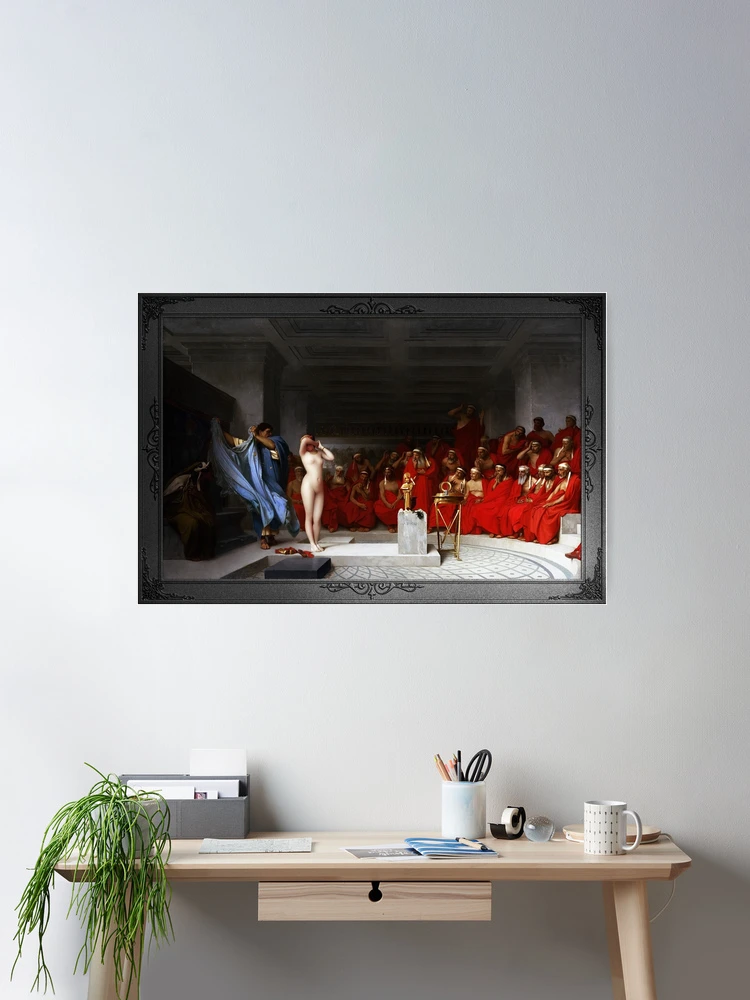
The composition is meticulously structured, guiding the viewer’s eye through the unfolding drama. The scene unfolds within a grand hall, likely representing the Areopagus, the ancient Athenian court known for its gravity and importance. Architectural elements dominate the background: tall columns with ornate capitals support a coffered ceiling, suggesting a space of considerable authority and permanence. Light streams in from an unseen source on the left, illuminating the central figures while casting long shadows that heighten the sense of drama. The hall is filled with seated men, all clad in similar crimson robes, forming a dense audience observing the proceedings. Their uniformity emphasizes their role as collective judges, representing Athenian society’s scrutiny.
Phryne: Центральная фигура
At the heart of the composition stands Phryne herself. She is depicted nude, her body rendered with anatomical precision and a classical idealization reminiscent of ancient Greek sculpture. Her pose is one of vulnerability and exposure; she appears to be in the process of disrobing, perhaps as part of an attempt at legal maneuvering or a demonstration of innocence. Her expression is difficult to definitively interpret – it could suggest defiance, resignation, or even a hint of melancholy. The artist avoids any overt display of emotion, instead opting for a subtle and restrained portrayal that allows viewers to project their own interpretations onto her character.
The Legal Processors & Supporting Characters
To Phryne’s left stands a man in Roman attire, likely an advocate or legal representative. He is actively engaged in the scene, holding back a drape of fabric as if revealing Phryne to the court. His posture suggests a degree of authority and control over the unfolding events. Further back, seated figures form the Areopagus itself. Their faces are largely obscured by shadow and their expressions are difficult to discern, contributing to an atmosphere of solemnity and impartiality. A small altar or pedestal stands in the foreground, upon which rests a bronze statue – possibly representing Athena, the goddess of wisdom and justice, subtly alluding to the divine sanction underpinning Athenian law.
Gérôme’s Technical Skill & Художественные влияния
Gérôme’s mastery of realism is evident throughout the painting. The textures of the fabrics, the smoothness of Phryne’s skin, and the cool marble of the architectural elements are rendered with remarkable fidelity. His use of chiaroscuro – the dramatic contrast between light and shadow – enhances the sense of depth and creates a theatrical atmosphere. The work reflects Gérôme’s deep interest in classical antiquity and his desire to recreate historical scenes with accuracy and authenticity. He was influenced by earlier masters such as Jacques-Louis David, but he developed his own distinctive style characterized by meticulous detail and a focus on narrative clarity. The painting’s composition also draws inspiration from theatrical staging, creating a sense of dramatic tension that engages the viewer directly.
Исторический контекст & Интерпретация
The story behind “Phryne Revealed Before the Areopagus” is rooted in ancient Greek history. Phryne was a renowned courtesan known for her beauty and wealth. She was accused of impiety and brought before the Areopagus. According to accounts, she offered a substantial bribe to the court officials, which was then used to fund the construction of a statue of Hermes at the Temple of Ares. The painting captures this moment of legal drama, focusing on the tension between Phryne’s vulnerability and the power of the Athenian court. While Gérôme’s work is based on historical accounts, it also transcends mere illustration; it explores themes of justice, societal judgment, and the complexities of human relationships within a specific cultural context.
Наследие & Значение
“Phryne Revealed Before the Areopagus” remains one of Jean-Léon Gérôme’s most celebrated works. It exemplifies his skill as a historical genre painter and his ability to create compelling narratives through meticulous detail and dramatic composition. The painting has been admired for its technical virtuosity, его воспоминания атмосфера, and its exploration of timeless themes related to law, мораль, and the human condition. It continues to be studied by art historians and appreciated by audiences for its enduring power and historical significance.
Декоративные акценты, использованные в этом изделии, доступны по адресу Тип наследия
Биография художника получена из Wikipedia.org
Жан-Леон Жером (11 Май 1824 - 10 Январь 1904) был французским художником и скульптором в стиле, ныне известном как академизм.. Его картины были настолько широко воспроизведены, что он был “возможно, самый известный в мире художник к 1880 году.”[1] В сферу его творчества входила историческая живопись., Греческая мифология, Ориентализм, портреты, и другие предметы, доведение академической живописной традиции до художественной кульминации. Он считается одним из самых важных художников этого академического периода..
В 1840 он уехал в Париж, где он учился у Поля Делароша, кого он сопровождал в Италию в 1843. Он посетил Флоренцию, Рим, Ватикан и Помпеи. По возвращении в Париж в 1844, как и многие ученики Делароша, он поступил в ателье Чарльза Глейра и проучился там недолгое время. Затем он учился в Школе изящных искусств.. В 1846 он пытался попасть на престижную премию Prix de Rome, но потерпел неудачу на заключительном этапе, потому что его рисунок был неадекватным.
Его картина "Петушиный бой" (1846) это академическое упражнение, изображающее обнаженного молодого человека и очень тонко драпированную молодую женщину с двумя боевыми членами., на фоне Неаполитанского залива. Он отправил эту картину в Парижский салон 1847, где он принес ему медаль третьей степени. Эта работа рассматривалась как воплощение нео-греческого движения, которое сформировалось из студии Глейра. (в том числе Анри-Пьер Пику и Жан-Луи Амон), и был защищен влиятельным французским критиком Теофилем Готье., обзор которого сделал Жерома известным и положил начало его карьере..
Жером отказался от своей мечты выиграть Римскую премию и воспользовался своим внезапным успехом.. Его картины Богородица, Младенец Иисус, Святой Иоанн и Анакреонт, Вакх и Эрос завоевали медаль второй степени на Парижском салоне в г. 1848. В 1849, он создал картины Микеланджело (также называется в его студии) и портрет дамы.
В 1851, он украсил вазу, позже предложенную императором Франции Наполеоном III принцу Альберту., теперь часть Королевской коллекции на улице Св.. Джеймсский дворец, Лондон. Он выставил греческий интерьер., Сувенир из Италии, Вакх и любовь, Пьяный в 1851; в Пестуме 1852; и идиллия в 1853
В 1852, Жером получил заказ нарисовать большую фреску с аллегорическим сюжетом по своему выбору.. Эпоха Августа, Рождение Христа, который сочетал бы рождение Христа с покоренными народами, воздавшими должное Августу, мог быть призван польстить Наполеону III, чье правительство заказало фреску и кто был идентифицирован как “новый август.
Значительный первоначальный взнос позволил Жерому путешествовать и исследовать, первый в 1853 в Константинополь, вместе с актером Эдмоном Готом, И в 1854 в Грецию и Турцию и на берега Дуная, где он присутствовал на концерте русских призывников, занимающихся музыкой под угрозой удара плетью.
В 1853, Жером переехал в Чайную коробку., группа студий на улице Нотр-Дам-де-Шам, Париж. Это станет местом встречи художников., писатели и актеры, где Жорж Санд развлекал композитора Гектора Берлиоза, Иоганнес Брамс и Джоакино Россини и романисты Теофиль Готье и Иван Тургенев.
В 1854, он выполнил еще одно важное поручение, украшение часовни св.. Иероним в церкви св.. Северин в Париже. Его последнее причастие св.. Иероним в этой часовне отражает влияние школы Энгра на его религиозные работы..
На Всемирную выставку 1855 он внес Пиффераро, Пасти, и Эпоха Августа, Рождение Христа, но наибольшее внимание привлекла скромная картина «Отдых в русском лагере»…
Phryne Revealed Before The Areopagus is a retouched digital art old masters reproduction of a public domain image.