

Phryne Revealed Before The Areopagus: A Study in Classical Drama
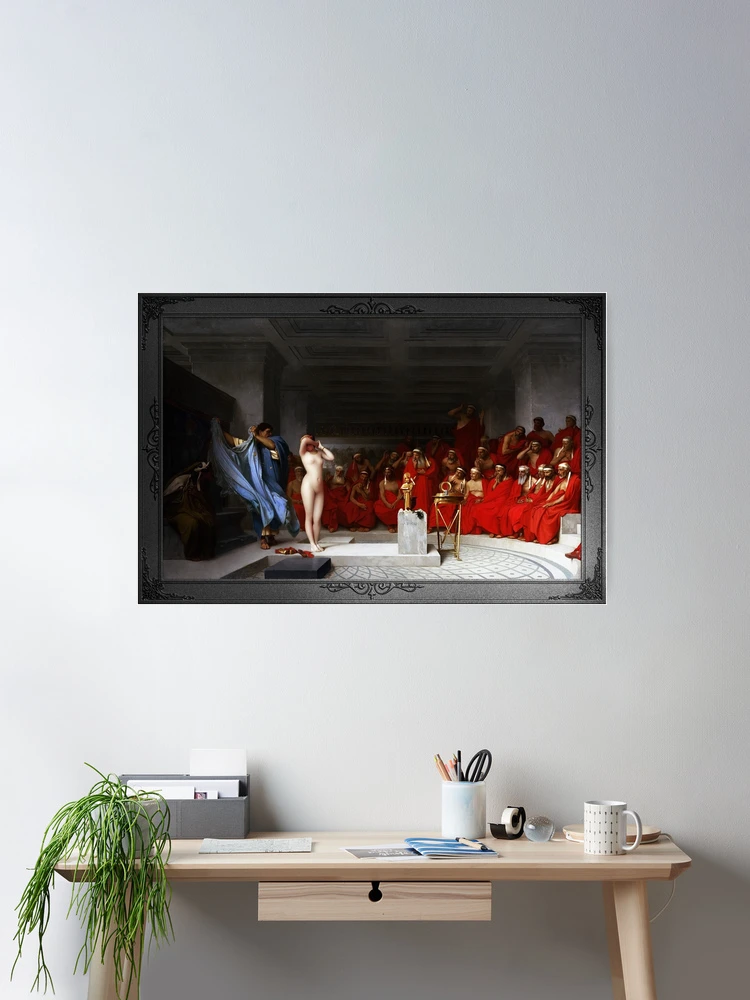
Jean-Léon Gérôme’s “Phryne Revealed Before the Areopagus,”Målad 1861, is a compelling work of historical genre painting that draws heavily from classical antiquity. It depicts a dramatic scene rooted in ancient Greek legal proceedings, specifically the trial of Phryne, a celebrated courtesan of Athens. Gérôme was renowned for his meticulous attention to detail and his ability to recreate historical settings with remarkable accuracy, and this piece exemplifies those qualities. The painting is not merely an illustration of a story; it’s a carefully constructed tableau designed to evoke a sense of tension, anticipation, and the weight of societal judgment.
Innehållsförteckning
Kompositionsstruktur & Miljö
The composition is meticulously structured, guiding the viewer’s eye through the unfolding drama. The scene unfolds within a grand hall, likely representing the Areopagus, the ancient Athenian court known for its gravity and importance. Architectural elements dominate the background: tall columns with ornate capitals support a coffered ceiling, suggesting a space of considerable authority and permanence. Light streams in from an unseen source on the left, illuminating the central figures while casting long shadows that heighten the sense of drama. The hall is filled with seated men, all clad in similar crimson robes, forming a dense audience observing the proceedings. Their uniformity emphasizes their role as collective judges, representing Athenian society’s scrutiny.
Phryne: Den centrala figuren
At the heart of the composition stands Phryne herself. She is depicted nude, her body rendered with anatomical precision and a classical idealization reminiscent of ancient Greek sculpture. Her pose is one of vulnerability and exposure; she appears to be in the process of disrobing, perhaps as part of an attempt at legal maneuvering or a demonstration of innocence. Her expression is difficult to definitively interpret – it could suggest defiance, resignation, or even a hint of melancholy. The artist avoids any overt display of emotion, instead opting for a subtle and restrained portrayal that allows viewers to project their own interpretations onto her character.
The Legal Processors & Supporting Characters
To Phryne’s left stands a man in Roman attire, likely an advocate or legal representative. He is actively engaged in the scene, holding back a drape of fabric as if revealing Phryne to the court. His posture suggests a degree of authority and control over the unfolding events. Längre bak, seated figures form the Areopagus itself. Their faces are largely obscured by shadow and their expressions are difficult to discern, contributing to an atmosphere of solemnity and impartiality. A small altar or pedestal stands in the foreground, upon which rests a bronze statue – possibly representing Athena, the goddess of wisdom and justice, subtly alluding to the divine sanction underpinning Athenian law.
Gérôme’s Technical Skill & Konstnärliga influenser
Gérôme’s mastery of realism is evident throughout the painting. The textures of the fabrics, the smoothness of Phryne’s skin, and the cool marble of the architectural elements are rendered with remarkable fidelity. His use of chiaroscuro – the dramatic contrast between light and shadow – enhances the sense of depth and creates a theatrical atmosphere. The work reflects Gérôme’s deep interest in classical antiquity and his desire to recreate historical scenes with accuracy and authenticity. He was influenced by earlier masters such as Jacques-Louis David, but he developed his own distinctive style characterized by meticulous detail and a focus on narrative clarity. The painting’s composition also draws inspiration from theatrical staging, creating a sense of dramatic tension that engages the viewer directly.
Historical Context & Tolkning
The story behind “Phryne Revealed Before the Areopagus” is rooted in ancient Greek history. Phryne was a renowned courtesan known for her beauty and wealth. She was accused of impiety and brought before the Areopagus. According to accounts, she offered a substantial bribe to the court officials, which was then used to fund the construction of a statue of Hermes at the Temple of Ares. The painting captures this moment of legal drama, focusing on the tension between Phryne’s vulnerability and the power of the Athenian court. While Gérôme’s work is based on historical accounts, it also transcends mere illustration; it explores themes of justice, societal judgment, and the complexities of human relationships within a specific cultural context.
Arv & Betydelse
“Phryne Revealed Before the Areopagus” remains one of Jean-Léon Gérôme’s most celebrated works. It exemplifies his skill as a historical genre painter and his ability to create compelling narratives through meticulous detail and dramatic composition. The painting has been admired for its technical virtuosity, its evocative atmosphere, and its exploration of timeless themes related to law, moral, and the human condition. It continues to be studied by art historians and appreciated by audiences for its enduring power and historical significance.
Dekorativa accenter som används i detta stycke finns tillgängliga på HeritageType
Artist Bio härledd från Wikipedia.org
Jean-Léon Gérôme (11 Maj 1824 - 10 Januari 1904) var en fransk målare och skulptör i stilen som nu kallas akademism. Hans målningar reproducerades så mycket att han var det “utan tvekan världens mest kända levande konstnär 1880.”[1] Utbudet av hans verk omfattade historisk målning, grekisk mytologi, Orientalism, porträtt, och andra ämnen, att föra den akademiska målartraditionen till ett konstnärligt klimax. Han anses vara en av de viktigaste målarna från denna akademiska period.
I 1840 han åkte till Paris, där han studerade under Paul Delaroche, som han följde med till Italien i 1843. Han besökte Florens, Rom, Vatikanen och Pompeji. Vid sin återkomst till Paris in 1844, som många studenter i Delaroche, han gick med i ateljén för Charles Gleyre och studerade där en kort tid. Han gick sedan på School of Fine Arts. I 1846 han försökte komma in i det prestigefyllda Prix de Rome, men misslyckades i slutskedet eftersom hans figurritning var otillräcklig.
Hans målning The Cock Fight (1846) är en akademisk övning som visar en naken ung man och en mycket tunt draperad ung kvinna med två kämpande kukar, med Neapelbukten i bakgrunden. Han skickade denna målning till Paris Salon of 1847, där det fick honom en tredje klassens medalj. Detta arbete sågs som en symbol för Neo-Grec-rörelsen som hade bildats ur Gleyres studio (inklusive Henri-Pierre Picou och Jean-Louis Hamon), och blev förkämpad av den inflytelserika franska kritikern Théophile Gautier, vars recension gjorde Gérôme känd och effektivt lanserade sin karriär.
Gérôme övergav sin dröm om att vinna Prix de Rome och utnyttjade sin plötsliga framgång. Hans målningar The Virgin, spädbarnet Jesus och Sankt Johannes och Anacreon, Bacchus och Eros tog en andra klassens medalj på Parissalongen i 1848. I 1849, han producerade målningarna Michelangelo (kallas också In his Studio) och Ett porträtt av en dam.
I 1851, han dekorerade en vas som senare erbjöds av kejsaren Napoleon III av Frankrike till prins Albert, nu en del av Royal Collection på St.. Jakobs palats, London. Han ställde ut grekisk inredning, Souvenir från Italien, Bacchus och kärlek, Berusad i 1851; Paestum in 1852; och en idyll i 1853
I 1852, Gérôme fick en uppgift att måla en stor väggmålning av ett allegoriskt ämne som han valde. Augustus ålder, Kristi födelse, som skulle kombinera Kristi födelse med erövrade nationer som hyllade Augustus, kan ha varit avsedd att smickra Napoleon III, vars regering beställde väggmålningen och som identifierades som en “nya Augustus.
En betydande handpenning gjorde att Gérôme kunde resa och forska, först in 1853 till Konstantinopel, tillsammans med skådespelaren Edmond Got, och i 1854 till Grekland och Turkiet och Donaus stränder, där han var närvarande vid en konsert med ryska värnpliktiga som gjorde musik under hot om en frans.
I 1853, Gérôme flyttade till Tea Box, en grupp studior i Rue Notre-Dame-des-Champs, Paris. Detta skulle bli en mötesplats för konstnärer, skribenter och skådespelare, där George Sand underhöll kompositörerna Hector Berlioz, Johannes Brahms och Gioachino Rossini och romanförfattarna Théophile Gautier och Ivan Turgenev.
I 1854, han avslutade ett annat viktigt uppdrag, dekorera kapellet St.. Jerome i kyrkan St.. Séverin i Paris. Hans sista kommunion av St.. Jerome i detta kapell återspeglar ingresskolans inflytande på hans religiösa verk.
Till den universella utställningen av 1855 bidrog han med Pifferaro, herde, och Augustus ålder, Kristi födelse, men det var den blygsamma målningen Rekreation i ett ryskt läger som fick mest uppmärksamhet ...
Phryne Revealed Before The Areopagus is a retouched digital art old masters reproduction of a public domain image.