

Pigmalione e Galatee c1819
“Pigmalione e Galatée,” a cruthaíodh i 1819 by the French neoclassical artist Anne-Louis Girodet de Roussy-Trioson (1767 – 1824), is a masterpiece that delves into the realms of classical mythology and Romanticism, blending emotion, áilleacht, and human aspiration. The painting depicts the myth of Pygmalion, a sculptor who falls in love with his own creation, Galatée, a statue of extraordinary beauty. Tríd an saothar ealaíne seo, Girodet captures not only the physical transformation of Galatée from stone to flesh but also the emotional and philosophical undercurrents of love, longing, and artistic creation.
An phéintéireacht, rendered in a meticulous and delicate style, is rooted deeply in the themes of idealized beauty and the divine power of love. Pygmalion, an t-ealaíontóir, léirithe i throes nóiméad tairisceana agus dian agus é ag amharc ar a chruthú, Galatée, a sheasann os a chomhair amhail is dá mba ag teacht ar an saol. An scéal rómánsúil seo, spreagtha ag Ovid's Meiteamorfóis, aistrithe go hálainn ina shiansach amhairc de dhath saibhir, uigeacht, agus léiriú mothúchánach.

Clár na nÁbhar
Stíl agus teicníc
Is cur chuige nuachlasaiceach é cur chuige Girodet maidir leis an bpéintéireacht seo, arb iad is sainairíonna iad rindreáil mhionsonraithe anatamaíochta daonna agus úsáid an tsolais chun atmaisféar ethereal a chruthú. Tá saineolas teicniúil an ealaíontóra ar fhíoracha a léiriú le cruinneas anatamaíoch le feiceáil i ndromchlaí míne agus snasta na gcorp., go háirithe i gcodarsnacht idir an íogair, craiceann pale Galatée agus toin níos dorcha an chúlra. A chur i bhfeidhm bog, cuireann solas glórach isteach ar an radharc le caighdeán beagnach osnádúrtha, ag cur béime ar an nóiméad claochlaithe.
Tá an comhdhéanamh cothrom agus comhchuí, agus aird chúramach á tabhairt ar shiméadracht agus ar chomhréir, tipiciúil den ealaín nuachlasaiceach. Tá aird Girodet ar éadaitheoireachta suntasach freisin, le róbaí dearga Pygmalion ag sileadh go géar i gcoinne na míne, craiceann beagnach tréshoilseach Galatée. Tá uigeachtaí na fabraice péinteáilte le scuabbheart mín a thugann le tuiscint a meáchan agus a ngluaiseacht, agus an geal, Tugann dathanna lonrúla beatha don láthair.
Is meascán de toin te agus fionnuar é an pailéad, ó dhearga lasracha na róbaí Pygmalion go bánta boga agus pastail chraiceann Galatée, a léiríonn an solas ar bhealach a thaispeánann íonacht agus diagacht araon. An figiúr de Pygmalion, cé go éadaí, tá dlúthchaidreamh aici le Galatée amhail is gurb é a cruthaitheoir agus a leannán é, an fad idir an naofa agus an marfach a dhúnadh.
Príomh-Ábhar agus Insint
Ag croílár na péintéireachta tá an t-idirghníomhú idir Pygmalion agus Galatée, áit a dtagann an scéal miotaseolaíoch chun cinn. Pygmalion, a léirítear mar fhear galánta maisithe i róbaí dearga, ar a ghlúine agus é ag baint le foirm na dealbha, líon a léiriú le hiontas agus cumha. Tugann a shúil dhian agus a lámh sínte le tuiscint go bhfuil meas agus nasc mothúchánach domhain aige leis an bhfigiúr atá os a chomhair. Is féidir leis an lucht féachana meáchan a chuid mothúchán a mhothú, ní hamháin go bhfuil meas ag an dealbhóir ar a chruthú ach go bhfuil sé i ngrá leis.
Seasann Galatée mar embodiment bheo na háilleachta, a corp bog agus ethereal, míne a craiceann i gcodarsnacht leis an solad, seasamh dealbhóireachta a choinníonn sí. A posture, lámh amháin ardaithe beagán ar a chíche, molann feasacht ar a foirm ach freisin leochaileacht. Cothaíonn sreabhántacht a géaga agus an dóigh a dtagann sí ar an saol as na clocha téamaí meiteamorfacha agus cumhacht an ghrá chun teorainneacha a shárú., fiú an teorainn idir ealaín agus an saol.
Idir eatarthu, figiúr cosúil le leanbh, b'fhéidir a ionadaíonn an Dia Gréagach Eros; mac Aphrodite nó spiorad an ghrá, chríochnaíonn an comhdhéanamh. Tá an figiúr seo neamhchiontach, láithreacht beagnach playful, reinforcing the theme of love’s power and influence. The child’s inclusion hints at the divine intervention that brought Galatée to life, as in the myth, it is Greek Goddess Aphrodite, the goddess of love, who answers Pygmalion’s prayers.
Réada, tír-raon, agus Ábhair
The setting of the artwork is a classical one, with elements that evoke a sense of grandeur and timelessness. Sa chúlra, a distant, classical architectural ruin looms, adding to the mythological setting while reinforcing the connection between human endeavor and the divine. This ruin, though not the primary focus, acts as a subtle reminder of the permanence of art and the transience of human life.
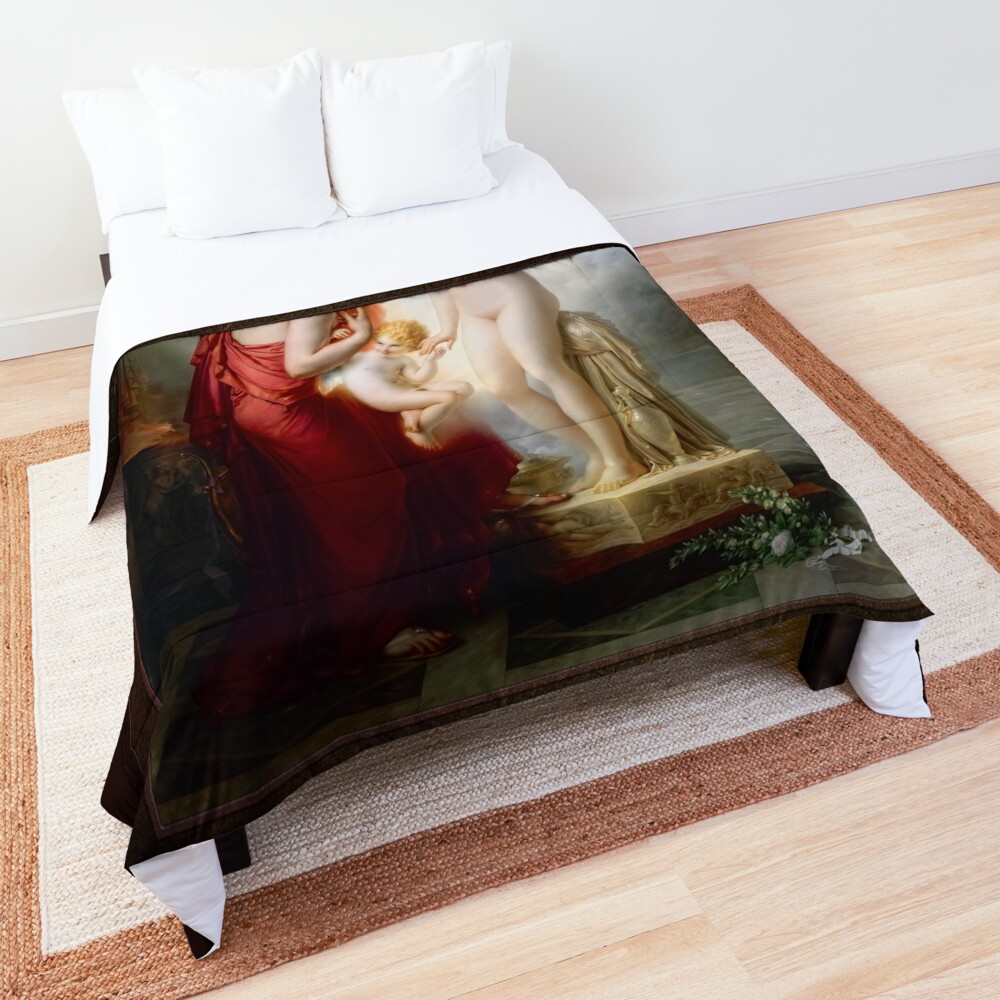
The objects in the scene, particularly the pedestal on which Galatée stands, are rendered with exquisite detail, further suggesting the high status of both Pygmalion as an artist and Galatée as his perfect creation. The pedestal serves as a transition point between the stone world of sculpture and the living realm of the human form. The delicate flowers at the bottom of the pedestal symbolize fertility and rebirth, enhancing the theme of life springing from art.
Girodet also includes lush details in the surrounding environment. An solas, almost misty quality of the background landscape imbues the scene with a sense of otherworldliness, as if this moment is happening in a place where reality and myth merge. The subtle atmospheric effects further emphasize the surreal quality of Galatée’s transformation.
Giúmar agus Tionchar Mothúchánach
An giúmar de Pygmalion agus Galatea is one of reverence, uafás, and sensual beauty. The viewer is invited to experience the intimate and transformative moment between the artist and his creation. The emotional intensity of the scene is heightened by the tender gesture of Pygmalion and the tranquil yet almost expectant expression on Galatée’s face. There is a sense of both wonder and longing, as Pygmalion reaches out to touch the form of his beloved, EDS, for a brief moment, seems to be awakening into life.
The juxtaposition of physical beauty and divine love serves as an emotional counterpoint, adding a layer of depth to the narrative. The soft light enveloping the figures creates a serene atmosphere that invites the viewer to consider the deeper themes of the painting — the relationship between love, creation, and the human desire to transcend the limitations of the physical world.
Conclúid
“Pygmalion agus Galatea” by Anne-Louis Girodet de Roussy-Trioson is a striking exploration of mythological themes through the lens of neoclassical art. The painter’s technical mastery is evident in his rendering of the human form, the emotional depth of the characters, and the serene atmosphere that surrounds the scene. The painting not only tells the story of Pygmalion’s love and artistic creation but also reflects the timeless nature of beauty and the transformative power of love.
Cúlscéal Saothar Ealaíne
Pigmalione e Galatee c1819 by French Painter Anne-Louis Girodet de Roussy-Trioson (1767 – 1824); who was a student of Jacques-Louis David and was part of the early Romantic Movement. Tá sé suntasach mar gheall ar a stíl shoiléir bheacht agus ar phictiúir an teaghlaigh Napoleon.
This is a beautiful Romantic Period piece of Greek Mythological Tale of Pygmalion et Galatee; Pygmalion is a Cypriot King and Sculptor who having given up on women because of the faults that were natural to them, focused his attention on sculpting.
Then upon creating an ivory statue of untold beauty and perfection, he falls in love with his creation and wishes for a bride that would be the living likeness of his beautiful statue after making offerings at the altar of the Greek Goddess Aphrodite.
Aphrodite grants him his wish and transforms his beautiful ivory statue into a beautiful living woman, whom he marries with the blessing of Aphrodite.
In this painting we see Pygmalion dressed in a red robe with gold accent borders and a floral arrange wrapped around his head and tied off with a white ribbon.
He is looking at Galatee or Galatea as she is also referred to as she is transforming from a statue of ivory into a living woman.
Between them is the Greek God Eros; son of Aphrodite, the Goddess of Love and Ares, the God of War, looking up at Pygmalion as he floats between them in invisible form.
Behind Pygmalion is golden lyre that is close to the altar of Aphrodite that has a statue of her wearing a golden crown and holding porcelain dove in her left hand with a gold ankle bracelet on her left leg and a sculpted robe around her waist; as incense burns just below her statue.
The ivory statue Galatee is situated on a dark maroon marble square base that has on top of it stone like headpiece with reliefs of a reclining nude woman on the front and putti on the side playing horns and riding dolphins.
On top of this base, beside the statue is a long sculpted vase complete with a cap on it, and behind that a sculpted robe on which the statue is partially resting; and farther back a large incense burner with billowing clouds of smoke coming from the openings in its covering.
In the distant wall as in the wall behind Pygmalion are sculpted reliefs; and in the far wall overlooking the ledge is a mountain terrain on the right, and a building with columns on the left.
Tying the piece together is a tiled pattern floor of diamond, square and rectangular shapes comprised of green, white and brown marble that covers the entire visible area.
Seo atáirgeadh seanmháistrí ealaíne digiteach athmháistrithe d’íomhá fearainn phoiblí atá ar fáil mar a cló chanbhás ar líne.