

Pigmalione e Galatee c1819
“Pigmalione e Galatée,” criado em 1819 by the French neoclassical artist Anne-Louis Girodet de Roussy-Trioson (1767 – 1824), is a masterpiece that delves into the realms of classical mythology and Romanticism, blending emotion, beleza, and human aspiration. The painting depicts the myth of Pigmalião, a sculptor who falls in love with his own creation, Galatéia, a statue of extraordinary beauty. Através desta obra de arte, Girodet captures not only the physical transformation of Galatée from stone to flesh but also the emotional and philosophical undercurrents of love, saudade, and artistic creation.
A pintura, rendered in a meticulous and delicate style, is rooted deeply in the themes of idealized beauty and the divine power of love. Pigmalião, o artista, is shown in the throes of a tender and intense moment as he gazes at his creation, Galatéia, who stands before him as if coming to life. This romantic narrative, inspired by Ovid’s Metamorphoses, is beautifully translated into a visual symphony of rich color, textura, e expressão emocional.

Índice
Estilo e técnica
Girodet’s approach to this painting is quintessentially neoclassical, characterized by the detailed rendering of human anatomy and the use of light to create an ethereal atmosphere. The artist’s technical expertise in portraying figures with anatomical precision is evident in the smooth and polished surfaces of the bodies, particularly in the contrast between the delicate, pale skin of Galatée and the darker tones of the background. His application of soft, glowing light imbues the scene with an almost supernatural quality, emphasizing the moment of transformation.
The composition is balanced and harmonious, with careful attention to symmetry and proportion, typical of neoclassical art. Girodet’s attention to drapery is also notable, with the flowing red robes of Pygmalion contrasting sharply against the smooth, almost translucent skin of Galatée. The textures of the fabric are painted with fine brushstrokes that suggest their weight and movement, and the bright, luminous hues bring life to the scene.
The palette is a mix of warm and cool tones, from the fiery reds of Pygmalion’s robes to the soft whites and pastels of Galatée’s skin, which reflects the light in a way that evokes both purity and divinity. The figure of Pygmalion, though clothed, has a sense of intimacy with Galatée as if he is both her creator and her lover, bridging the distance between the sacred and the mortal.
Main Subject and Narrative
At the heart of the painting is the interaction between Pygmalion and Galatée, where the mythological narrative unfolds. Pigmalião, depicted as an elegant man adorned in red robes, is kneeling as he touches the statue’s form, his expression filled with awe and longing. His intense gaze and outstretched hand suggest both admiration and a profound emotional connection with the figure before him. The viewer can feel the weight of his emotions, the sculptor is not merely admiring his creation but is deeply in love with it.
Galatée stands as the living embodiment of beauty, her body soft and ethereal, the smoothness of her skin contrasting with the solid, sculptural stance she retains. Sua postura, one hand raised slightly to her breast, suggests an awareness of her form but also a vulnerability. The fluidity of her limbs and the way she seems to come to life out of the stone evoke themes of metamorphosis and the power of love to transcend boundaries, even the boundary between art and life.
Between them, a childlike figure, possibly representing the Greek God Eros; son of Aphrodite or a spirit of love, completes the composition. This figure holds an innocent, almost playful presence, reinforcing the theme of love’s power and influence. The child’s inclusion hints at the divine intervention that brought Galatée to life, as in the myth, it is Greek Goddess Aphrodite, the goddess of love, who answers Pygmalion’s prayers.
Objetos, Terreno, and Materials
The setting of the artwork is a classical one, with elements that evoke a sense of grandeur and timelessness. Em segundo plano, a distant, classical architectural ruin looms, adding to the mythological setting while reinforcing the connection between human endeavor and the divine. This ruin, though not the primary focus, acts as a subtle reminder of the permanence of art and the transience of human life.
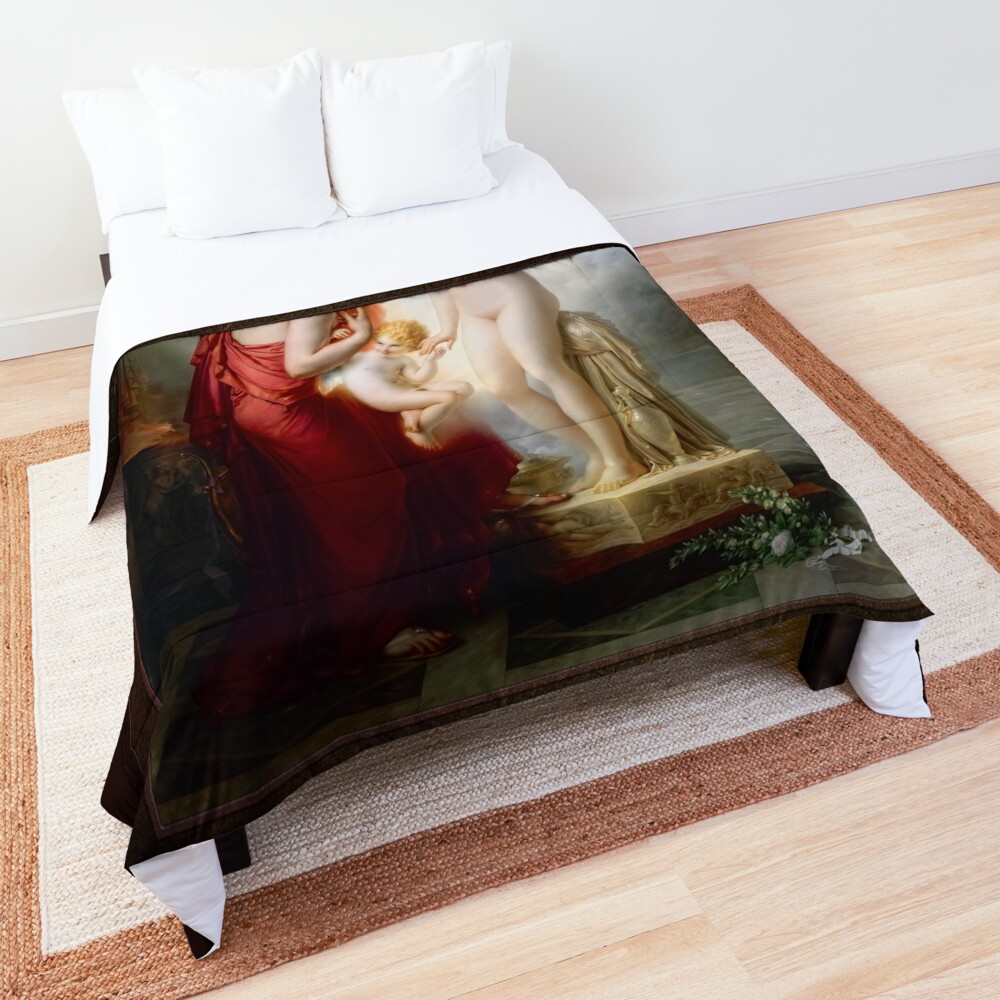
The objects in the scene, particularly the pedestal on which Galatée stands, are rendered with exquisite detail, further suggesting the high status of both Pygmalion as an artist and Galatée as his perfect creation. The pedestal serves as a transition point between the stone world of sculpture and the living realm of the human form. The delicate flowers at the bottom of the pedestal symbolize fertility and rebirth, enhancing the theme of life springing from art.
Girodet also includes lush details in the surrounding environment. A luz, almost misty quality of the background landscape imbues the scene with a sense of otherworldliness, as if this moment is happening in a place where reality and myth merge. The subtle atmospheric effects further emphasize the surreal quality of Galatée’s transformation.
Humor e impacto emocional
O humor de Pigmalião e Galatéia is one of reverence, awe, and sensual beauty. The viewer is invited to experience the intimate and transformative moment between the artist and his creation. The emotional intensity of the scene is heightened by the tender gesture of Pygmalion and the tranquil yet almost expectant expression on Galatée’s face. There is a sense of both wonder and longing, as Pygmalion reaches out to touch the form of his beloved, Quem, for a brief moment, seems to be awakening into life.
The juxtaposition of physical beauty and divine love serves as an emotional counterpoint, adding a layer of depth to the narrative. The soft light enveloping the figures creates a serene atmosphere that invites the viewer to consider the deeper themes of the painting — the relationship between love, creation, and the human desire to transcend the limitations of the physical world.
Conclusão
“Pigmalião e Galatéia” by Anne-Louis Girodet de Roussy-Trioson is a striking exploration of mythological themes through the lens of neoclassical art. The painter’s technical mastery is evident in his rendering of the human form, the emotional depth of the characters, and the serene atmosphere that surrounds the scene. The painting not only tells the story of Pygmalion’s love and artistic creation but also reflects the timeless nature of beauty and the transformative power of love.
História de arte
Pigmalião e Galatéia c1819 pela pintora francesa Anne-Louis Girodet de Roussy-Trioson (1767 – 1824); que foi aluno de Jacques-Louis David e fez parte do início do Movimento Romântico. Ele é conhecido por seu estilo claro e preciso e pelas pinturas da família napoleônica.
Esta é uma bela peça do período romântico do conto mitológico grego de Pigmalião et obrigado; Pigmalião é um rei e escultor cipriota que desistiu das mulheres por causa dos defeitos que lhes eram naturais, concentrou sua atenção em esculpir.
Então, ao criar uma estátua de marfim de beleza e perfeição incalculáveis, ele se apaixona por sua criação e deseja uma noiva que seja a semelhança viva de sua bela estátua após fazer oferendas no altar da deusa grega Afrodite.
Afrodite concede-lhe o seu desejo e transforma a sua bela estátua de marfim numa bela mulher viva., com quem ele se casa com a bênção de Afrodite.
Nesta pintura vemos Pigmalião vestido com um manto vermelho com bordas douradas e um arranjo floral enrolado na cabeça e amarrado com uma fita branca..
Ele está olhando para Galatee ou Galatea, como ela também é chamada, pois está se transformando de uma estátua de marfim em uma mulher viva.
Entre eles está o deus grego Eros; filho de Afrodite, a Deusa do Amor e Ares, o Deus da Guerra, olhando para Pigmalião enquanto ele flutua entre eles em uma forma invisível.
Atrás de Pigmalião está uma lira dourada que fica perto do altar de Afrodite que tem uma estátua dela usando uma coroa de ouro e segurando uma pomba de porcelana na mão esquerda com uma tornozeleira de ouro na perna esquerda e um manto esculpido na cintura; enquanto o incenso queima logo abaixo de sua estátua.
A estátua de marfim Galatee está situada sobre uma base quadrada de mármore marrom escuro que tem no topo um capacete semelhante a uma pedra com relevos de uma mulher nua reclinada na frente e putti ao lado tocando trompas e montando golfinhos.
Em cima desta base, ao lado da estátua há um longo vaso esculpido completo com uma tampa, e atrás dele um manto esculpido sobre o qual a estátua repousa parcialmente; e mais atrás, um grande queimador de incenso com nuvens ondulantes de fumaça saindo das aberturas em sua cobertura.
Na parede distante, como na parede atrás de Pigmalião, há relevos esculpidos; e na parede oposta com vista para a saliência há um terreno montanhoso à direita, e um prédio com colunas à esquerda.
Amarrando a peça está um piso de diamante com padrão de azulejos, formas quadradas e retangulares compostas por verde, mármore branco e marrom que cobre toda a área visível.
Esta é uma reprodução remasterizada dos antigos mestres de arte digital de uma imagem de domínio público que está disponível como um impressão em tela on-line.