

Portrait d'une jeune fille
Le “Portrait d'une jeune fille” par un peintre français Etienne Adolphe Piot (1825 – 1910) est une œuvre d'art captivante, caractéristique du portrait élégant et romantique du XIXe siècle. Ce tableau démontre la maîtrise exceptionnelle de la lumière de Piot, texture, et la représentation délicate de l'émotion humaine, ce qui en fait un témoignage de son talent en tant que l'un des portraitistes les plus éminents de son temps.
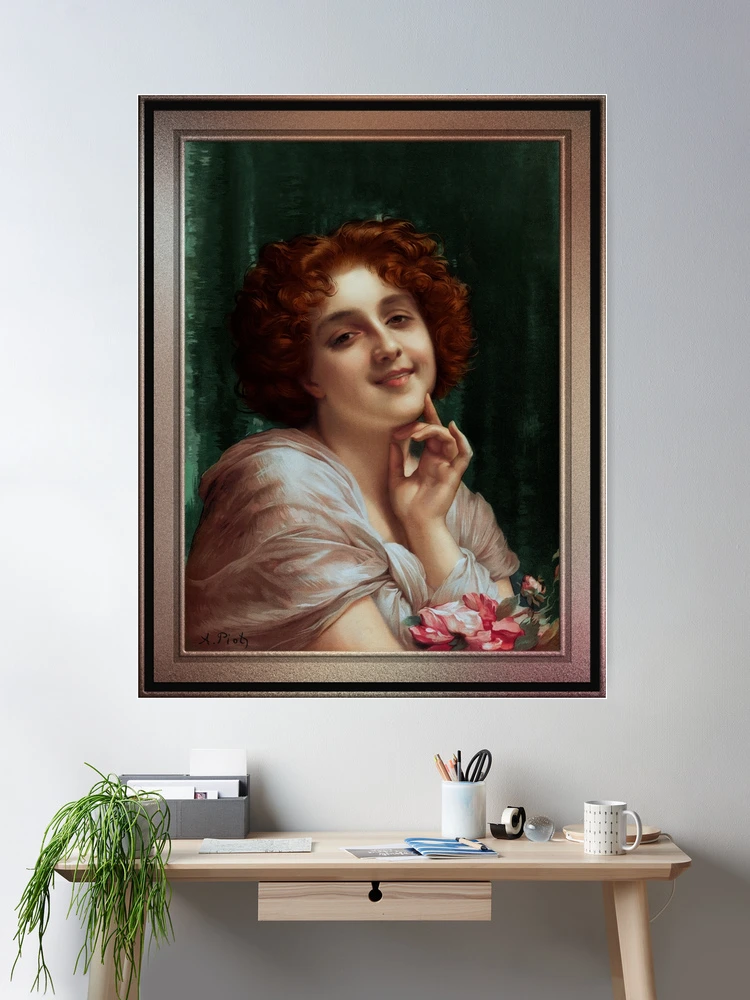
Table des matières
Le sujet: Un aperçu de l'innocence et de la beauté
La figure centrale de cette œuvre d'art est une jeune femme aux cheveux auburn radieux coiffés de cheveux doux., des boucles naturelles qui encadrent son visage délicat. Son expression dégage une combinaison enchanteresse de chaleur et de confiance., entraînant le spectateur dans son monde. Son léger sourire et son regard direct suggèrent une attitude sereine mais enjouée., une caractéristique de la capacité de Piot à imprégner ses sujets d’une aura réaliste et accessible. La pose, sa main touchant légèrement son menton, est détendu et introspectif, renforçant encore le sentiment d'intimité entre le sujet et le spectateur.
Contexte et composition: Un cadre harmonieux
L'arrière-plan du tableau est riche, rideau vert foncé, rendu avec des traits texturés pour apporter de la profondeur et du contraste au sujet. Le choix du vert complète non seulement les cheveux auburn du sujet, mais évoque également un sentiment d'élégance naturelle., ancrer la composition dans la simplicité sans détourner l'attention du personnage central. La toile de fond discrète permet aux tons chauds de sa peau et aux teintes douces de sa tenue vestimentaire de dominer le récit visuel..
Tenues et accessoires: Une étude en douceur
The girl is draped in a gossamer-like fabric, likely a fine, sheer shawl or wrap, that flows gracefully around her shoulders. The translucent quality of the fabric is depicted with remarkable detail, as Piot captures the way it gently clings to her form while reflecting subtle light. This mastery of texture underscores the painter’s ability to convey the ethereal and delicate qualities of fabric, adding to the overall impression of refinement.
In the lower portion of the painting, partially visible, are red and pink flowers. These blooms, placed subtly yet purposefully, enhance the romantic theme of the work. Their inclusion not only adds a splash of vibrant color but also symbolizes youth, beauté, and fleeting moments of life—concepts frequently explored in 19th-century portraiture.
Style et technique: Un réalisme romantique
Etienne Adolphe Piot is renowned for his Romantic Realism, a style that combines the emotive qualities of Romanticism with the precision and accuracy of Realism. Dans ce portrait, he employs a soft, almost luminous palette that enhances the gentle features of the subject. The brushstrokes are smooth and meticulous, particularly in the rendering of the girl’s skin and hair, showcasing Piot’s dedication to detail and his ability to capture the subtleties of human anatomy.
The interplay of light and shadow is another striking feature of this painting. The subject’s face is bathed in soft, diffused light that highlights her cheeks and brow, Créer un sentiment de trois dimensions. This use of lighting not only draws attention to her features but also imparts a glowing, almost otherworldly quality to her visage.
Humeur et atmosphère: Une célébration de la grâce féminine
L'humeur globale de “Portrait d'une jeune fille” est celui de la tendresse et de l'admiration pour la grâce et la beauté féminines. L'expression tranquille du sujet, couplé aux couleurs douces et à la composition élégante, crée une atmosphère de calme et d'introspection. La peinture dégage un sentiment d'intemporalité, capturer un moment éphémère de jeunesse et d'innocence qui transcende les contraintes du temps et de l'espace.
Contexte artistique: L'héritage de Piot
Etienne Adolphe Piot était célèbre pour sa capacité à transmettre le monde intérieur de ses sujets à travers leurs expressions extérieures.. Ce portrait, comme une grande partie de son travail, se concentre sur la beauté et l'individualité du gardien, éviter le symbolisme manifeste ou la narration élaborée. Au lieu, il met l'accent sur la valeur intrinsèque de la forme humaine et la résonance émotionnelle d'un instant unique capturé sur toile.
Le mélange habile de Piot entre les idéaux romantiques et les techniques réalistes le place parmi les artistes notables de son époque., et “Portrait d'une jeune fille” est un exemple typique de son œuvre. La peinture reflète non seulement sa maîtrise technique mais aussi sa profonde appréciation pour l'esprit humain., ce qui en fait une œuvre d'un attrait durable.
Conclusion
“Portrait d'une jeune fille” d'Etienne Adolphe Piot est un exemple magistral du portrait du XIXe siècle, mettant en valeur la remarquable capacité de l’artiste à mélanger réalisme et romantisme. Grâce à son rendu détaillé, composition harmonieuse, et ambiance évocatrice, la peinture capture l'essence de la beauté juvénile et de l'élégance intemporelle. L’œuvre témoigne du savoir-faire et de la vision artistique de Piot., assurant sa place parmi les chefs-d'œuvre précieux de son époque.
Portrait Of A Girl est une reproduction de maîtres anciens d'art numérique retouchée d'une image du domaine public.
Biographie de l'artiste dérivée de Wikipedia.org
Étienne-Adolphe Piot est né à Digoin, Saône-et-Loire, La France. Il s'installe à Paris et étudie auprès de Léon Cogniet, et exposé pour la première fois au Salon de Paris en 1850, on suppose donc qu'il est probablement né au milieu des années 1820.
Dans 1860 il était parmi les peintres dont le travail a été montré à l'Exposition de Bourdeaux, et en 1864 quand il vivait à New York, il expose un portrait à la National Academy of Design.
Jusqu'à 1876 Piot expose ses œuvres sous le nom d'Adolphe Piot, après cela, il a également commencé à utiliser les noms Adolphe-Étienne Piot et Étienne-Adolphe Piot sur ses œuvres d'art.
Piot a connu un grand succès commercial, profiter de la demande croissante de portraits de Parisiens fortunés. A la Belle Époque, chaque débutante devait faire peindre son portrait, et Piot était habile à créer les portraits captivants que les jeunes femmes cherchaient.
Piot became a member of the Société des Artistes Français in 1883, et en 1890 a reçu une mention honorable pour le travail qu'il a exposé au 1889 Exposition Universelle. Sa dernière entrée au Salon semble avoir été soumise en 1909, un an avant sa mort.