

Portrait of a Lady
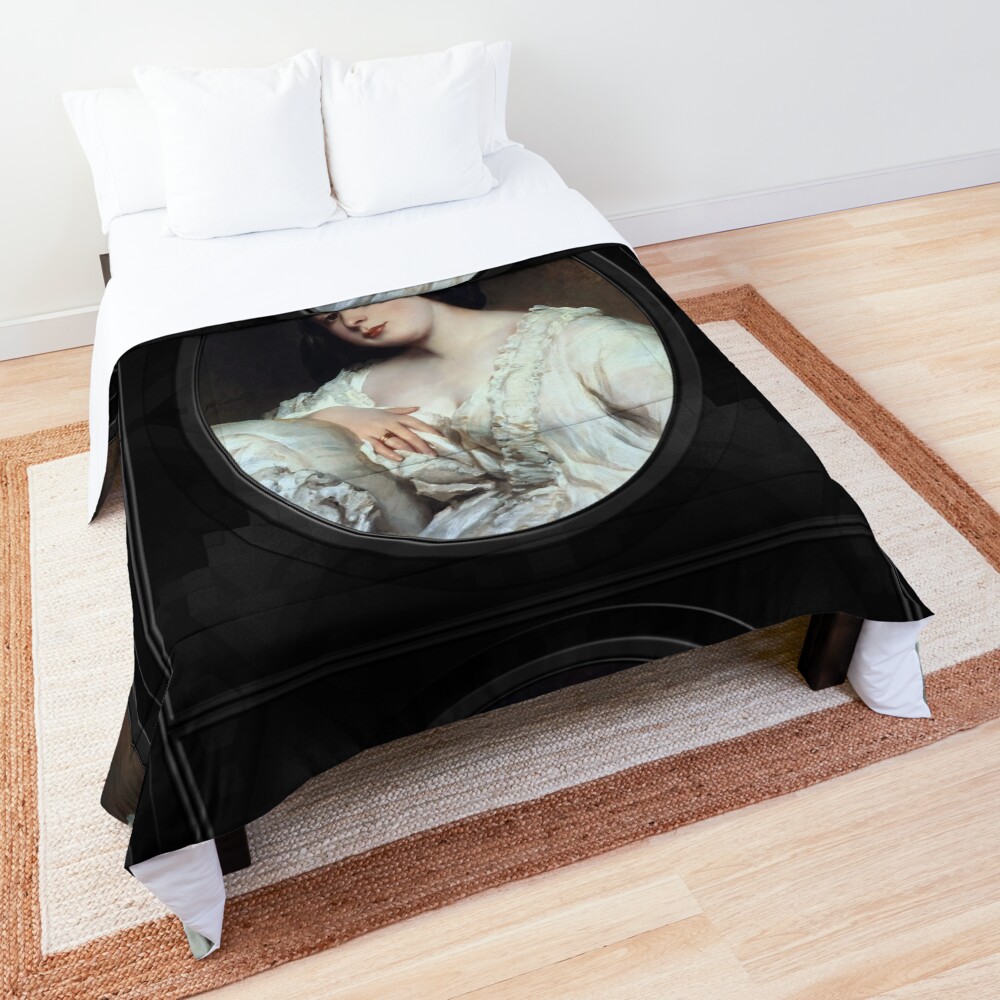
Franz Xaver Winterhalter’s Portrait of a Lady (C. 1850s) stands as a quintessential representation of mid-19th-century European portraiture. Winterhalter (1805 – 1873), a German artist renowned for his highly polished, elegant works; and older brother of German painter Hermann Fidel Winterhalter (1808 – 1891), often painted the aristocracy and elite of Europe, capturing them in ways that highlighted both their opulence and refinement.
This portrait, an example of his mastery, features a lady in a delicate pose, her somber yet poised expression framed by the soft, almost ethereal quality of her attire and the setting. Umělcova pečlivá pozornost k detailu, and his ability to create lifelike textures and warm tones, bring the subject to life with remarkable realism and grace.
Obsah
The Subject and Composition
The portrait is a close-up of a young lady, likely from the European upper classes, given the sophistication and quality of her attire. Her white gown, characterized by soft ruffles and intricate folds, drapes gently across her shoulders and chest, vytváří pocit pohybu a milosti.
Her calm yet enigmatic expression is the focal point of the piece, drawing the viewer’s attention to her delicate features. The lady’s dark hair, parted in the center and styled in a smooth, controlled manner, contrasts beautifully with the light fabric of her dress, enhancing the overall balance of light and dark within the composition.
Her hand rests lightly on her lap, fingers elegantly spread, with a ring visible on her left hand, signifying her status and perhaps an important relationship or heritage. The subtle gesture adds an air of refinement and nobility to the scene, encapsulating the dignity of the subject. Winterhalter captures the soft textures of her skin and the luminosity of her skin tone with the same reverence that he bestows upon the fabric of her gown. This is a hallmark of his style, an obsession with texture that enhances the lifelike quality of the subjects he painted.
Materiály a technika
Winterhalter worked with oils, employing a layered technique that allowed him to achieve remarkable depth and nuance in his colors. Měkký, almost translucent nature of the lady’s white dress suggests Winterhalter’s ability to master the subtleties of fabric, creating lifelike textures that capture the way light interacts with different materials. The texture of her skin, delicate and luminous, is painted with equal precision, as is the smoothness of her black hair, which appears to shimmer under the light.
The use of shadows in the portrait is also striking. Winterhalter’s mastery of chiaroscuro, where light and dark are carefully balanced, gives the painting a sense of three-dimensionality, making the subject appear as though she could step off the canvas. The background is softly blurred, s temnou, muted tones that help the figure stand out sharply. This technique, which blurs the boundary between figure and ground, is characteristic of the artist’s work and helps the viewer focus entirely on the subject, free from distraction.
Téma a nálada
The overall theme of this portrait can be understood as one of quiet elegance, where beauty, šlechta, and refinement are represented not through grand gestures but through subtlety and restraint. The lady in the portrait, while dressed in a lavish gown, does not express exuberance or overt joy. Místo toho, there is an air of quiet contemplation or perhaps melancholy. Her serious expression suggests introspection, possibly hinting at the societal pressures or expectations placed upon women of her class during the time.
The mood of the painting is serene and dignified. The muted color palette, with its emphasis on soft whites, černoši, and warm browns, evokes a sense of tranquility, while the lady’s composed demeanor adds a layer of solemnity. Její pohled, directed slightly to the left, seems contemplative, as though she is lost in thought, or perhaps pondering something beyond the viewer’s reach. This gives the portrait an almost timeless quality, as though it captures a fleeting moment in the life of the subject, one that is both personal and universally relatable.
The Style of Winterhalter
Franz Xaver Winterhalter was known for his refined, flattering portraits of aristocrats and royalty. His style blends elements of both academic realism and romanticism, capturing the likeness of the subject with precision while also idealizing their form.
Měkký, smooth lines, glowing flesh tones, and harmonious composition suggest an aesthetic ideal that was highly popular during the mid-19th century, especially in the courtly circles Winterhalter often painted for. While his subjects are rendered realistically, there is an element of stylization in the way he emphasizes elegance and poise, presenting his sitters as paragons of beauty and grace.
The soft focus of the background, with minimal detail, allows the subject to be the central focus of the composition. This technique, paired with Winterhalter’s skill in capturing human emotion and character, made his portraits highly sought after by royal families and aristocrats.
The portrait’s atmosphere, combined with the artist’s characteristic style, speaks to the social and cultural values of the time: the ideal of refined beauty, the status of the subject, and the artist’s desire to create a lasting, timeless image of aristocratic life.
Závěr
Portrait of a Lady by Franz Xaver Winterhalter remains an exemplary piece of 19th-century portraiture. With its exquisite detailing, careful attention to the subject’s demeanor, and the subtle interplay of light and shadow, the work embodies the grace and sophistication that Winterhalter was known for.
The painting captures not only the physical likeness of the subject but also evokes the mood and atmosphere of the time, one of poised elegance and quiet introspection. Winterhalter’s ability to depict the subject’s character, through both the delicate textures of her attire and the nuanced expression on her face, makes this painting a lasting testament to the high art of portraiture during the Victorian era.
Portrait of a Lady is a retouched digital art old masters reproduction of a public domain image.
Umělec bio z Wikipedia.org
Franz Xaver Winterhalter se narodil v malé vesnici Menzenschwand, (nyní součástí Sankt Blasien), v německém Černém lese[1] v Bádenském kurfiřtství, na 20 duben 1805.[2] Byl šestým dítětem Fidela Winterhaltera (1773–1863), farmář a výrobce pryskyřice v obci, a jeho manželky Evy Meyerové (1765–1838), člen dlouho zavedené rodiny Menzenschwand.
Jeho otec byl rolníka a měl na jeho život velký vliv. Z osmi bratrů a sester, pouze čtyři přežili dětství. Franz Xaver byl po celý svůj život velmi blízko své rodině, zejména svému bratru Hermannovi (1808–1891), který byl také malířem.
Po návštěvě školy v benediktinském klášteře v St.. Blasien, Winterhalter nechal Menzenschwand 1818 ve věku 13 studovat kresbu a rytinu. Vyučil se kreslířem a litografem v dílně Karla Ludwiga Schülera (1785–1852) ve Freiburgu im Breisgau. v 1823, ve věku 18, odjel do Mnichova, sponzorovaný průmyslníkem baronem von Eichtal (1775–1850).
v 1825, od Ludwiga I. mu bylo uděleno stipendium, Velkovévoda badenský (1763–1830) a zahájil studium na Akademii umění v Mnichově u Petera von Cornelius (1783–1867), jehož akademické metody mu byly nepříjemné. Winterhalter našel příjemnějšího mentora v módním portrétistovi Josephu Karlovi Stielerovi (1781–1858). Během této doby, živil se jako litograf.
Winterhalter vstoupil do soudních kruhů, když byl dovnitř 1828 stal se kreslířským mistrem Sophie Margravine z Badenu, v Karlsruhe.[6] Jeho příležitost prosadit se mimo jižní Německo přišla 1832 když mohl cestovat do Itálie, 1833–1834, za podpory velkovévody Leopolda z Badenu. V Římě skládal romantické žánrové scény na způsob Louise Léopolda Roberta a připojil se ke kruhu ředitele Francouzské akademie, Horace Vernet. Po návratu do Karlsruhe namaloval portréty velkovévody Leopolda z Badenu a jeho manželky, a byl jmenován malířem velkovévodského dvora.
Nicméně, opustil Baden, aby se přestěhoval do Francie, kde jeho italská žánrová scéna Il dolce Farniente upoutala pozornost v Salonu 1836. Il Decameron o rok později byl také chválen; oba obrazy jsou akademické kompozice ve stylu Raphaela. V salonu 1838 vystavil portrét prince z Wagramu se svou malou dcerou. Jeho kariéra portrétisty byla brzy zajištěna, když v témže roce namaloval Louise Marie Orleánskou, Královna Belgičanů, a jejího syna. Pravděpodobně díky tomuto obrazu se Winterhalter dostal k Marii Amalii z Obojí Sicílie, Francouzská královna, matka belgické královny.