

Naisen muotokuva
Franz Xaver Winterhalter’s Naisen muotokuva (c. 1850s) stands as a quintessential representation of mid-19th-century European portraiture. Winterhalter (1805 – 1873), a German artist renowned for his highly polished, elegant works; and older brother of German painter Hermann Fidel Winterhalter (1808 – 1891), often painted the aristocracy and elite of Europe, capturing them in ways that highlighted both their opulence and refinement.
Tämä muotokuva, an example of his mastery, features a lady in a delicate pose, her somber yet poised expression framed by the soft, almost ethereal quality of her attire and the setting. Taiteilijan huolellinen huomio yksityiskohtiin, and his ability to create lifelike textures and warm tones, bring the subject to life with remarkable realism and grace.
Sisällysluettelo
Aihe ja koostumus
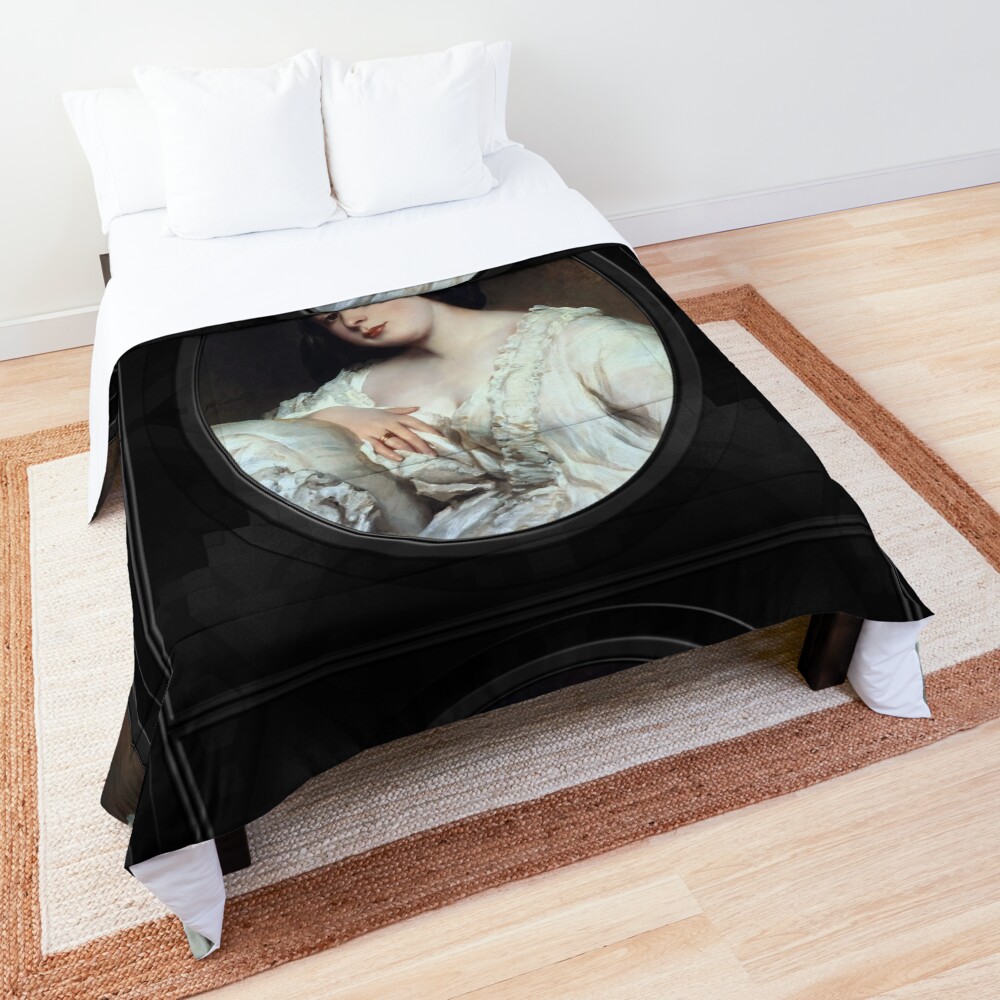
The portrait is a close-up of a young lady, likely from the European upper classes, given the sophistication and quality of her attire. Her white gown, characterized by soft ruffles and intricate folds, drapes gently across her shoulders and chest, creating a sense of movement and grace.
Her calm yet enigmatic expression is the focal point of the piece, drawing the viewer’s attention to her delicate features. The lady’s dark hair, parted in the center and styled in a smooth, controlled manner, contrasts beautifully with the light fabric of her dress, enhancing the overall balance of light and dark within the composition.
Her hand rests lightly on her lap, fingers elegantly spread, with a ring visible on her left hand, signifying her status and perhaps an important relationship or heritage. The subtle gesture adds an air of refinement and nobility to the scene, encapsulating the dignity of the subject. Winterhalter captures the soft textures of her skin and the luminosity of her skin tone with the same reverence that he bestows upon the fabric of her gown. This is a hallmark of his style, an obsession with texture that enhances the lifelike quality of the subjects he painted.
Materiaalit ja tekniikka
Winterhalter worked with oils, employing a layered technique that allowed him to achieve remarkable depth and nuance in his colors. Pehmeä, almost translucent nature of the lady’s white dress suggests Winterhalter’s ability to master the subtleties of fabric, creating lifelike textures that capture the way light interacts with different materials. The texture of her skin, delicate and luminous, is painted with equal precision, as is the smoothness of her black hair, which appears to shimmer under the light.
The use of shadows in the portrait is also striking. Winterhalter’s mastery of chiaroscuro, where light and dark are carefully balanced, gives the painting a sense of three-dimensionality, making the subject appear as though she could step off the canvas. The background is softly blurred, pimeällä, muted tones that help the figure stand out sharply. This technique, which blurs the boundary between figure and ground, is characteristic of the artist’s work and helps the viewer focus entirely on the subject, free from distraction.
Teema ja mieliala
The overall theme of this portrait can be understood as one of quiet elegance, Missä kauneus, aatelisto, and refinement are represented not through grand gestures but through subtlety and restraint. The lady in the portrait, while dressed in a lavish gown, does not express exuberance or overt joy. Sen sijaan, there is an air of quiet contemplation or perhaps melancholy. Her serious expression suggests introspection, possibly hinting at the societal pressures or expectations placed upon women of her class during the time.
The mood of the painting is serene and dignified. Mykistetty värivalikoima, with its emphasis on soft whites, mustat, and warm browns, evokes a sense of tranquility, while the lady’s composed demeanor adds a layer of solemnity. Hänen katseensa, directed slightly to the left, seems contemplative, ikään kuin hän olisi kadonnut ajatukseen, or perhaps pondering something beyond the viewer’s reach. This gives the portrait an almost timeless quality, as though it captures a fleeting moment in the life of the subject, one that is both personal and universally relatable.
The Style of Winterhalter
Franz Xaver Winterhalter was known for his refined, flattering portraits of aristocrats and royalty. His style blends elements of both academic realism and romanticism, capturing the likeness of the subject with precision while also idealizing their form.
Pehmeä, smooth lines, glowing flesh tones, and harmonious composition suggest an aesthetic ideal that was highly popular during the mid-19th century, especially in the courtly circles Winterhalter often painted for. While his subjects are rendered realistically, there is an element of stylization in the way he emphasizes elegance and poise, presenting his sitters as paragons of beauty and grace.
The soft focus of the background, with minimal detail, allows the subject to be the central focus of the composition. This technique, paired with Winterhalter’s skill in capturing human emotion and character, made his portraits highly sought after by royal families and aristocrats.
The portrait’s atmosphere, combined with the artist’s characteristic style, speaks to the social and cultural values of the time: the ideal of refined beauty, the status of the subject, and the artist’s desire to create a lasting, timeless image of aristocratic life.
Johtopäätös
Naisen muotokuva by Franz Xaver Winterhalter remains an exemplary piece of 19th-century portraiture. With its exquisite detailing, careful attention to the subject’s demeanor, and the subtle interplay of light and shadow, the work embodies the grace and sophistication that Winterhalter was known for.
The painting captures not only the physical likeness of the subject but also evokes the mood and atmosphere of the time, one of poised elegance and quiet introspection. Winterhalter’s ability to depict the subject’s character, through both the delicate textures of her attire and the nuanced expression on her face, makes this painting a lasting testament to the high art of portraiture during the Victorian era.
Naisen muotokuva on retusoitu digitaalisen taiteen vanhojen mestarien kopio julkisesta kuvasta.
Taiteilija bio Wikipedia.org
Franz Xaver Winterhalter syntyi pienessä Menzenschwandin kylässä, (nyt osa Sankt Blasienia), Saksan Schwarzwaldissa[1] Badenin vaalilautakunnassa, päällä 20 huhtikuu 1805.[2] Hän oli Fidel Winterhalterin kuudes lapsi (1773- 1863), viljelijä ja hartsin tuottaja kylässä, ja hänen vaimonsa Eva Meyer (1765- 1838), pitkään vakiintuneen Menzenschwandin perheen jäsen.
Hänen isänsä oli talonpoikaista ja hänellä oli voimakas vaikutus hänen elämäänsä. Kahdeksasta veljestä ja sisaresta, vain neljä selviytyi lapsuudesta. Franz Xaver pysyi koko elämänsä ajan hyvin lähellä perhettään, erityisesti veljelleen Hermannille (1808–1891), joka oli myös maalari.
Koulun jälkeen benediktiiniläisessä luostarissa St.. Blasien, Winterhalter jätti Menzenschwandin sisään 1818 iässä 13 opiskella piirtämistä ja kaivertamista. Hän valmistui piirtäjäksi ja litografiksi Karl Ludwig Schülerin työpajassa (1785- 1852) Freiburg im Breisgaussa. Sisään 1823, iässä 18, hän meni Müncheniin, sponsoroi teollisuusmies Baron von Eichtal (1775- 1850).
Sisään 1825, Ludwig I myönsi hänelle stipendin, Badenin suurherttua (1763- 1830) ja aloitti opinnot Münchenin taideakatemiassa Peter von Corneliuksen johdolla (1783- 1867), jonka akateemiset menetelmät tekivät hänestä epämukavan. Winterhalter löysi miellyttävämmän mentorin muodikkaasta muotokuvaaja Joseph Karl Stieleristä (1781–1858). Tänä aikana, hän tuki itseään litografina.
Winterhalter tuli tuomioistuimen piireihin sisään tullessaan 1828 hänestä tuli piirustusmestari Sophie Margravine Badenista, Karlsruhessa.[6] Hänen tilaisuutensa sijoittua Etelä -Saksan ulkopuolelle tuli 1832 kun hän matkusti Italiaan, 1833- 1834, Badenin suuriruhtinas Leopoldin tuella. Roomassa hän sävelsi romanttisia genre -kohtauksia Louis Léopold Robertin tapaan ja liittyi Ranskan akatemian johtajan piiriin, Horace Vernet. Palattuaan Karlsruheen hän maalasi muotokuvia Badenin suurherttuasta Leopoldista ja hänen vaimostaan, ja hänet nimitettiin maalariksi suurherttuakunnassa.
tästä huolimatta, hän lähti Badenista muuttaakseen Ranskaan, jossa hänen italialainen genre -kohtaus Il dolce Farniente herätti huomiota Salon of 1836. Il Decameron vuotta myöhemmin sai myös kiitosta; Molemmat maalaukset ovat Raphaelin tyylistä akateemisia sävellyksiä. Salonissa 1838 hän esitteli muotokuvan Wagramin prinssistä nuoren tyttärensä kanssa. Hänen uransa muotokuvamaalarina varmistettiin pian, kun samana vuonna hän maalasi Louise Marie Orleansista, Belgian kuningatar, ja hänen poikansa. Todennäköisesti tämän maalauksen kautta Winterhalter huomasi Maria Amalian kahdesta Sisiliasta, Ranskan kuningatar, belgian kuningattaren äiti.