

Portráid de Mhuire
Cluiche Franz Xaver Winterhalter Portráid de Mhuire (c. 1850s) seasann sé mar léiriú bunúsach ar phortráidíocht Eorpach lár an 19ú haois. Geimhreadh (1805 – 1873), ealaíontóir Gearmánach a bhfuil cáil air as a chuid ard-snasta, oibreacha galánta; agus deartháir níos sine leis an bpéintéir Gearmánach Hermann Fidel Winterhalter (1808 – 1891), go minic péinteáilte aristocracy agus mionlach na hEorpa, iad a ghabháil ar bhealaí a léirigh a n-opulence agus a mionchoigeartú.
An phortráid seo, sampla dá máistreacht, gnéithe bean i staidiúir íogair, a léiriú somber fós poised frámaithe ag an bog, caighdeán beagnach ethereal a feisteas agus an suíomh. Aird ghéar an ealaíontóra ar mhionsonraí, agus a chumas uigeachtaí agus toin teolaí a chruthú, an t-ábhar a thabhairt ar an saol le réalachas agus grásta iontach.
Clár na nÁbhar
An tÁbhar agus Comhdhéanamh
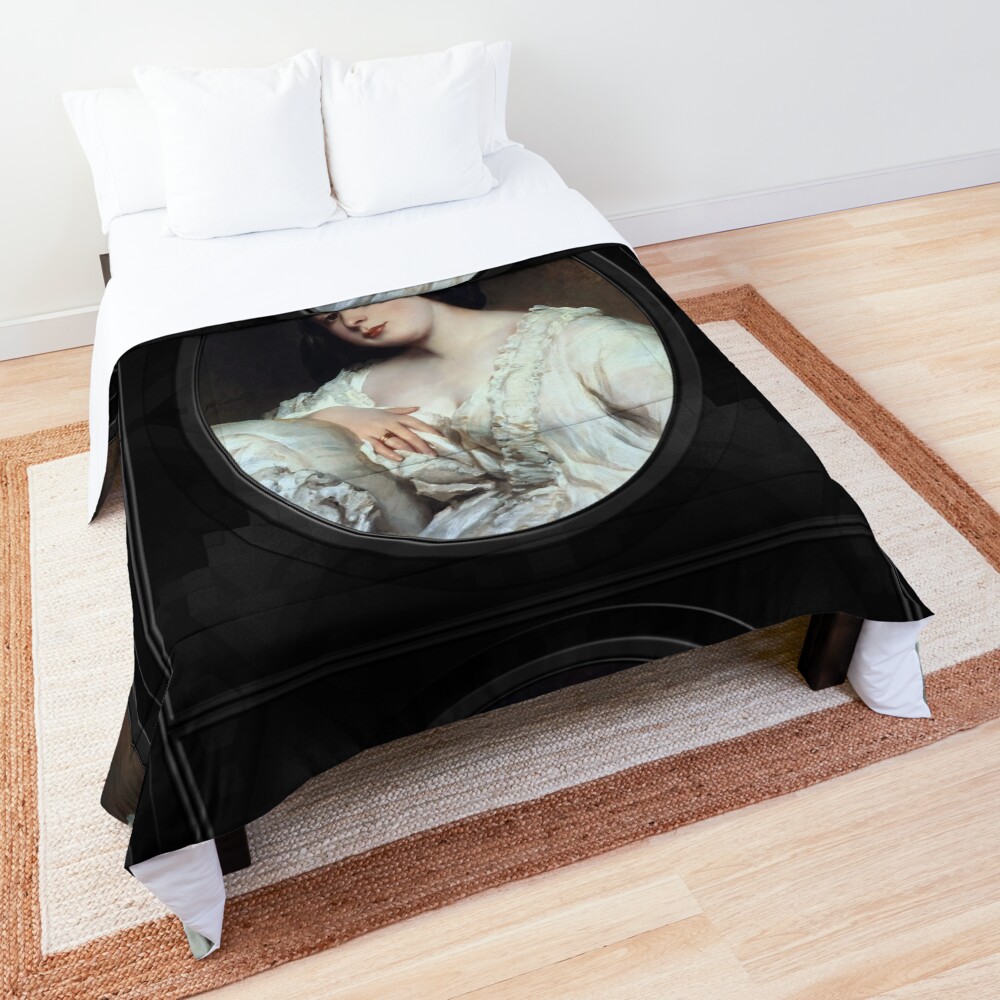
The portrait is a close-up of a young lady, likely from the European upper classes, given the sophistication and quality of her attire. A gúna bán, characterized by soft ruffles and intricate folds, drapes gently across her shoulders and chest, creating a sense of movement and grace.
Her calm yet enigmatic expression is the focal point of the piece, drawing the viewer’s attention to her delicate features. The lady’s dark hair, parted in the center and styled in a smooth, controlled manner, contrasts beautifully with the light fabric of her dress, enhancing the overall balance of light and dark within the composition.
Her hand rests lightly on her lap, fingers elegantly spread, with a ring visible on her left hand, signifying her status and perhaps an important relationship or heritage. Cuireann an comhartha caolchúiseach aer coigeartaithe agus uaisle leis an ardán, ag cuimsiú dínit an ábhair. Gabhann Winterhalter uigeachtaí boga a craiceann agus gealtachta ton a craiceann leis an urraim chéanna a bhronnann sé ar fhabraic a gúna. Is sainmharc é seo dá stíl, obsession leis an uigeacht a chuireann le caighdeán saoil na n-ábhar a phéinteáil sé.
Ábhair agus Teicníc
D'oibrigh Winterhalter le olaí, úsáid a bhaint as teicníocht layered a lig dó doimhneacht agus nuance iontach a bhaint amach ina dathanna. An bog, Tugann nádúr beagnach tréshoilseach gúna bán na mná le fios go bhfuil cumas Winterhalter chun máistreacht a fháil ar subtleties na fabraice, uigeachtaí saolta a chruthú a ghabhann leis an mbealach a idirghníomhaíonn solas le hábhair éagsúla. Uigeacht a craiceann, íogair agus lonrúil, is painted with equal precision, as is the smoothness of her black hair, which appears to shimmer under the light.
The use of shadows in the portrait is also striking. Winterhalter’s mastery of chiaroscuro, where light and dark are carefully balanced, gives the painting a sense of three-dimensionality, making the subject appear as though she could step off the canvas. The background is softly blurred, with dark, muted tones that help the figure stand out sharply. This technique, which blurs the boundary between figure and ground, is characteristic of the artist’s work and helps the viewer focus entirely on the subject, free from distraction.
Téama agus giúmar
The overall theme of this portrait can be understood as one of quiet elegance, áit áilleacht, nobility, and refinement are represented not through grand gestures but through subtlety and restraint. The lady in the portrait, while dressed in a lavish gown, does not express exuberance or overt joy. Ina áit sin, there is an air of quiet contemplation or perhaps melancholy. Her serious expression suggests introspection, possibly hinting at the societal pressures or expectations placed upon women of her class during the time.
The mood of the painting is serene and dignified. The muted color palette, with its emphasis on soft whites, dubh, and warm browns, evokes a sense of tranquility, while the lady’s composed demeanor adds a layer of solemnity. A radharc, directed slightly to the left, seems contemplative, as though she is lost in thought, or perhaps pondering something beyond the viewer’s reach. This gives the portrait an almost timeless quality, as though it captures a fleeting moment in the life of the subject, one that is both personal and universally relatable.
The Style of Winterhalter
Franz Xaver Winterhalter was known for his refined, flattering portraits of aristocrats and royalty. His style blends elements of both academic realism and romanticism, capturing the likeness of the subject with precision while also idealizing their form.
An bog, smooth lines, glowing flesh tones, and harmonious composition suggest an aesthetic ideal that was highly popular during the mid-19th century, especially in the courtly circles Winterhalter often painted for. While his subjects are rendered realistically, there is an element of stylization in the way he emphasizes elegance and poise, presenting his sitters as paragons of beauty and grace.
The soft focus of the background, with minimal detail, allows the subject to be the central focus of the composition. This technique, paired with Winterhalter’s skill in capturing human emotion and character, made his portraits highly sought after by royal families and aristocrats.
The portrait’s atmosphere, combined with the artist’s characteristic style, speaks to the social and cultural values of the time: the ideal of refined beauty, the status of the subject, and the artist’s desire to create a lasting, timeless image of aristocratic life.
Conclúid
Portráid de Mhuire by Franz Xaver Winterhalter remains an exemplary piece of 19th-century portraiture. With its exquisite detailing, careful attention to the subject’s demeanor, and the subtle interplay of light and shadow, the work embodies the grace and sophistication that Winterhalter was known for.
The painting captures not only the physical likeness of the subject but also evokes the mood and atmosphere of the time, one of poised elegance and quiet introspection. Winterhalter’s ability to depict the subject’s character, through both the delicate textures of her attire and the nuanced expression on her face, makes this painting a lasting testament to the high art of portraiture during the Victorian era.
Portrait of a Lady is a retouched digital art old masters reproduction of a public domain image.
Beathaisnéis Ealaíontóir Ó Wikipedia.org
Rugadh Franz Xaver Winterhalter i sráidbhaile beag Menzenschwand, (anois mar chuid de Sankt Blasien), i bhForaois Dhubh na Gearmáine[1] i dToghcheantar Baden, ar 20 Aibreán 1805.[2] Ba é an séú leanbh de Fidel Winterhalter (1773–1863), feirmeoir agus léiritheoir roisín sa sráidbhaile, agus a bhean Eva Meyer (1765–1838), ball de theaghlach Menzenschwand fadbhunaithe.
Bhí stoc tuathánach ag a athair agus bhí tionchar cumhachtach aige ina shaol. As an ochtar deartháireacha agus deirfiúracha, níor mhair ach ceathrar ina naíonán. Ar feadh a shaoil d’fhan Franz Xaver an-dlúth lena theaghlach, go háirithe dá dheartháir Hermann (1808–1891), a bhí ina phéintéir freisin.
Tar éis dó freastal ar scoil ag mainistir Bheinidicteach i St.. Blasien, D’fhág Winterhalter Menzenschwand isteach 1818 ag aois 13 chun staidéar a dhéanamh ar líníocht agus greanadh. Fuair sé oiliúint mar dhréachtóir agus mar liteagrafaí i gceardlann Karl Ludwig Schüler (1785–1852) in Freiburg im Breisgau. I 1823, ag aois 18, chuaigh sé go München, urraithe ag an tionsclaí Baron von Eichtal (1775–1850).
I 1825, bhronn Ludwig I stipinn air, Grand Duke of Baden (1763–1830) agus chuir sé tús le cúrsa staidéir in Acadamh na nEalaíon i München le Peter von Cornelius (1783–1867), chuir a mhodhanna acadúla míchompord air. D'aimsigh Winterhalter meantóir níos congenial sa phortráidí faiseanta Joseph Karl Stieler (1781–1858). Le linn na tréimhse seo, thacaigh sé leis féin ag obair mar liteagrafaí.
Chuaigh Winterhalter isteach i gciorcail chúirte nuair a bhí sé isteach 1828 rinneadh máistir líníochta de le Sophie Margravine as Baden, ag Karlsruhe.[6] Tháinig a dheis chun é féin a bhunú taobh amuigh de dheisceart na Gearmáine 1832 nuair a bhí sé in ann taisteal chun na hIodáile, 1833–1834, le tacaíocht ó Grand Duke Leopold as Baden. Sa Róimh chum sé radhairc seánra rómánsúla ar bhealach Louis Léopold Robert agus cheangail sé é féin le ciorcal stiúrthóir Acadamh na Fraince, Horace Vernet. Ar fhilleadh ar Karlsruhe phéinteáil sé portráidí den Grand Duke Leopold de Baden agus a bhean chéile, agus ceapadh é mar phéintéir don chúirt mhór-ducal.
mar sin féin, d’fhág sé Baden chun bogadh go dtí an Fhrainc, áit ar tharraing a radharc seánra Iodálach Il dolce Farniente fógra ag Salon of 1836. Moladh Il Decameron bliain ina dhiaidh sin freisin; is cumadóireachta acadúla iad an dá phictiúr i stíl Raphael. I Salon na 1838 thaispeáin sé portráid de Phrionsa Wagram lena iníon óg. Fuarthas a shlí bheatha mar phéintéir portráid go luath nuair a phéinteáil sé Louise Marie as Orleans an bhliain chéanna, Banríon na Beilge, agus a mac. Is dócha gur tríd an bpictiúr seo a tháinig Winterhalter faoi deara Maria Amalia as an Dá Shicil, Banríon na Fraince, máthair Bhanríon na Beilge.