

Ritratto di signora
Franz Xaver Winterhalter’s Ritratto di signora (Una delizia da sogno. 1850S) stands as a quintessential representation of mid-19th-century European portraiture. Winterhalter (1805 – 1873), a German artist renowned for his highly polished, elegant works; and older brother of German painter Hermann Fidel Winterhalter (1808 – 1891), often painted the aristocracy and elite of Europe, capturing them in ways that highlighted both their opulence and refinement.
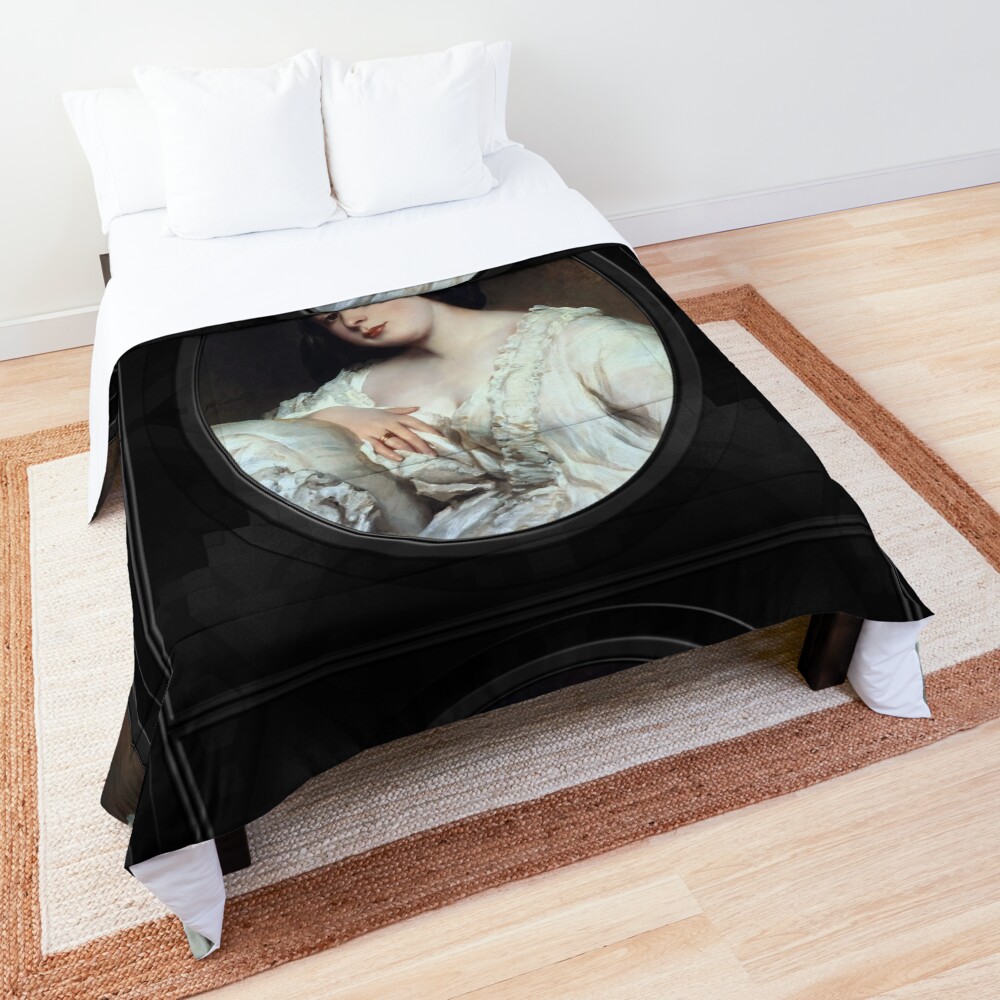
Questo ritratto, an example of his mastery, features a lady in a delicate pose, her somber yet poised expression framed by the soft, almost ethereal quality of her attire and the setting. La meticolosa attenzione dell'artista ai dettagli, and his ability to create lifelike textures and warm tones, bring the subject to life with remarkable realism and grace.
Sommario
Il soggetto e la composizione
The portrait is a close-up of a young lady, likely from the European upper classes, given the sophistication and quality of her attire. Il suo abito bianco, characterized by soft ruffles and intricate folds, drapes gently across her shoulders and chest, creating a sense of movement and grace.
Her calm yet enigmatic expression is the focal point of the piece, drawing the viewer’s attention to her delicate features. The lady’s dark hair, parted in the center and styled in a smooth, controlled manner, contrasts beautifully with the light fabric of her dress, enhancing the overall balance of light and dark within the composition.
Her hand rests lightly on her lap, fingers elegantly spread, with a ring visible on her left hand, signifying her status and perhaps an important relationship or heritage. The subtle gesture adds an air of refinement and nobility to the scene, encapsulating the dignity of the subject. Winterhalter captures the soft textures of her skin and the luminosity of her skin tone with the same reverence that he bestows upon the fabric of her gown. This is a hallmark of his style, an obsession with texture that enhances the lifelike quality of the subjects he painted.
Materiali e Tecnica
Winterhalter worked with oils, employing a layered technique that allowed him to achieve remarkable depth and nuance in his colors. Il morbido, almost translucent nature of the lady’s white dress suggests Winterhalter’s ability to master the subtleties of fabric, creating lifelike textures that capture the way light interacts with different materials. The texture of her skin, delicate and luminous, is painted with equal precision, as is the smoothness of her black hair, which appears to shimmer under the light.
The use of shadows in the portrait is also striking. Winterhalter’s mastery of chiaroscuro, where light and dark are carefully balanced, gives the painting a sense of three-dimensionality, making the subject appear as though she could step off the canvas. The background is softly blurred, with dark, muted tones that help the figure stand out sharply. This technique, which blurs the boundary between figure and ground, is characteristic of the artist’s work and helps the viewer focus entirely on the subject, free from distraction.
Tema e umore
The overall theme of this portrait can be understood as one of quiet elegance, dove la bellezza, nobility, and refinement are represented not through grand gestures but through subtlety and restraint. The lady in the portrait, while dressed in a lavish gown, does not express exuberance or overt joy. Invece, there is an air of quiet contemplation or perhaps melancholy. Her serious expression suggests introspection, possibly hinting at the societal pressures or expectations placed upon women of her class during the time.
The mood of the painting is serene and dignified. La tavolozza dei colori tenui, with its emphasis on soft whites, blacks, and warm browns, evokes a sense of tranquility, while the lady’s composed demeanor adds a layer of solemnity. Il suo sguardo, directed slightly to the left, seems contemplative, as though she is lost in thought, or perhaps pondering something beyond the viewer’s reach. This gives the portrait an almost timeless quality, as though it captures a fleeting moment in the life of the subject, one that is both personal and universally relatable.
The Style of Winterhalter
Franz Xaver Winterhalter was known for his refined, flattering portraits of aristocrats and royalty. His style blends elements of both academic realism and romanticism, capturing the likeness of the subject with precision while also idealizing their form.
Il morbido, smooth lines, glowing flesh tones, and harmonious composition suggest an aesthetic ideal that was highly popular during the mid-19th century, especially in the courtly circles Winterhalter often painted for. While his subjects are rendered realistically, there is an element of stylization in the way he emphasizes elegance and poise, presenting his sitters as paragons of beauty and grace.
The soft focus of the background, with minimal detail, allows the subject to be the central focus of the composition. This technique, paired with Winterhalter’s skill in capturing human emotion and character, made his portraits highly sought after by royal families and aristocrats.
The portrait’s atmosphere, combined with the artist’s characteristic style, speaks to the social and cultural values of the time: the ideal of refined beauty, the status of the subject, and the artist’s desire to create a lasting, timeless image of aristocratic life.
Conclusione
Ritratto di signora by Franz Xaver Winterhalter remains an exemplary piece of 19th-century portraiture. With its exquisite detailing, careful attention to the subject’s demeanor, e la sottile interazione di luce e ombra, the work embodies the grace and sophistication that Winterhalter was known for.
The painting captures not only the physical likeness of the subject but also evokes the mood and atmosphere of the time, one of poised elegance and quiet introspection. Winterhalter’s ability to depict the subject’s character, through both the delicate textures of her attire and the nuanced expression on her face, makes this painting a lasting testament to the high art of portraiture during the Victorian era.
Ritratto di una signora è una riproduzione di vecchi maestri di arte digitale ritoccata di un'immagine di pubblico dominio.
Bio dell'artista da Wikipedia.org
Franz Xaver Winterhalter è nato nel piccolo villaggio di Menzenschwand, (ora parte di Sankt Blasien), nella Foresta Nera in Germania[1] nell'elettorato di Baden, sopra 20 aprile 1805.[2] Era il sesto figlio di Fidel Winterhalter (1773–1863), un agricoltore e produttore di resina nel villaggio, e sua moglie Eva Meyer (1765–1838), un membro di una famiglia Menzenschwand di lunga data.
Suo padre era di stirpe contadina ed ebbe una forte influenza nella sua vita. Degli otto fratelli e sorelle, solo quattro sopravvissero all'infanzia. Per tutta la vita Franz Xaver è rimasto molto vicino alla sua famiglia, in particolare al fratello Hermann (1808–1891), che era anche pittore.
Dopo aver frequentato la scuola in un monastero benedettino a St. Blasien, Winterhalter lasciò Menzenschwand in 1818 all'età di 13 to study drawing and engraving. Si è formato come disegnatore e litografo nella bottega di Karl Ludwig Schüler (1785–1852) a Friburgo in Brisgovia. Nel 1823, all'età di 18, è andato a Monaco di Baviera, sponsorizzato dall'industriale barone von Eichtal (1775–1850).
Nel 1825, gli fu concesso uno stipendio da Ludwig I, Granduca di Baden (1763–1830) e iniziò un corso di studi presso l'Accademia delle Arti di Monaco di Baviera con Peter von Cornelius (1783–1867), i cui metodi accademici lo mettevano a disagio. Winterhalter trovò un mentore più congeniale nel ritrattista alla moda Joseph Karl Stieler (1781–1858). Durante questo periodo, si manteneva lavorando come litografo.
Winterhalter entrò nei circoli di corte quando in 1828 divenne maestro di disegno di Sophie Margravine di Baden, a Karlsruhe.[6] È arrivata la sua opportunità di affermarsi al di fuori della Germania meridionale 1832 quando poté viaggiare in Italia, 1833–1834, con il sostegno del Granduca Leopoldo di Baden. A Roma compose scene di genere romantico alla maniera di Louis Léopold Robert e si unì alla cerchia del direttore dell'Accademia di Francia, Orazio Vernet. Al suo ritorno a Karlsruhe dipinse i ritratti del Granduca Leopoldo di Baden e di sua moglie, e fu nominato pittore alla corte granducale.
tuttavia, lasciò Baden per trasferirsi in Francia, dove la sua scena di genere italiana Il dolce Farniente ha attirato l'attenzione al Salon of 1836. Anche Il Decameron un anno dopo fu elogiato; entrambi i dipinti sono composizioni accademiche nello stile di Raffaello. Nel Salone di 1838 espose un ritratto del principe di Wagram con la sua giovane figlia. La sua carriera come ritrattista fu presto assicurata quando nello stesso anno dipinse Louise Marie of Orleans, Regina dei Belgi, e suo figlio. Fu probabilmente attraverso questo dipinto che Winterhalter venne a conoscenza di Maria Amalia delle Due Sicilie, Regina dei Francesi, madre della regina dei belgi.