

여인의 초상
Franz Xaver Winterhalter’s 여인의 초상 (씨. 1850NS) stands as a quintessential representation of mid-19th-century European portraiture. 윈터홀더 (1805 – 1873), a German artist renowned for his highly polished, elegant works; and older brother of German painter Hermann Fidel Winterhalter (1808 – 1891), often painted the aristocracy and elite of Europe, capturing them in ways that highlighted both their opulence and refinement.
이 초상화, an example of his mastery, features a lady in a delicate pose, her somber yet poised expression framed by the soft, almost ethereal quality of her attire and the setting. 디테일에 대한 작가의 세심한 관심, and his ability to create lifelike textures and warm tones, bring the subject to life with remarkable realism and grace.
목차
주제와 구성
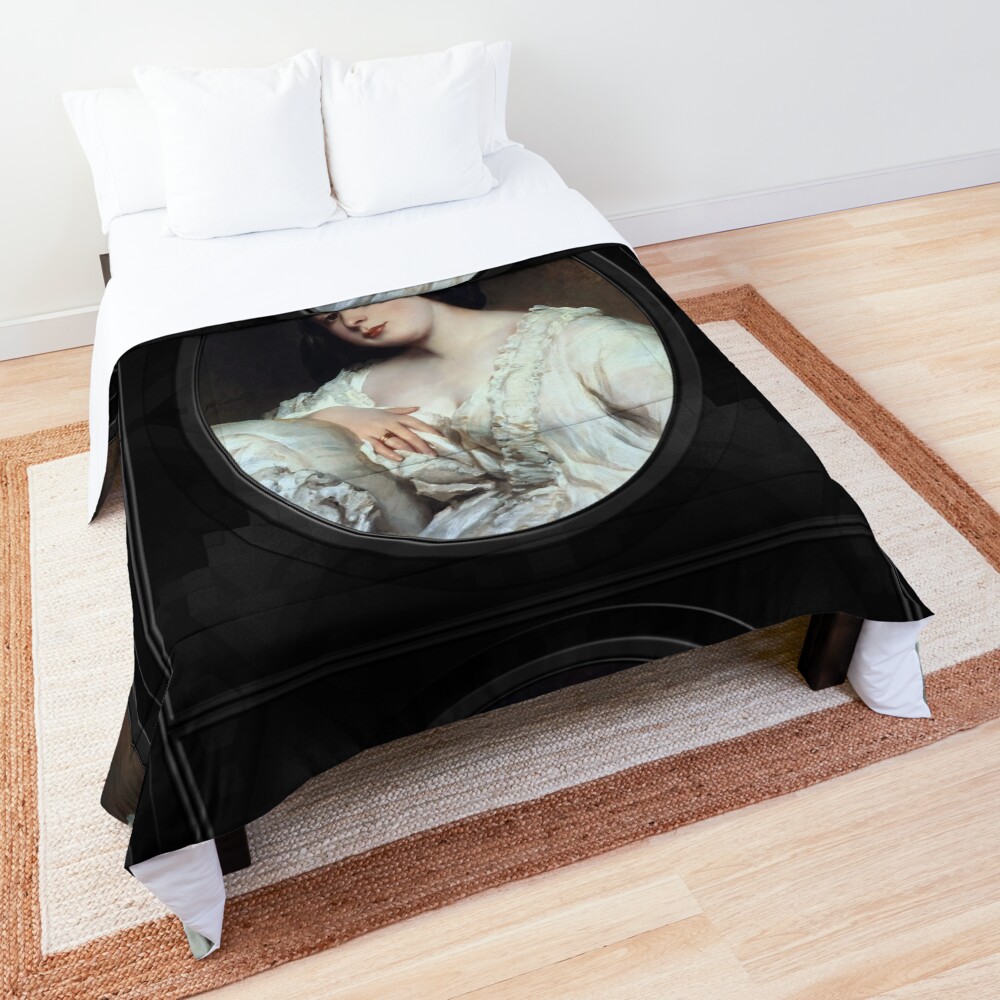
The portrait is a close-up of a young lady, likely from the European upper classes, given the sophistication and quality of her attire. Her white gown, characterized by soft ruffles and intricate folds, drapes gently across her shoulders and chest, creating a sense of movement and grace.
Her calm yet enigmatic expression is the focal point of the piece, drawing the viewer’s attention to her delicate features. The lady’s dark hair, parted in the center and styled in a smooth, controlled manner, contrasts beautifully with the light fabric of her dress, enhancing the overall balance of light and dark within the composition.
Her hand rests lightly on her lap, fingers elegantly spread, with a ring visible on her left hand, signifying her status and perhaps an important relationship or heritage. The subtle gesture adds an air of refinement and nobility to the scene, encapsulating the dignity of the subject. Winterhalter captures the soft textures of her skin and the luminosity of her skin tone with the same reverence that he bestows upon the fabric of her gown. This is a hallmark of his style, an obsession with texture that enhances the lifelike quality of the subjects he painted.
재료 및 기술
Winterhalter worked with oils, employing a layered technique that allowed him to achieve remarkable depth and nuance in his colors. 부드러운, almost translucent nature of the lady’s white dress suggests Winterhalter’s ability to master the subtleties of fabric, creating lifelike textures that capture the way light interacts with different materials. The texture of her skin, delicate and luminous, is painted with equal precision, as is the smoothness of her black hair, which appears to shimmer under the light.
The use of shadows in the portrait is also striking. Winterhalter’s mastery of chiaroscuro, where light and dark are carefully balanced, gives the painting a sense of three-dimensionality, making the subject appear as though she could step off the canvas. 배경이 부드럽게 흐려짐, 어두운 곳, muted tones that help the figure stand out sharply. 이 기술, which blurs the boundary between figure and ground, is characteristic of the artist’s work and helps the viewer focus entirely on the subject, free from distraction.
테마와 분위기
The overall theme of this portrait can be understood as one of quiet elegance, 아름다움, 귀족, and refinement are represented not through grand gestures but through subtlety and restraint. The lady in the portrait, while dressed in a lavish gown, does not express exuberance or overt joy. 대신에, there is an air of quiet contemplation or perhaps melancholy. Her serious expression suggests introspection, possibly hinting at the societal pressures or expectations placed upon women of her class during the time.
The mood of the painting is serene and dignified. The muted color palette, with its emphasis on soft whites, 흑인, and warm browns, evokes a sense of tranquility, while the lady’s composed demeanor adds a layer of solemnity. 그녀의 시선, directed slightly to the left, seems contemplative, as though she is lost in thought, or perhaps pondering something beyond the viewer’s reach. This gives the portrait an almost timeless quality, as though it captures a fleeting moment in the life of the subject, one that is both personal and universally relatable.
The Style of Winterhalter
Franz Xaver Winterhalter was known for his refined, flattering portraits of aristocrats and royalty. His style blends elements of both academic realism and romanticism, capturing the likeness of the subject with precision while also idealizing their form.
부드러운, smooth lines, glowing flesh tones, and harmonious composition suggest an aesthetic ideal that was highly popular during the mid-19th century, especially in the courtly circles Winterhalter often painted for. While his subjects are rendered realistically, there is an element of stylization in the way he emphasizes elegance and poise, presenting his sitters as paragons of beauty and grace.
The soft focus of the background, with minimal detail, allows the subject to be the central focus of the composition. 이 기술, paired with Winterhalter’s skill in capturing human emotion and character, made his portraits highly sought after by royal families and aristocrats.
The portrait’s atmosphere, combined with the artist’s characteristic style, speaks to the social and cultural values of the time: the ideal of refined beauty, the status of the subject, and the artist’s desire to create a lasting, timeless image of aristocratic life.
결론
여인의 초상 by Franz Xaver Winterhalter remains an exemplary piece of 19th-century portraiture. With its exquisite detailing, careful attention to the subject’s demeanor, and the subtle interplay of light and shadow, the work embodies the grace and sophistication that Winterhalter was known for.
The painting captures not only the physical likeness of the subject but also evokes the mood and atmosphere of the time, one of poised elegance and quiet introspection. Winterhalter’s ability to depict the subject’s character, through both the delicate textures of her attire and the nuanced expression on her face, makes this painting a lasting testament to the high art of portraiture during the Victorian era.
Portrait of a Lady is a retouched digital art old masters reproduction of a public domain image.
아티스트 바이오 Wikipedia.org
Franz Xaver Winterhalter는 Menzenschwand의 작은 마을에서 태어났습니다., (이제 Sankt Blasien의 일부), in Germany’s Black Forest[1] in the Electorate of Baden, ~에 20 4 월 1805.[2] 그는 Fidel Winterhalter의 여섯 번째 자녀였습니다. (1773–1863), 마을의 농부이자 수지 생산자, 그의 아내 에바 메이어 (1765–1838), 오랫동안 설립된 Menzenschwand 가족의 일원.
그의 아버지는 소작농이었고 그의 삶에 강력한 영향을 미쳤습니다.. 여덟 남매 중, 4명만이 유아기에서 살아남았다. 평생 동안 Franz Xaver는 가족과 매우 가깝게 지냈습니다., 특히 그의 형제 헤르만에게 (1808–1891), 화가이기도 했던.
성 베네딕토회 수도원에서 학교를 마치고. 거품, 빈터할터는 멘젠슈반트를 떠났다. 1818 세의 나이에 13 그림과 조각을 공부하기 위해. 그는 Karl Ludwig Schüler의 작업장에서 제도가이자 석판가로 훈련을 받았습니다. (1785–1852) 프라이부르크 임 브리스가우에서. 에 1823, 세의 나이에 18, 그는 뮌헨에 갔다, 기업가 Baron von Eichtal 후원 (1775–1850).
에 1825, 그는 루트비히 1세로부터 봉급을 받았다., 바덴 대공 (1763–1830) Peter von Cornelius와 함께 뮌헨 예술 아카데미에서 공부를 시작했습니다. (1783–1867), 그의 학업 방식이 그를 불편하게 만들었습니다.. Winterhalter는 패셔너블한 초상화가 Joseph Karl Stieler에게서 더 마음에 맞는 멘토를 찾았습니다. (1781–1858). 이 시간 동안, 그는 석판 작가로 일하면서 자신을 지원했습니다..
Winterhalter는 법정에 들어섰습니다. 1828 그는 바덴의 소피 마그레빈(Sophie Margravine of Baden)의 드로잉 마스터가 되었습니다., at Karlsruhe.[6] 독일 남부를 넘어 자리를 잡을 기회가 찾아왔다. 1832 그가 이탈리아를 여행할 수 있었을 때, 1833–1834, 바덴의 레오폴드 대공의 지원으로. 로마에서 그는 루이 레오폴드 로베르의 방식으로 낭만적인 장르의 장면을 작곡하고 프랑스 아카데미 원장 서클에 합류했습니다., 호레이스 베르네. 카를스루에로 돌아온 그는 바덴의 레오폴드 대공과 그의 아내의 초상화를 그렸습니다., 그리고 대공법의 화가로 임명되었다..
그럼에도 불구하고, he left Baden to move to France, 그의 이탈리아 장르 장면 Il dolce Farniente가 살롱에서 주목을 받았던 곳 1836. Il Decameron a year later was also praised; both paintings are academic compositions in the style of Raphael. 살롱에서 1838 그는 어린 딸과 함께 Wagram 왕자의 초상화를 전시했습니다.. His career as a portrait painter was soon secured when in the same year he painted Louise Marie of Orleans, 벨기에의 여왕, 그리고 그녀의 아들. Winterhalter가 두 시칠리아의 Maria Amalia를 알게 된 것은 아마도 이 그림을 통해서였을 것입니다., 프랑스의 여왕, 벨기에 여왕의 어머니.