

Portret van een dame
Franz Xaver Winterhalter’s Portret van een dame (C. 1850s) stands as a quintessential representation of mid-19th-century European portraiture. Winterhalter (1805 – 1873), a German artist renowned for his highly polished, elegant works; and older brother of German painter Hermann Fidel Winterhalter (1808 – 1891), often painted the aristocracy and elite of Europe, capturing them in ways that highlighted both their opulence and refinement.
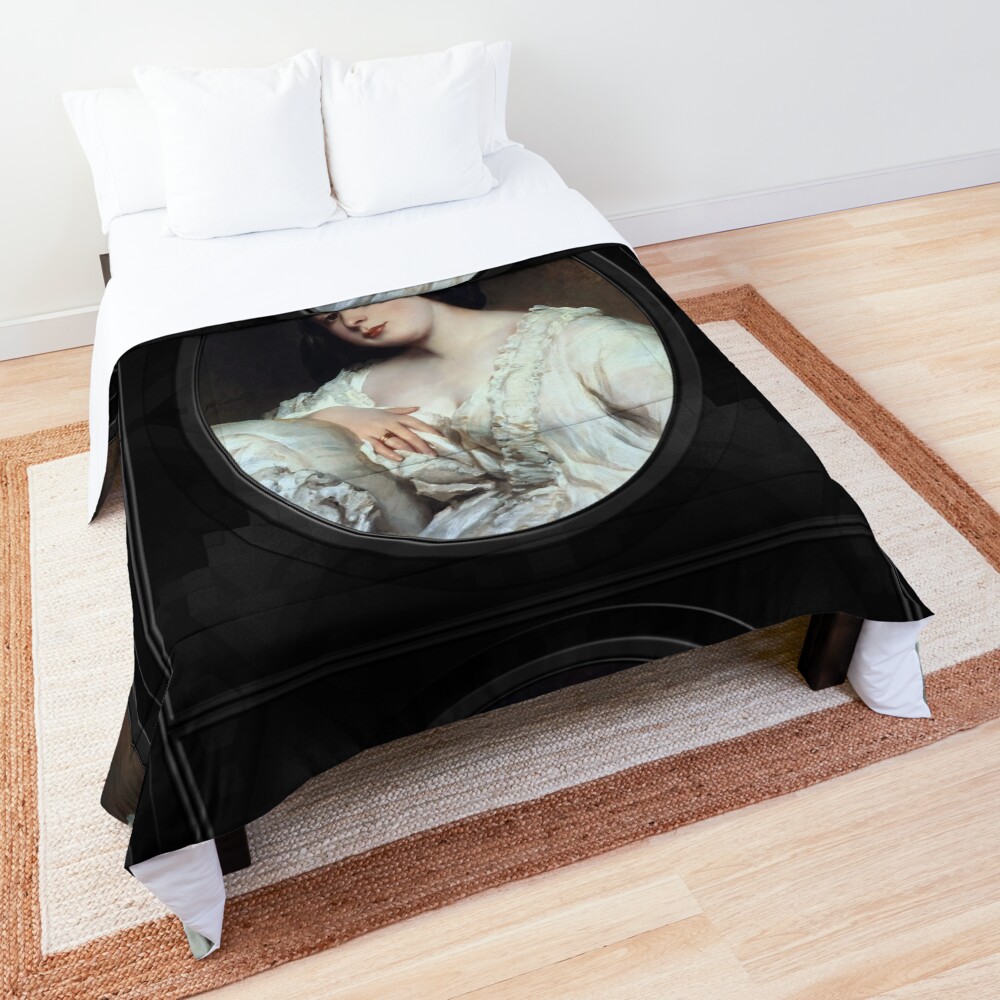
This portrait, an example of his mastery, features a lady in a delicate pose, her somber yet poised expression framed by the soft, almost ethereal quality of her attire and the setting. De nauwgezette aandacht van de kunstenaar voor detail, and his ability to create lifelike textures and warm tones, bring the subject to life with remarkable realism and grace.
Inhoudsopgave
The Subject and Composition
The portrait is a close-up of a young lady, likely from the European upper classes, given the sophistication and quality of her attire. Her white gown, characterized by soft ruffles and intricate folds, drapes gently across her shoulders and chest, creating a sense of movement and grace.
Her calm yet enigmatic expression is the focal point of the piece, drawing the viewer’s attention to her delicate features. The lady’s dark hair, parted in the center and styled in a smooth, controlled manner, contrasts beautifully with the light fabric of her dress, enhancing the overall balance of light and dark within the composition.
Her hand rests lightly on her lap, fingers elegantly spread, with a ring visible on her left hand, signifying her status and perhaps an important relationship or heritage. The subtle gesture adds an air of refinement and nobility to the scene, encapsulating the dignity of the subject. Winterhalter captures the soft textures of her skin and the luminosity of her skin tone with the same reverence that he bestows upon the fabric of her gown. This is a hallmark of his style, an obsession with texture that enhances the lifelike quality of the subjects he painted.
Materialen en techniek
Winterhalter worked with oils, employing a layered technique that allowed him to achieve remarkable depth and nuance in his colors. De zachte, almost translucent nature of the lady’s white dress suggests Winterhalter’s ability to master the subtleties of fabric, creating lifelike textures that capture the way light interacts with different materials. The texture of her skin, delicate and luminous, is painted with equal precision, as is the smoothness of her black hair, which appears to shimmer under the light.
The use of shadows in the portrait is also striking. Winterhalter’s mastery of chiaroscuro, where light and dark are carefully balanced, gives the painting a sense of three-dimensionality, making the subject appear as though she could step off the canvas. The background is softly blurred, with dark, muted tones that help the figure stand out sharply. This technique, which blurs the boundary between figure and ground, is characteristic of the artist’s work and helps the viewer focus entirely on the subject, free from distraction.
Thema en stemming
The overall theme of this portrait can be understood as one of quiet elegance, where beauty, nobility, and refinement are represented not through grand gestures but through subtlety and restraint. The lady in the portrait, while dressed in a lavish gown, does not express exuberance or overt joy. In plaats daarvan, there is an air of quiet contemplation or perhaps melancholy. Her serious expression suggests introspection, possibly hinting at the societal pressures or expectations placed upon women of her class during the time.
The mood of the painting is serene and dignified. The muted color palette, with its emphasis on soft whites, zwarten, and warm browns, evokes a sense of tranquility, while the lady’s composed demeanor adds a layer of solemnity. Haar blik, directed slightly to the left, seems contemplative, as though she is lost in thought, or perhaps pondering something beyond the viewer’s reach. This gives the portrait an almost timeless quality, as though it captures a fleeting moment in the life of the subject, one that is both personal and universally relatable.
The Style of Winterhalter
Franz Xaver Winterhalter was known for his refined, flattering portraits of aristocrats and royalty. His style blends elements of both academic realism and romanticism, capturing the likeness of the subject with precision while also idealizing their form.
De zachte, smooth lines, glowing flesh tones, and harmonious composition suggest an aesthetic ideal that was highly popular during the mid-19th century, especially in the courtly circles Winterhalter often painted for. While his subjects are rendered realistically, there is an element of stylization in the way he emphasizes elegance and poise, presenting his sitters as paragons of beauty and grace.
The soft focus of the background, with minimal detail, allows the subject to be the central focus of the composition. This technique, paired with Winterhalter’s skill in capturing human emotion and character, made his portraits highly sought after by royal families and aristocrats.
The portrait’s atmosphere, combined with the artist’s characteristic style, speaks to the social and cultural values of the time: the ideal of refined beauty, the status of the subject, and the artist’s desire to create a lasting, timeless image of aristocratic life.
Conclusie
Portret van een dame by Franz Xaver Winterhalter remains an exemplary piece of 19th-century portraiture. With its exquisite detailing, careful attention to the subject’s demeanor, en het subtiele samenspel van licht en schaduw, the work embodies the grace and sophistication that Winterhalter was known for.
The painting captures not only the physical likeness of the subject but also evokes the mood and atmosphere of the time, one of poised elegance and quiet introspection. Winterhalter’s ability to depict the subject’s character, through both the delicate textures of her attire and the nuanced expression on her face, makes this painting a lasting testament to the high art of portraiture during the Victorian era.
Portret van een dame is een geretoucheerde digitale kunst oude meesters reproductie van een afbeelding uit het publieke domein.
Kunstenaar bio van Wikipedia.org
Franz Xaver Winterhalter werd geboren in het kleine dorpje Menzenschwand, (nu onderdeel van Sankt Blasien), in het Duitse Zwarte Woud[1] in het electoraat van Baden, Aan 20 april 1805.[2] Hij was het zesde kind van Fidel Winterhalter (1773–1863), een boer en harsproducent in het dorp, en zijn vrouw Eva Meyer (1765–1838), een lid van een lang gevestigde Menzenschwand-familie.
Zijn vader was van boer en had een grote invloed op zijn leven. Van de acht broers en zussen, slechts vier overleefden de kindertijd. Zijn hele leven bleef Franz Xaver heel dicht bij zijn familie, in het bijzonder aan zijn broer Hermann (1808–1891), die ook schilder was.
Na school te hebben gevolgd in een benedictijnenklooster in St. Blasien, Winterhalter verliet Menzenschwand in 1818 op de leeftijd van 13 om tekenen en graveren te studeren. Hij volgde een opleiding tot tekenaar en lithograaf in de werkplaats van Karl Ludwig Schüler (1785–1852) in Freiburg im Breisgau. In 1823, op de leeftijd van 18, hij ging naar München, gesponsord door de industrieel Baron von Eichtal (1775–1850).
In 1825, hij kreeg een stipendium van Ludwig I, Groothertog van Baden (1763–1830) en begon een opleiding aan de kunstacademie in München bij Peter von Cornelius (1783–1867), wiens academische methoden hem ongemakkelijk maakten. Winterhalter vond een sympathiekere mentor in de modieuze portrettist Joseph Karl Stieler (1781–1858). Gedurende deze periode, hij ondersteunde zichzelf door te werken als lithograaf.
Winterhalter betrad hofkringen toen in 1828 hij werd tekenmeester van Sophie Markgravin van Baden, te Karlsruhe.[6] Zijn kans om zich buiten Zuid-Duitsland te vestigen deed zich voor 1832 toen hij naar Italië kon reizen, 1833–1834, met de steun van groothertog Leopold van Baden. In Rome componeerde hij romantische genretaferelen op de manier van Louis Léopold Robert en sloot zich aan in de kring van de directeur van de Franse Academie, Horace Vernet. Bij zijn terugkeer naar Karlsruhe schilderde hij portretten van de groothertog Leopold van Baden en zijn vrouw, en werd benoemd tot schilder aan het groothertogelijke hof.
niettemin, hij verliet Baden om naar Frankrijk te verhuizen, waar zijn Italiaanse genrescène Il dolce Farniente de aandacht trok op de Salon van 1836. Il Decameron werd een jaar later ook geprezen; beide schilderijen zijn academische composities in de stijl van Raphael. In de Salon van 1838 hij exposeerde een portret van de prins van Wagram met zijn jonge dochter. Zijn carrière als portretschilder werd al snel veiliggesteld toen hij in hetzelfde jaar Louise Marie van Orleans schilderde, Koningin der Belgen, en haar zoon. Het was waarschijnlijk door dit schilderij dat Winterhalter onder de aandacht kwam van Maria Amalia van Twee Sicilies, Koningin van de Fransen, moeder van de Koningin der Belgen.