

Portrait Of A Lady In Black
Portrait Of A Lady In Black by German Painter Franz Xaver Winterhalter (1805 – 1873); known for his portraits of mid nineteenth century royalty and older brother of German painter Hermann Fidel Winterhalter (1808 – 1891).
This is an elegant portrait of an attractive young raven haired brunette standing against blue sky with white clouds; with a portion of a tree on her left side.
She is standing by a large square pedestal that has a large urn on it, that is decorated with sculpted handles that have a pair of male faces on them.
The young lady is a wearing a full length off shoulder black fluffy dress with long sleeves and tight wrist cuffs.
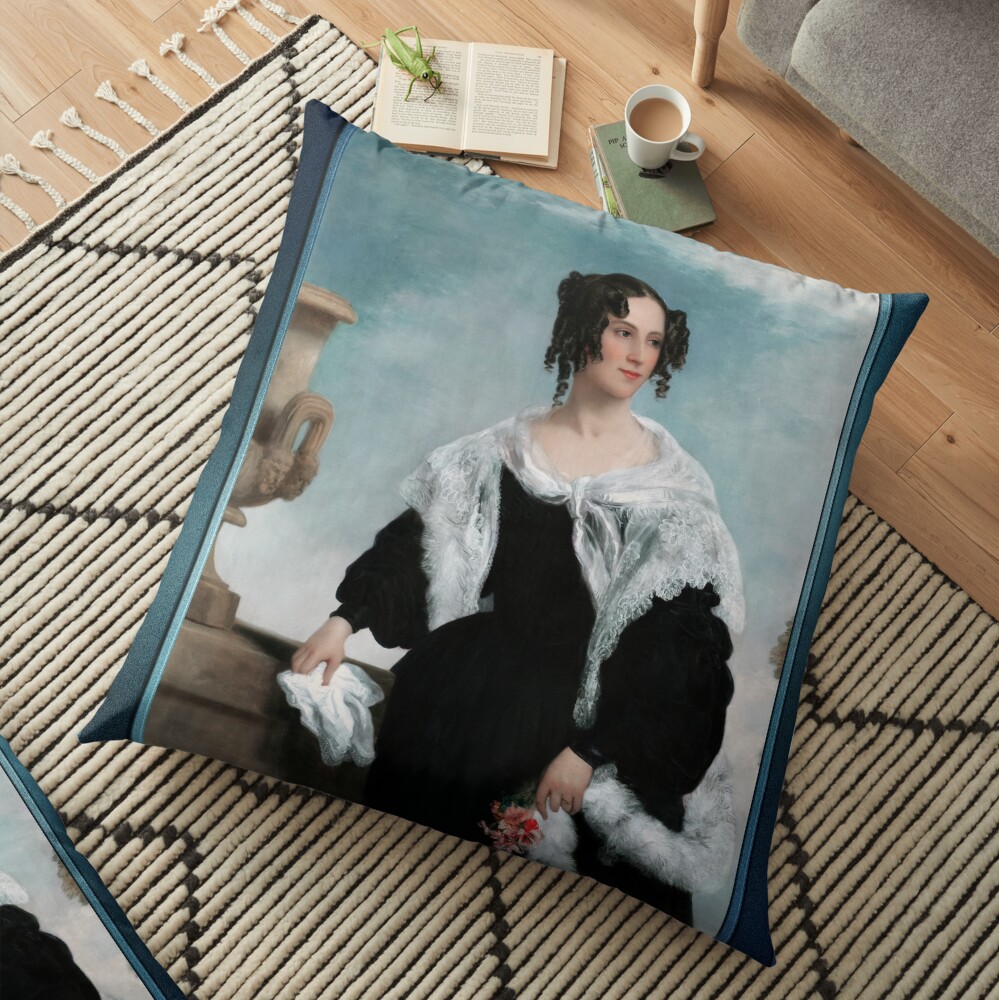
In her right hand which is resting on the pedestal is an embroidered white silk handkerchief; while in her left hand she is holding flowers by there stems along with a fur tube that wraps around her back and right arm, being covered by her embroidered scarf that is resting on her shoulders and tied at the front.
Portrait Of A Lady In Black is a retouched digital art old masters reproduction of a public domain image that you can buy as a lærred print.
Info nedenfor stammer fra Wikipedia.org
Franz Xaver Winterhalter blev født i den lille landsby Menzenschwand, (nu en del af Sankt Blasien), in Germany’s Black Forest in the Electorate of Baden, on April 20, 1805.
Han var Fidel Winterhalters sjette barn (1773 – 1863), en landmand og harpiksproducent i landsbyen, og hans kone Eva Meyer (1765 – 1838), a member of a long established Menzenschwand family.
Hans far var af bondebestand og havde en stærk indflydelse i hans liv. Af de otte brødre og søstre, kun fire overlevede barndommen.
Throughout his life Franz Xaver remained very close to his family, in particular to his brother Hermann (1808 – 1891), who was also a painter.
After attending school at a Benedictine monastery in St. Blasien, Winterhalter left Menzenschwand in 1818 i en alder af 13 to study drawing and engraving.
He trained as a draughtsman and lithographer in the workshop of Karl Ludwig Schüler (1785 – 1852) in Freiburg im Breisgau. I 1823, i en alder af 18, he went to Munich, sponsored by the industrialist Baron von Eichtal (1775 – 1850).
I 1825, he was granted a stipend by Ludwig I, Grand Duke of Baden (1763 – 1830) and began a course of study at the Academy of Arts in Munich with Peter von Cornelius (1783 – 1867), whose academic methods made him uncomfortable.
Winterhalter found a more congenial mentor in the fashionable portraitist Joseph Karl Stieler (1781 – 1858). During this time, he supported himself working as lithographer.
Winterhalter entered court circles when in 1828 he became drawing master to Sophie Margravine of Baden, at Karlsruhe.
His opportunity to establish himself beyond southern Germany came in 1832 when he was able to travel to Italy, med støtte fra storhertug Leopold af Baden.
I Rom komponerede han romantiske genrescener på Louis Léopold Roberts måde og knyttet sig til kredsen af direktøren for det franske akademi, Horace Vernet.
Da han vendte tilbage til Karlsruhe, malede han portrætter af storhertug Leopold af Baden og hans kone, og blev udnævnt til maler ved storhertuglig domstol.
alligevel, he left Baden and move to France, hvor hans italienske genrescene Il dolce Farniente tiltrak sig opmærksomhed på Salonen af 1836, and a year later he won praise for his painting Il Decameron; both of these paintings are academic compositions in the style of Raphael.
I Salonen af 1838 han udstillede et portræt af prinsen af Wagram med sin unge datter; and soon after that his career as a portrait painter was secured, when in the same year he painted Louise Marie of Orleans, Belgiens dronning, og hendes søn.
Det var sandsynligvis gennem dette maleri, at Winterhalter blev bekendt med Maria Amalia fra de to Sicilier, Dronning af franskmændene, mor til dronningen af belgierne.