

Portrait Of An Elegant Woman
The “Portrait of an Elegant Woman” is a remarkable painting created by the French artist François Martin-Kavel (1861 – 1931). The artwork is a stunning example of late 19th and early 20th-century French portraiture, capturing the sophistication and refinement of the era. Martin-Kavel was known for his detailed, romanticized depictions of women, Ja tämä pala ei ole poikkeus. The artist portrays a woman who exudes grace, kauneus, ja viehätys, showcasing his skill in rendering texture, valaistus, and emotion in his subject.
Sisällysluettelo
Kohde ja koostumus
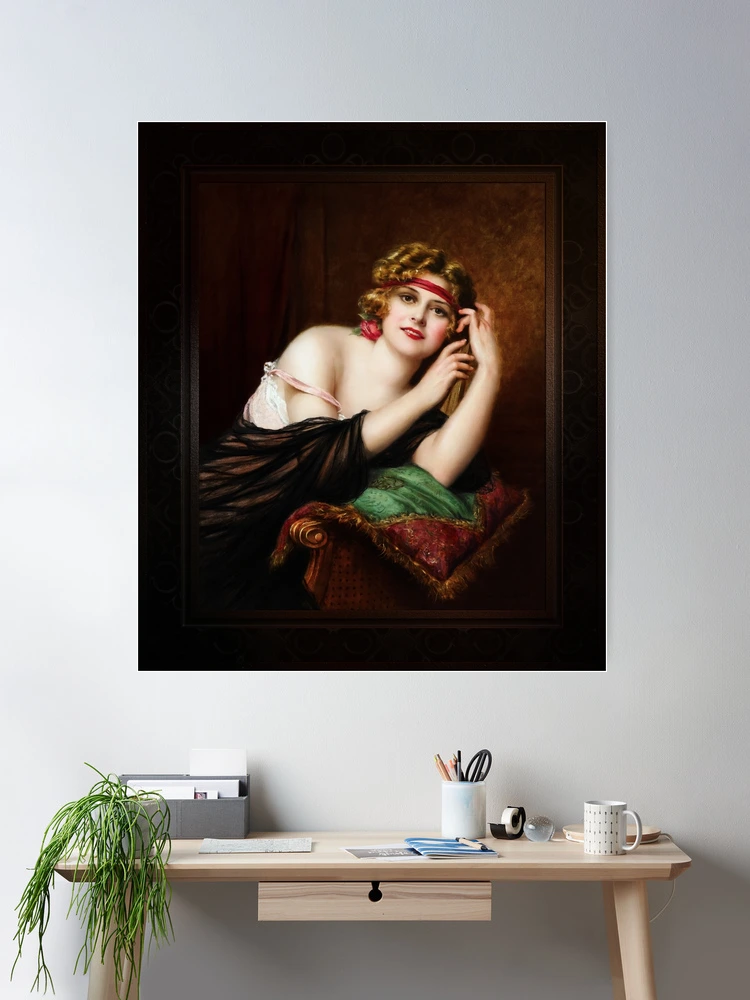
The central subject of the portrait is a woman who is seated gracefully, her gaze directed slightly away from the viewer. Her delicate posture and elegant demeanor are immediately striking. She sits on a richly adorned cushion, with a luxurious, muted green and gold fabric draped over her lap, adding a sense of opulence to the composition. Her left arm is bent gently, resting on the cushion, while her right hand is poised near her head as she adjusts the red ribbon that adorns her wavy, blonde hair. This gesture not only conveys a moment of quiet elegance but also highlights the fine details in the subject’s hair, which is meticulously painted to give it volume and texture.
Her expression is soft yet inviting, with a slight, knowing smile that adds an air of mystery and warmth to the overall mood. The subtle contrast of her pale skin against the dark background draws attention to her features, further emphasizing the artist’s ability to create harmony and balance in his works.
Asusteet ja asusteet
The woman in the portrait is dressed in a luxurious, semi-transparent gown made from fine materials. Her attire includes a soft, pink ribbon that rests just above her shoulder and contrasts against the dark, flowing fabric draped across her body. The gown appears to be partially off the shoulder, a style that was fashionable during the late 19th century and evokes a sense of both sensuality and modesty. The artist has paid careful attention to the fabric, capturing its light, delicate texture as it catches the light, which helps convey the richness of the materials used.
Her accessories, including the red ribbon in her hair, provide a subtle but vibrant pop of color against the otherwise soft tones of the portrait. The use of such a detail not only gives the painting an extra layer of depth but also draws attention to the subject’s refined appearance and attention to detail.
Background and Setting
The background of the portrait is dark and understated, using muted brown and sepia tones. This choice of background serves to highlight the subject, making her the focal point of the piece. It creates a strong contrast with the woman’s pale complexion, further enhancing her presence in the composition. The softness of the background suggests a sense of tranquility and quiet intimacy, allowing the viewer to focus solely on the woman’s elegant pose and the intricate details of her attire.
While there are no elaborate objects or intricate scenery in the background, the artist uses the cushion and the fabric beneath the subject to convey a sense of luxury and comfort. The subtle gradients and shading in the background reflect the artist’s mastery of light and shadow, drawing the viewer’s attention toward the subject without overwhelming the scene with unnecessary detail.
Tyyli ja tekniikka
François Martin-Kavel’s style is characterized by his attention to detail and his ability to capture the softness and refinement of his subjects. The painting reflects the academic traditions of the time, with its focus on lifelike portrayal and an emphasis on elegance. The smooth brushwork, particularly in the rendering of the skin and fabric, creates a sense of realism while maintaining a romanticized atmosphere.
Martin-Kavel’s use of light is also significant in the painting. The soft interplay of light and shadow enhances the texture of the fabric and skin, creating a three-dimensionality that brings the portrait to life. The shadows around the subject’s figure add depth to the composition, while the subtle highlights on her face and hands draw attention to the most delicate features, giving the viewer an intimate glimpse into the woman’s serene beauty.
The overall mood of the portrait is one of elegance and grace. It embodies the ideals of femininity and refinement that were celebrated during the turn of the century. The artist’s choice to depict the subject in a moment of quiet contemplation adds a layer of emotional depth, as if the woman is lost in thought or reflecting on something personal. This adds an element of intrigue, inviting the viewer to imagine her story and the world she inhabits.
Teema ja mieliala
The theme of the painting centers on beauty, eleganssi, ja naisellisuus. It captures a moment of timeless grace, emphasizing the inner strength and delicate nature of the subject. The mood is tranquil, seesteinen, and contemplative, inviting the viewer to appreciate the quiet allure of the woman in the portrait. There is no urgency in her expression or posture; sen sijaan, she embodies a sense of poise and confidence, which is enhanced by the artist’s careful rendering of her features and attire.
The use of muted tones in the background and the rich, opulent fabrics in the foreground also contribute to the overall theme of refinement and luxury. The viewer is invited to not only admire the subject’s beauty but to also appreciate the artist’s skill in capturing a moment of elegance that transcends time.
Johtopäätös
François Martin-Kavel’s “Portrait of an Elegant Woman” is a stunning representation of late 19th-century French portraiture. The artist’s technical mastery and attention to detail bring the subject to life, highlighting the softness of the fabrics, the smoothness of the skin, and the intricate details of the accessories. The portrait captures the timeless beauty of femininity, creating a narrative of grace, tasapainoa, and contemplation. Tämän maalauksen kautta, Martin-Kavel invites the viewer into a world of elegance, where the subject’s quiet strength and delicate charm resonate with timeless appeal.
Tämä on retusoitu digitaalisen taiteen vanhojen mestareiden kopio julkisesta kuvasta.
Taiteilija Bio on johdettu Artnet.com
François Martin-Kavel oli ranskalainen genretaidemaalari, joka tunnetaan parhaiten idealisoiduista muotokuvistaan kauniista nuorista naisista, joita hän usein kuvasi eksoottisissa puvuissa tai vaativissa riisuutumistiloissa.
Martin-Kavel maalasi usein naiskuviaan keskitettyihin sävellyksiin, joita ympäröi tumma kangastausta, ja teatraalisesti valaistu ikään kuin mallissa loistava kohdevalo.
Vaikka François tunnetaan suosituista naishahmoistaan, hän oli myös tunnettu asetelmistaan ja taidemaalauksistaan; ja oli säännöllinen näytteilleasettaja Salon des Artistes Françaisissa.
Salongin jäsenenä, hänelle myönnettiin mitali taiteellisesta panoksestaan 1881.