

Portrait d'Anna Elizabeth Hansen
Le “Portrait d'Anna Elizabeth Hansen” est une représentation exquise du style et de la maîtrise du célèbre peintre italien Giovanni Boldini (1842 – 1931). Ce portrait est une représentation élégante du modèle, Anna Elizabeth Hansen, capturé dans un moment de grandeur posée. Boldini, connu pour son travail au pinceau dynamique et sa capacité à évoquer l'élégance de la haute société à l'époque de la Belle Époque, imprègne cette œuvre de son approche distinctive de la capture de la lumière, texture, et personnalité. Le portrait reflète non seulement l’esthétique à la mode de l’époque mais révèle également la beauté raffinée du sujet et sa grâce aux yeux de l’artiste..
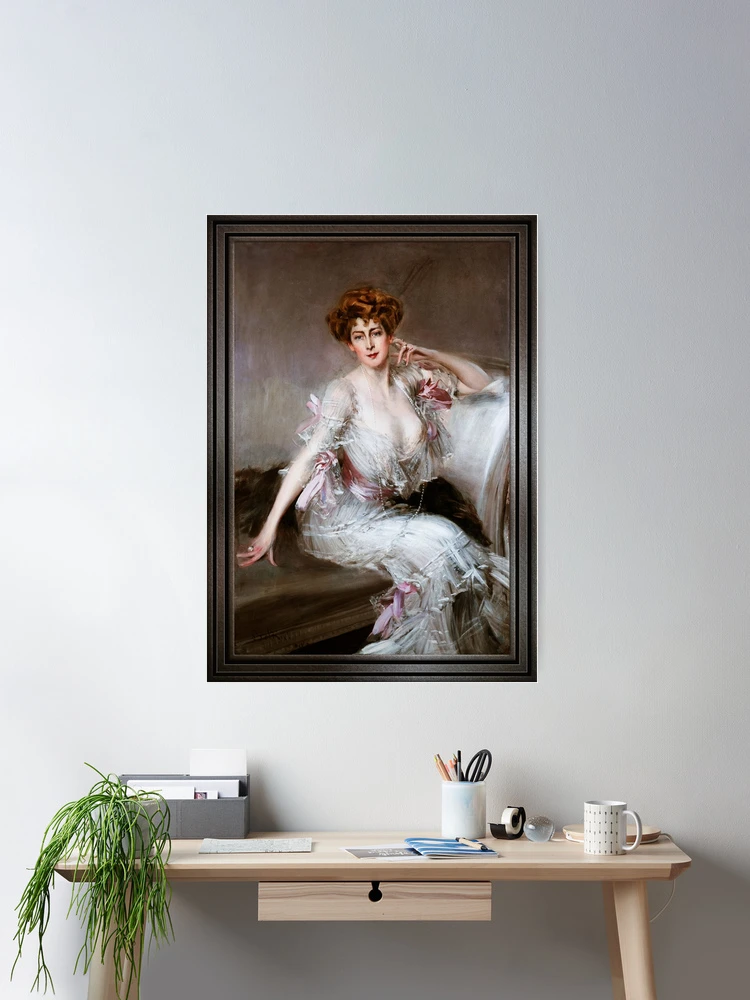
Table des matières
Le sujet et la composition
Le sujet du portrait, Anna Elizabeth Hansen, est assis dans une pose sereine et confiante. Son corps est positionné légèrement vers la gauche, bien qu'elle regarde directement vers le spectateur avec un air de calme et de contemplation. L'artiste a habilement capturé les traits de son visage, soulignant ses yeux délicatement dessinés et sa forte mâchoire, qui dégagent un sentiment à la fois de sérénité et de force.
Ses cheveux auburn sont coiffés doucement., avec des vrilles lâches tombant gracieusement pour encadrer son visage, suggérant à la fois l'ordre et un soupçon de désarroi naturel qui adoucit son apparence royale. L’expression du modèle est calme et sophistiquée, pourtant son sourire subtil invite à une connexion plus profonde avec l'observateur, donner au portrait une qualité intime et engageante.
L'utilisation par l'artiste de couleurs vives et de coups de pinceau fluides est évidente dans la robe luxueuse que porte Anna.. La robe, composé de tissus blanc pâle et ivoire, coule sans effort avec les courbes douces de son corps. Le talent de Boldini pour représenter la texture est pleinement visible ici, car il restitue magistralement l’éclat délicat du tissu et la qualité éthérée de la robe en soie.
La robe est ornée de rubans rose tendre qui ajoutent une touche de chaleur et de féminité à la composition., contrastant magnifiquement avec les tons froids de sa tenue vestimentaire et l'arrière-plan environnant. Le doux rougissement des rubans, avec le drapé de la robe, est souligné par le balayage, mouvement presque fluide des coups de pinceau de l’artiste.
Le décor dans lequel Anna est représentée est simple mais sophistiqué. Il n'y a pas d'arrière-plan complexe ou distrayant; plutôt, l'atmosphère du portrait est définie par un indéfini, toile de fond légèrement ombragée, qui attire l'attention sur le sujet sans rivaliser pour la mise au point. Cette technique renforce l’intimité de la composition et garantit que le regard du spectateur est entièrement fixé sur le sujet..
Style artistique et techniques
Giovanni Boldini était connu pour sa capacité à capturer les personnalités et les caractéristiques de ses sujets à travers un style expressif et fluide.. Ses portraits de la fin du XIXe et du début du XXe siècle sont célèbres pour leurs représentations vivantes de l’élite à la mode de la Belle Époque., mêlant réalisme et qualité presque onirique. Dans ce portrait d'Anna Elizabeth Hansen, Boldini emploie le martinet, des gestes qui sont devenus sa marque de fabrique, capturer non seulement la ressemblance de son sujet mais aussi son essence.
One of Boldini’s defining features in his work is his use of dynamic brushwork, which here evokes a sense of movement. While the subject is seated in a quiet, composed manner, the painter’s brushstrokes seem to suggest an inner vitality, creating a sense of fluidity that animates the canvas.
The texture of the fabric, the softness of the flesh tones, and the glossiness of her jewelry are all meticulously articulated through these energetic brushstrokes, creating a sense of immediacy in the work. Boldini’s light touch in areas such as the sitter’s face and the flowing folds of her gown contrasts with his more deliberate strokes in detailing the pearls and the delicate flowers of her attire. Cet équilibre de traits énergiques et contrôlés est l’une des caractéristiques du portrait de Boldini., lui permettant de transmettre à la fois la grâce et le mouvement.
Dans le portrait, l’interaction de la lumière et de l’ombre est une autre caractéristique déterminante du travail de Boldini. La lumière tombe doucement sur le visage d’Anna Elizabeth Hansen, projetant des ombres douces sur ses pommettes et soulignant les contours de son visage et de son cou. Ce jeu de lumière nuancé confère au portrait une qualité presque tridimensionnelle, élever le réalisme du modèle tout en conservant un élément de l'idéalisé.
Humeur et atmosphère
L'ambiance du tableau est celle d'une élégance tranquille et d'une sophistication., caractéristique des échelons supérieurs de la société européenne au début du XXe siècle. L’attitude posée du modèle suggère une confiance intérieure, one that may be a reflection of her social status or simply an innate grace. pourtant, there is also a subtle play of emotions captured in her expression, which suggests a thoughtful, introspective personality. This delicate balance between poise and vulnerability is perhaps what gives the portrait its enduring power.
The neutral tones of the background further contribute to the sense of calm and refinement. Boldini’s masterful control over his palette ensures that the colors do not overwhelm but instead work together to create a harmonious atmosphere that allows the subject to shine. The soft contrasts between the light and dark areas, along with the graceful curves of the sitter’s posture and gown, give the composition a sense of timelessness. Ce portrait, like many of Boldini’s works, transmet un sentiment de beauté éphémère, celui qui capture un moment dans le temps, mais semble éternel dans son exécution.
Conclusion
Le “Portrait d'Anna Elizabeth Hansen” est un exemple frappant de la capacité de Giovanni Boldini à combiner mode, personnalité, et une technique magistrale en un seul, image évocatrice. Par son utilisation dynamique des coups de pinceau et son rendu exceptionnel de la lumière et des textures, Boldini donne vie à l'élégance et au raffinement de sa gardienne. Ce portrait témoigne des prouesses du peintre et de sa sensibilité aux nuances de l’émotion humaine et du statut social.. C'est une œuvre qui capture non seulement la ressemblance physique d'Anna Elizabeth Hansen, mais reflète également l'esprit d'une époque définie par l'élégance et la sophistication..
Ce Portrait D'Anna Elizabeth Hansen est une reproduction de maîtres anciens d'art numérique retouchée d'une image du domaine public.
Biographie de l'artiste dérivée de Wikipedia.org
Boldini est né à Ferrare, L'Italie en décembre 31, 1842, au fils d'un peintre de sujets religieux. Dans 1862 à l'âge de 20, il est allé à Florence pendant six ans pour étudier et poursuivre la peinture.
Il n'a suivi que rarement des cours à l'Académie des Beaux-Arts, mais à Florence, rencontré d'autres peintres réalistes connus sous le nom de Macchiaioli, qui étaient les précurseurs italiens de l'impressionnisme.
Leur influence se voit dans les paysages de Boldini qui montrent sa réponse spontanée à la nature, même si c'est pour ses portraits qu'il est devenu le plus connu
Déménager à Londres, Boldini a atteint le succès en tant que portraitiste. Il a réalisé des portraits de membres de premier plan de la société, dont Lady Holland et la duchesse de Westminster..
Dans 1872 il a déménagé à Paris, où il rencontre et se lie d'amitié avec Edgar Degas. À la fin du XIXe siècle, il devient le portraitiste le plus en vogue de Paris., avec un style de peinture fringant qui met en évidence une partie de l'influence Macchiaioli et un brio qui rappelle le travail des jeunes artistes, tels que John Singer Sargent et Paul Helleu.
Dans 1889, il a été nommé commissaire de la section italienne de l'Exposition de Paris, et reçu la Légion d'honneur pour cette nomination. Dans 1897 il a eu une exposition solo à New York City; et il a également participé à la Biennale de Venise en 1895, 1903, 1905, et 1912.