

Portrait Of Anna Elizabeth Hansen
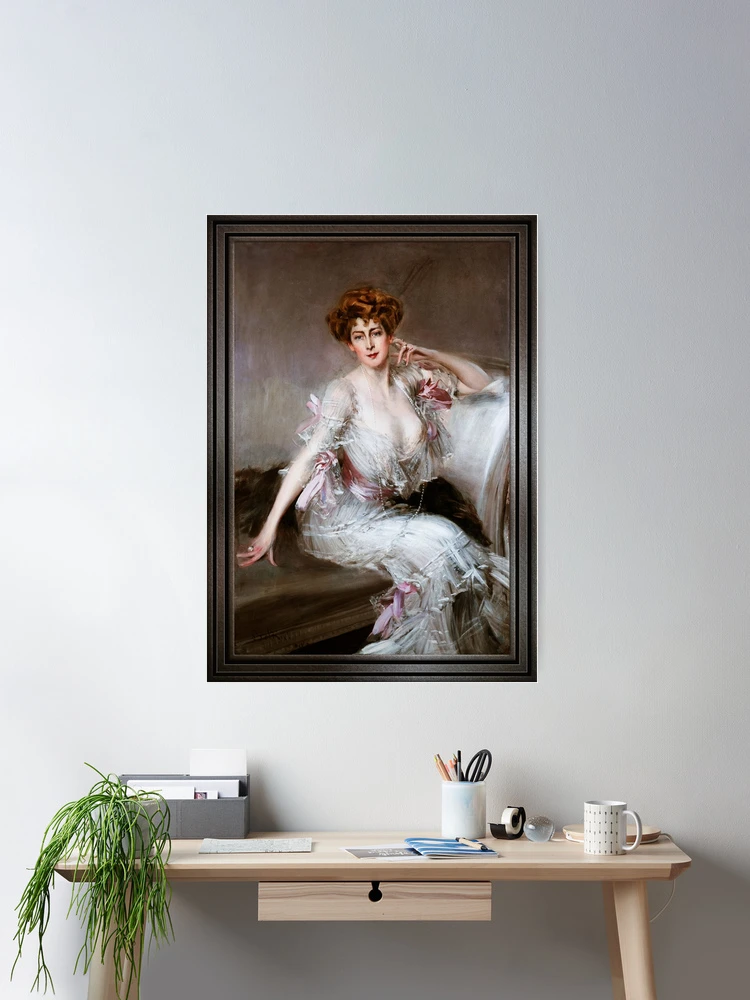
Tá an “Portráid of Anna Elizabeth Hansen” is an exquisite representation of the style and mastery of the renowned Italian painter Giovanni Boldini (1842 – 1931). This portrait is an elegant portrayal of the sitter, Anna Elizabeth Hansen, captured in a moment of poised grandeur. Boldini, known for his dynamic brushwork and ability to evoke the elegance of high society during the Belle Époque era, imbues this work with his distinctive approach to capturing light, uigeacht, and personality. The portrait reflects not only the fashionable aesthetic of the period but also reveals the subject’s refined beauty and her grace in the eyes of the artist.
Clár na nÁbhar
An tÁbhar agus Comhdhéanamh
The subject of the portrait, Anna Elizabeth Hansen, sits in a serene and confident pose. Her body is positioned slightly to the left, though she gazes directly toward the viewer with an air of quiet composure and contemplation. The artist has skillfully captured her facial features, emphasizing her delicately drawn eyes and strong jawline, which exude a sense of both serenity and strength.
Her auburn hair is styled in a softly swept-up manner, with loose tendrils falling gracefully to frame her face, suggesting both order and a hint of natural disarray that softens her regal appearance. The sitter’s expression is calm and sophisticated, yet her subtle smile invites a deeper connection with the observer, giving the portrait an intimate and engaging quality.
The artist’s use of vibrant colors and fluid brushstrokes is evident in the luxurious gown Anna wears. An gúna, composed of pale white and ivory fabrics, flows effortlessly with the soft curves of her body. Boldini’s talent for depicting texture is on full display here, as he masterfully renders the fabric’s delicate sheen and the ethereal quality of the silken dress.
The gown is adorned with soft pink ribbon accents that add a touch of warmth and femininity to the composition, contrasting beautifully with the cool tones of her attire and the surrounding background. The soft blush of the ribbons, along with the drape of the gown, is emphasized by the sweeping, almost fluid motion of the artist’s brushstrokes.
The setting in which Anna is portrayed is simple yet sophisticated. There is no complex or distracting background; ina ionad, the atmosphere of the portrait is defined by an undefined, softly shaded backdrop, which draws attention to the subject without competing for focus. This technique enhances the intimacy of the composition and ensures that the viewer’s gaze is fixed entirely on the subject.
Artistic Style and Techniques
Giovanni Boldini was known for his ability to capture the personalities and characteristics of his subjects through an expressive and fluid style. His portraits from the late 19th and early 20th centuries are celebrated for their vivid depictions of the Belle Époque’s fashionable elite, blending realism with an almost dreamlike quality. In this portrait of Anna Elizabeth Hansen, Boldini employs the swift, gestural strokes that became his trademark, capturing not only the likeness of his subject but also her essence.
One of Boldini’s defining features in his work is his use of dynamic brushwork, which here evokes a sense of movement. While the subject is seated in a quiet, composed manner, the painter’s brushstrokes seem to suggest an inner vitality, creating a sense of fluidity that animates the canvas.
The texture of the fabric, the softness of the flesh tones, and the glossiness of her jewelry are all meticulously articulated through these energetic brushstrokes, creating a sense of immediacy in the work. Boldini’s light touch in areas such as the sitter’s face and the flowing folds of her gown contrasts with his more deliberate strokes in detailing the pearls and the delicate flowers of her attire. This balance of energetic and controlled strokes is one of the hallmarks of Boldini’s portraiture, allowing him to convey both grace and motion.
In the portrait, the interplay of light and shadow is another defining characteristic of Boldini’s work. The light falls gently on Anna Elizabeth Hansen’s face, casting soft shadows across her cheekbones and highlighting the contours of her face and neck. This nuanced play of light lends the portrait an almost three-dimensional quality, elevating the realism of the sitter while maintaining an element of the idealized.
Giúmar agus Atmaisféar
The mood of the painting is one of quiet elegance and sophistication, characteristic of the upper echelons of European society in the early 20th century. The sitter’s composed demeanor suggests an inner confidence, one that may be a reflection of her social status or simply an innate grace. ach, there is also a subtle play of emotions captured in her expression, which suggests a thoughtful, introspective personality. This delicate balance between poise and vulnerability is perhaps what gives the portrait its enduring power.
The neutral tones of the background further contribute to the sense of calm and refinement. Boldini’s masterful control over his palette ensures that the colors do not overwhelm but instead work together to create a harmonious atmosphere that allows the subject to shine. The soft contrasts between the light and dark areas, along with the graceful curves of the sitter’s posture and gown, give the composition a sense of timelessness. An phortráid seo, like many of Boldini’s works, conveys a sense of fleeting beauty, one that captures a moment in time, yet feels eternal in its execution.
Conclúid
Tá an “Portrait of Anna Elizabeth Hansen” is a striking example of Giovanni Boldini’s ability to combine fashion, personality, and a masterful technique into a single, evocative image. Through his dynamic use of brushstrokes and his exceptional rendering of light and texture, Boldini brings to life the elegance and refinement of his sitter. This portrait stands as a testament to the painter’s prowess and his sensitivity to the nuances of human emotion and social status. It is a work that not only captures the physical likeness of Anna Elizabeth Hansen but also reflects the spirit of an era defined by elegance and sophistication.
Seo Portráid Is é atá in Anna Elizabeth Hansen ná seanmháistrí ealaíne digití atá á athachtú ar íomhá fearainn phoiblí.
Ealaíontóir Bith Díorthaithe Ó Wikipedia.org
Rugadh Boldini i Ferrara, An Iodáil ar Nollaig 31, 1842, do mhac péintéir ábhair reiligiúnaigh. I 1862 ag aois 20, chuaigh sé go Florence ar feadh sé bliana chun staidéar a dhéanamh agus dul sa tóir ar phéintéireacht.
Is annamh a d’fhreastail sé ar ranganna in Acadamh na nEalaíon Mín, ach i bhFlórans, bhuail siad le péintéirí réalaíocha eile ar a dtugtar na Macchiaioli, a bhí ina réamhtheachtaithe Iodáilis ar an Impriseanachas.
Feictear a dtionchar i dtírdhreacha Boldini a léiríonn a fhreagairt spontáineach don dúlra, cé gur mar gheall ar a phortráidí a tháinig sé chun aithne is fearr
Ag bogadh go Londain, D'éirigh go maith le Boldini mar phortráidí. Chríochnaigh sé portráidí de phríomhbhaill na sochaí lena n-áirítear Lady Holland agus Bandiúc Westminster.
I 1872 bhog sé go Páras, áit ar bhuail sé agus ar tháinig sé i gcairdeas le Edgar Degas. I ndeireadh an 19ú haois bhí sé ar an bpéintéir portráid is faiseanta i bPáras, le stíl ghrinn péintéireachta a leagann béim ar chuid de thionchar Macchiaioli agus brio i gcuimhne ar shaothar ealaíontóirí níos óige, mar shampla John Singer Sargent agus Paul Helleu.
I 1889, ainmníodh é mar choimisinéir ar roinn na hIodáile den Paris Exposition, agus fuair sé an Légion blianahonneur don cheapachán seo. I 1897 bhí taispeántas aonair aige i gCathair Nua Eabhrac; agus ghlac sé páirt freisin i Biennale na Veinéise i 1895, 1903, 1905, agus 1912.