

Portrett af stórhertogaynjunni Alexandru Iosifovnu
Portrett af stórhertogaynjunni Alexandru Iosifovnu (1830 – 1911) c1859 eftir þýskan málara Franz Xaver Winterhalter (1805 – 1873); þekktur fyrir andlitsmyndir sínar af kóngafólki um miðja nítjándu öld og eldri bróður þýska málarans Hermann Fidel Winterhalter (1808 – 1891).
Þetta er glæsileg portrett af stórhertogaynjunni Alexandru Iosifovnu, fædd prinsessa af Saxe-Altenburg (Portrett af Großfürstin Alexandra Iosifowna, geb. Prinsessa af Saxe-Altenburg).
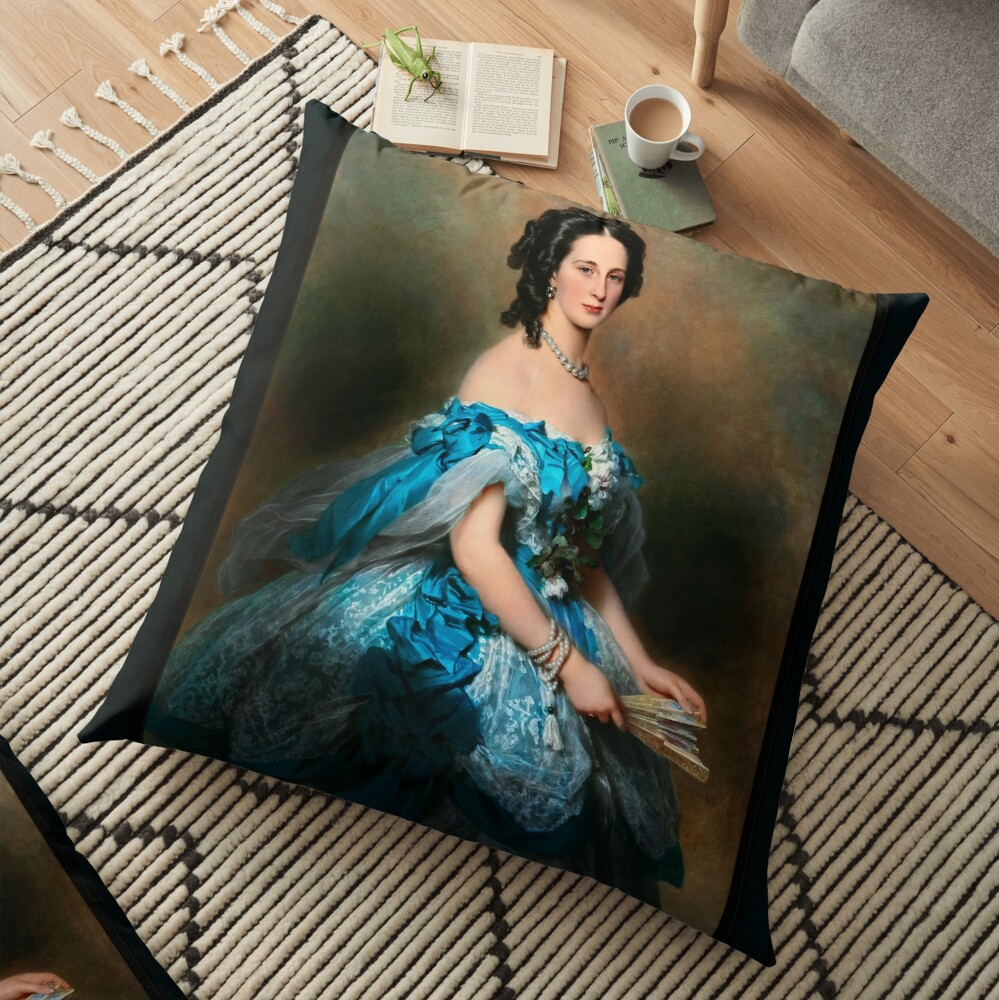
Hún er í þriggja fjórðu sniði standandi stellingu með hægri öxl snýr að áhorfandanum, staðsett fyrir framan marglitan vegg með tveimur stórum dökkum blettum sem ramma hana inn með einum aftan á og hinn fyrir framan mitti hennar.
She is adorned in a a lavish off shoulder blue dress with large silk ribbon accents along the sides, shoulders and as edge trim; with an additional embroidered white sheer overlay and a very light blue linen shawl, with added white and blue flowers that are placed at the center chest that go down to her waist.
She is also wearing large diamond earrings, a large pearl necklace and a wrap around pearl bracelet with a blue gemstone connected to a silk tassel on her right wrist, a gold ring with an embedded ruby on the fourth finger of her right hand; which is also holding a gold accented foldable fan.
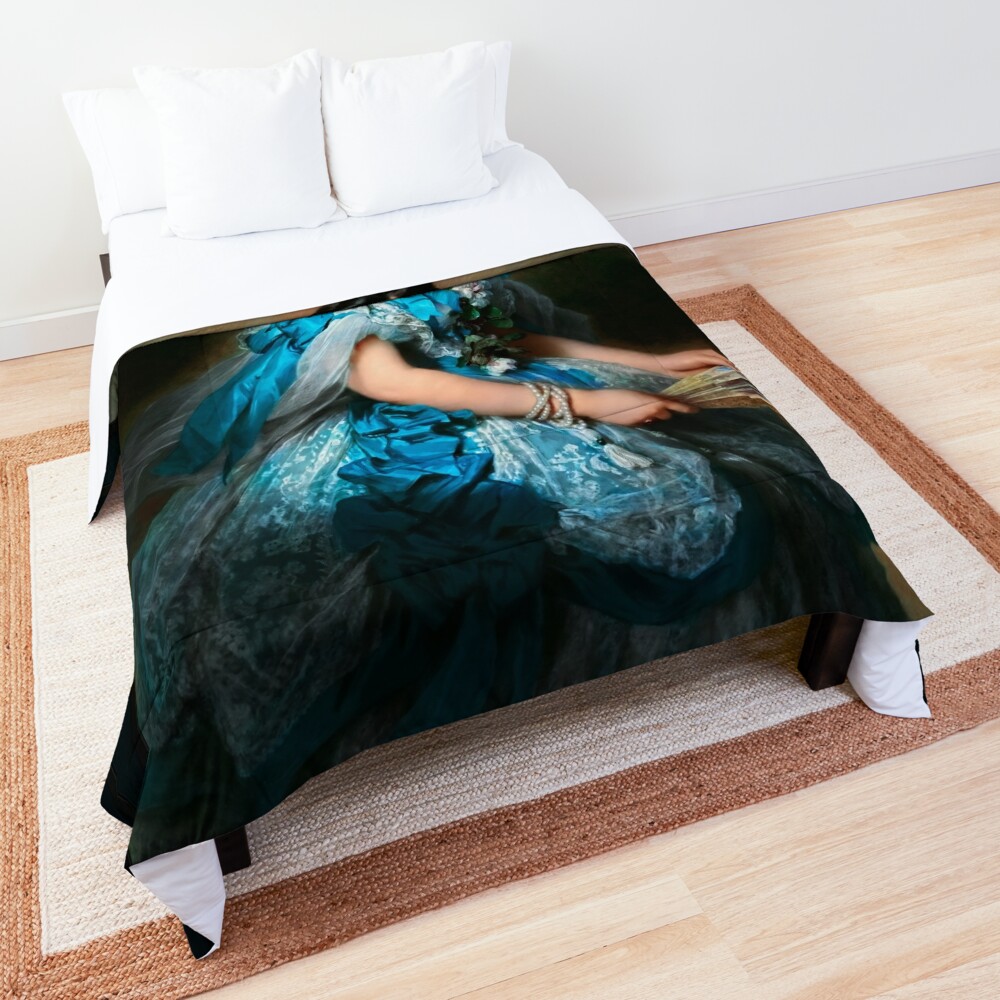
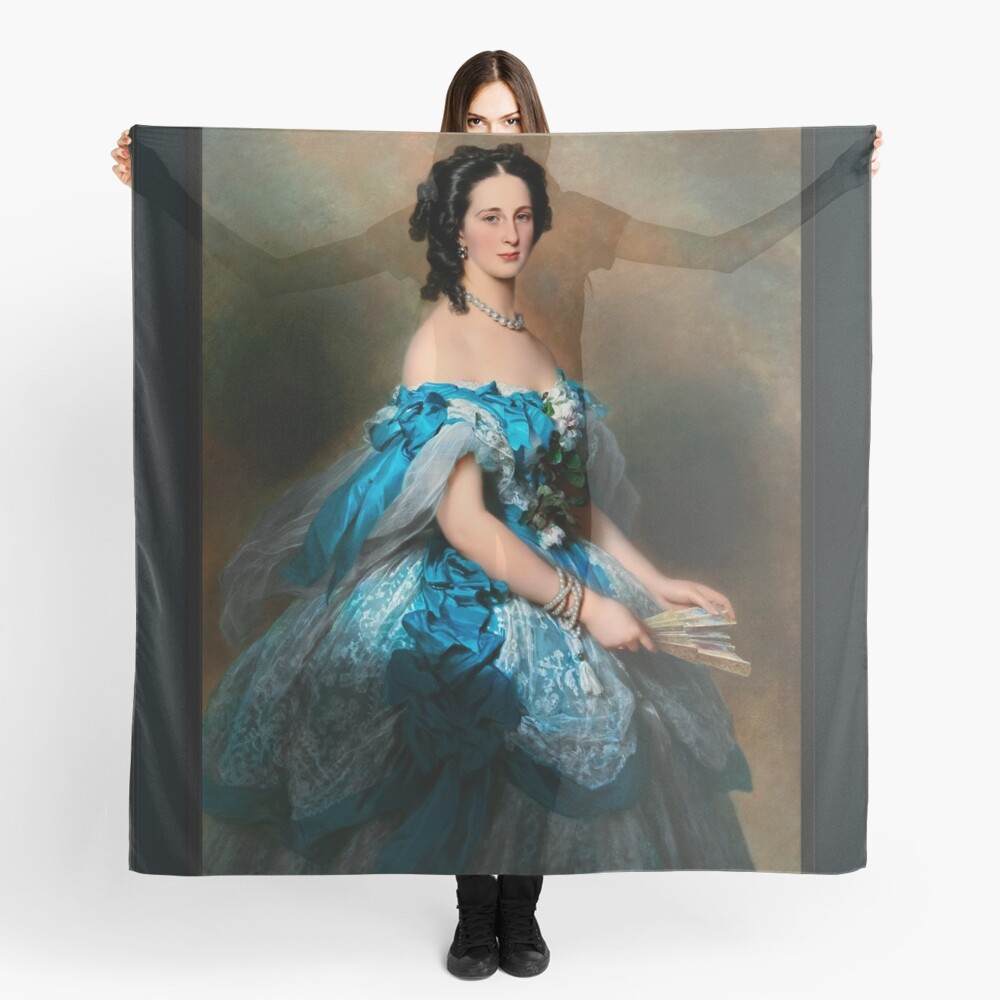
Portrait of Grand Duchess Alexandra Iosifovna is a remastered digital art old masters reproduction of a public domain image that is available as a strigaprentun á netinu.
Upplýsingar hér að neðan fengnar af Wikipedia.org
Franz Xaver Winterhalter was born in the small village of Menzenschwand, (nú hluti af Sankt Blasien), í Svartaskógi Þýskalands í kjördæminu Baden, apríl 20, 1805.
He was the sixth child of Fidel Winterhalter (1773 – 1863), a farmer and resin producer in the village, and his wife Eva Meyer (1765 – 1838), a member of a long established Menzenschwand family.
His father was of peasant stock and was a powerful influence in his life. Of the eight brothers and sisters, only four survived infancy.
Throughout his life Franz Xaver remained very close to his family, in particular to his brother Hermann (1808 – 1891), sem einnig var málari.
After attending school at a Benedictine monastery in St. Blasien, Winterhalter left Menzenschwand in 1818 á aldrinum 13 to study drawing and engraving.
He trained as a draughtsman and lithographer in the workshop of Karl Ludwig Schüler (1785 – 1852) in Freiburg im Breisgau. Í 1823, á aldrinum 18, he went to Munich, sponsored by the industrialist Baron von Eichtal (1775 – 1850).
Í 1825, he was granted a stipend by Ludwig I, Grand Duke of Baden (1763 – 1830) and began a course of study at the Academy of Arts in Munich with Peter von Cornelius (1783 – 1867), whose academic methods made him uncomfortable.
Winterhalter found a more congenial mentor in the fashionable portraitist Joseph Karl Stieler (1781 – 1858). During this time, he supported himself working as lithographer.
Winterhalter entered court circles when in 1828 he became drawing master to Sophie Margravine of Baden, at Karlsruhe.
His opportunity to establish himself beyond southern Germany came in 1832 when he was able to travel to Italy, with the support of Grand Duke Leopold of Baden.
In Rome he composed romantic genre scenes in the manner of Louis Léopold Robert and attached himself to the circle of the director of the French Academy, Horace Vernet.
On his return to Karlsruhe he painted portraits of the Grand Duke Leopold of Baden and his wife, and was appointed painter to the grand-ducal court.
Nevertheless, he left Baden and move to France, where his Italian genre scene Il dolce Farniente attracted notice at the Salon of 1836, and a year later he won praise for his painting Il Decameron; both of these paintings are academic compositions in the style of Raphael.
In the Salon of 1838 he exhibited a portrait of the Prince of Wagram with his young daughter; and soon after that his career as a portrait painter was secured, when in the same year he painted Louise Marie of Orleans, Queen of the Belgians, and her son.
It was probably through this painting that Winterhalter came to the notice of Maria Amalia of the Two Sicilies, Queen of the French, mother of the Queen of the Belgians.