

Portrait of Hortense Mancini Duchesse de Mazarin, as Aphrodite
Jacob Ferdinand Voet‘s (1639 – 1689) “Ritratto di Hortense Mancini (1646 – 1699), Duchesse de Mazarin, as Aphrodite,” created around 1675, presents a striking and graceful depiction of Hortense Mancini, one of the most celebrated women of her time. Born into the illustrious Mancini family, she was the niece of Cardinal Mazarin, and her life was marked by intrigue, ricchezza, and beauty. Voet’s painting exemplifies the opulence of the late 17th century, particularly the French court’s fascination with classical mythology, combining both her aristocratic status and mythological grandeur. Hortense Mancini is portrayed as Aphrodite, the goddess of love, bellezza, è desideriu, a figure whose essence permeates the entire composition.
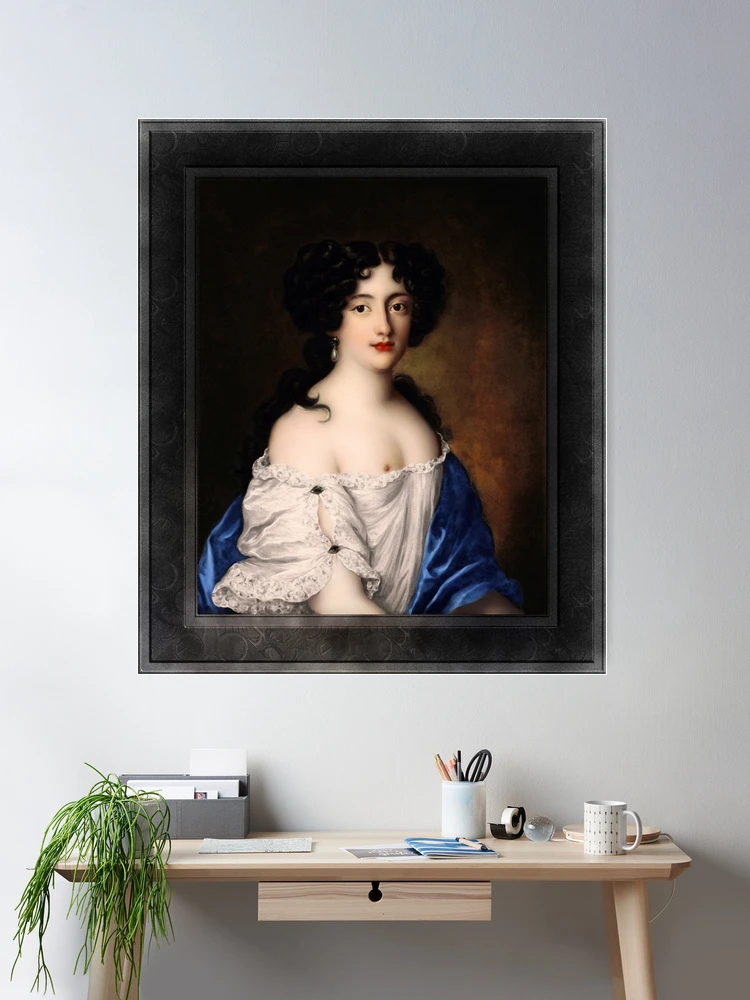
Table of Contents
Subject and Composition
The central figure of the painting, Hortense Mancini, is the epitome of refined elegance. She is depicted with soft yet assertive poise, her gaze meeting the viewer with a sense of subtle confidence. Voet carefully captures her beauty, infusing the painting with a sense of nobility and mythological grandeur. Hortense’s classical features, including a high forehead, labbra pienu, and well-shaped eyes, are meticulously rendered, adding an ethereal quality to the portrait.
U so vestitu, a striking combination of rich fabrics, is an immediate visual focus. The loose, partially draped gown, made from a shimmering white material, is held together by delicate clasps, creating an illusion of effortless luxury. The gown’s neckline is open and flowing, its folds evoking the natural movement of fabric, which draws attention to the softness of the skin and the graceful contours of her body. The deep blue robe, draped over her shoulders and cascading down her back, contrasts beautifully with the white dress. It serves to highlight the goddess-like radiance that Hortense exudes, enhancing her role as Aphrodite.
Aphrodite is often depicted with flowing, voluminous hair, è quì, Voet adheres to this tradition. Hortense’s hair, dark and luxuriant, is styled in soft waves, flowing over her shoulders and further emphasizing her divine femininity. Her curls, meticulously painted, frame her face in a way that enhances the sensuality and softness of her expression.
To further emphasize her connection with the classical goddess, Voet includes subtle elements of the mythological world. A delicate pearl earring is visible in her ear, symbolizing both her wealth and divine status, while her hands rest gently on her gown, one hand slightly raised as though inviting the viewer into her world of beauty. These small yet significant details further elevate Hortense from a mere aristocratic subject to a symbolic embodiment of love and beauty.
U sfondate è u paràmetru
The background of the portrait remains intentionally subdued, with deep, dark hues that allow the figure of Hortense to emerge almost from the shadows. I ricchi, velvety tones of the backdrop are characteristic of many Flemish and Baroque portraits of the time. The lack of a clear, detailed setting allows the viewer to focus entirely on the figure of Hortense and her symbolic role as Aphrodite. The subtle interplay of light and shadow helps create a sense of depth, with light subtly illuminating the folds of her gown and her radiant face, enhancing her almost otherworldly presence.
While the background remains neutral, the overall composition evokes the idealized and mythological, much like the romanticized depictions of classical goddesses. Voet, much like other artists of his time, understood that portraits of aristocratic women were often not just representations of physical beauty but also reflections of their power, statutu, and symbolic roles in society.
Stile è tecnica artistica
Voet’s style reflects the Baroque tradition, with a focus on opulence, intricate detail, and emotional intensity. His rendering of texture, particularly in the depiction of fabrics, capelli, and skin, is masterful. The play of light on the different surfaces—glossy pearls, velvety fabric, and soft flesh—demonstrates his exceptional skill in capturing realism while still maintaining an idealized, almost dreamlike quality in the subject’s presentation.
The use of soft, blended brushstrokes creates a seamless transition between light and shadow, contributing to the overall sense of harmony in the composition. Voet’s technique is refined and meticulous, particularly evident in the way he captures the luminous quality of Hortense’s complexion, which contrasts beautifully with the darker hues of the background. The detail in her gown, especially the delicate folds, highlights the artist’s attention to the tactile quality of fabric, an important element in portraits from the Baroque period, where the representation of wealth was a key factor in symbolizing nobility.
Umore è tema
The mood of the portrait is one of quiet dignity, a delicate blend of sensuality and power. Hortense’s pose and expression suggest both vulnerability and control, inviting the viewer into a world where beauty transcends the ordinary. By casting her as Aphrodite, Voet elevates her image from that of an aristocratic woman to a figure of mythological significance. The themes of love, bellezza, and divine grace are interwoven throughout the painting, as Voet uses classical references to elevate the subject beyond her earthly role.
The portrait also suggests the complex and often contradictory nature of Hortense’s life. While she was celebrated for her beauty and status, her life was also marked by personal and political struggles. As Aphrodite, she becomes an idealized symbol of love and beauty, but this idealization also creates a distance from the complexities of her reality. The contrast between the idealized image and her actual life serves to deepen the emotional resonance of the painting, as it highlights the tension between appearance and reality that is often present in aristocratic portraiture.
Cunclusione
Jacob Ferdinand Voet’s “Portrait of Hortense Mancini as Aphrodite” is a stunning work that combines meticulous technical skill with deep symbolic meaning. Through the lens of classical mythology, Voet transforms Hortense into a timeless figure of beauty and love, elevating her to a status beyond the earthly realm. The rich textures, the dramatic use of light and shadow, and the serene yet powerful expression on Hortense’s face all contribute to a portrait that speaks to both her personal elegance and her mythological significance. It remains an exemplary piece of 17th-century portraiture, combining the baroque fascination with mythological symbolism with the personal grandeur of an aristocratic subject.
Storia di l'opera d'arte
This is a beautiful portrait of Hortense Mancini (Francese) or Ortensia Mancini (Talianu), the niece of Italian Cardinal Mazarin (1602 – 1661), diplomat, politician, and chief minister of France to the Kings of France Louis XIII and Louis XIV from 1642 finu à a so morte in 1661.
She was the mistress of Charles II, King of England, Scotland, and Ireland; and was the fourth of the five famous Mancini sisters, who along with two of their female Martinozzi cousins, were known at the court of King Louis XIV of France as the Mazarinettes.
In this portrait she is suppose to represent the Greek Goddess Aphrodite, the Goddess that is associated with love,pleasure, passion, beauty and procreation.
Questa hè una ripruduzzione di l'antichi maestri di l'arti digitale ritoccata di una maghjina di duminiu publicu.
Biografia di l'artista Cortesia Wikipedia.org
Pochi dettagli nantu à a prima vita di Voet, a furmazione è a carriera sò stati cunservati. Voet hè natu in Anversa cum'è u figliolu di u pittore Elias Voet. Era unu di i quindici figlioli; u so fratellu maiò Carlo si trasfirìu in Amsterdam è si maritò in 1661 una figliola di i ricchi Joan Coymans è Sophia Trip. Ghjacobbu lasciò a so Anversa nativa è viaghja in Roma induve ellu stava 1663 à 1680.
Voet hè diventatu un membru di i Bentvueghels, un'associu di artisti principalmente olandesi è fiamminghi attivu in Roma. Voet hà fattu un ritrattu in carbone di tutti i membri di i Bentvueghel nantu à u muru imbiancatu di una osteria in Roma chì era un locu pupulare di scontru di stu gruppu.. U ritrattu era abbastanza preziosu per esse risparmiatu ogni volta chì i mura eranu ridipinte.
In Roma, l'abilità di Voet cum'è ritrattista era assai dumandata à a corte papale è da l'aristocrazia romana., cumpresi i famiglii Colonna è Odescalchi prominenti. Hè statu patronatu da Christina, Regina di Svezia, chì era tandu residente in Roma. Pintò u so ritrattu cum'è quellu di u so amicu, Cardinal Azzolino. L'Inglesi è l'altri europei chì visitanu Roma in u so Grand Tour cumandanu ancu ritratti da Voet.
In 1671 – 1672 Voet hà ricivutu un incaricu da u Cardinal Chigi per pintà ritratti di giovani donne chì eranu prominenti in a sucità rumana. Hà creatu una prima serie di 37 ritratti di e donne più incantevoli di Roma ("Galleria di Bellezze") trà 1672 è 1678 per a sala di pranzu di u Cardinal Chigi in u so palazzu in Ariccia (in i colli Albani fora di Roma). Doppu copiò è ancu ingrandò a serie per altre famiglie nobili romane è taliane. Questu hà iniziatu una furia per i ritratti di e donne giovani in Roma è in l'esteru.