

Portrait of Louise-Antoinette-Scholastique Guéhéneuc with her Children
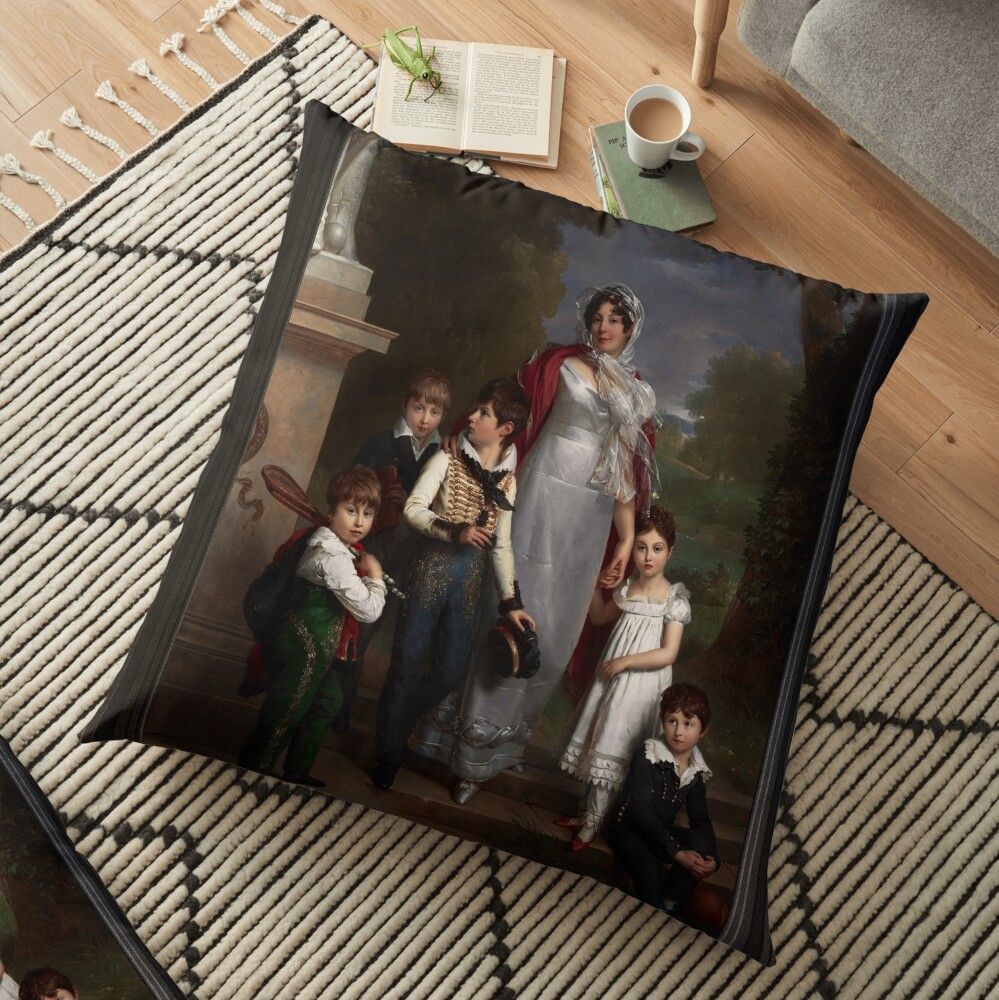
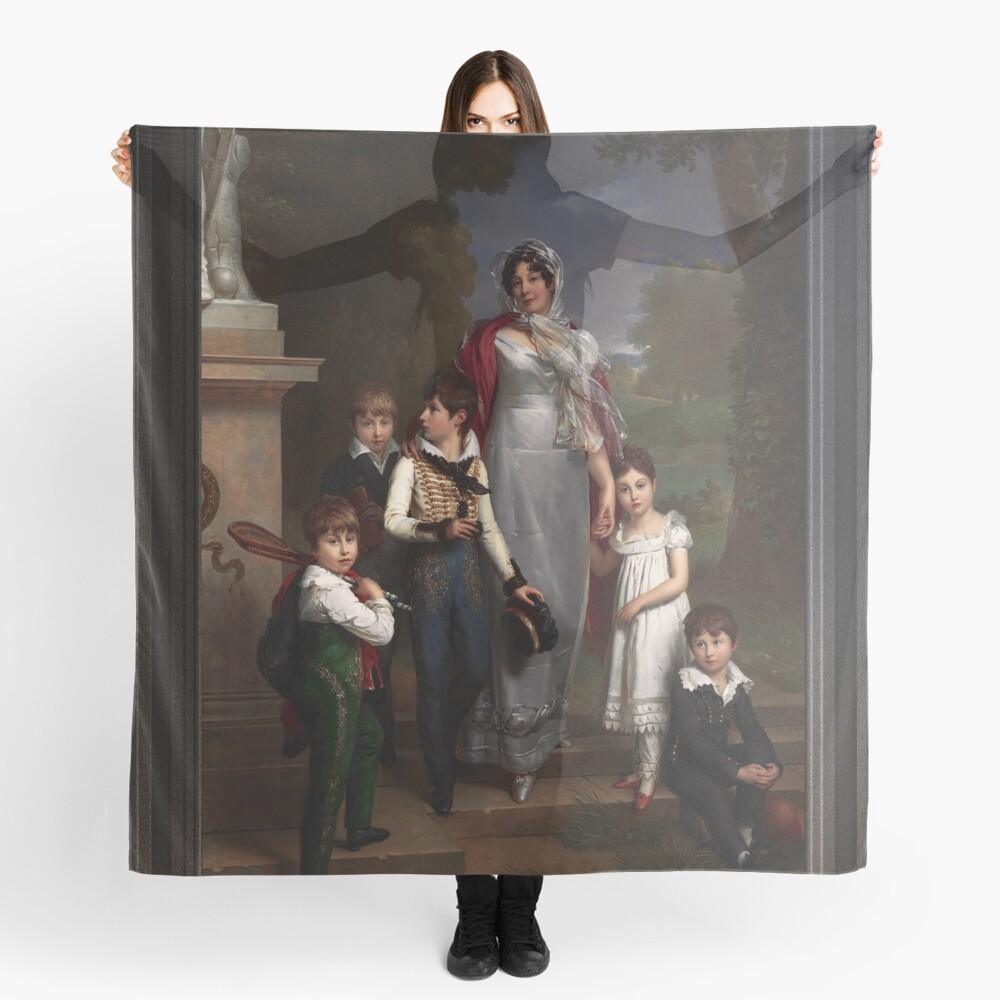
Retrato of Louise-Antoinette-Scholastique Guéhéneuc, Madame la Maréchale Lannes, Duchesse de Montebello, with her Children c1814 by French Painter Francois Pascal Simon Gérard (1770 – 1837); a prominent French painter who was named Baron of the Empire in 1809 by Emperor Napoleon; who was then known as Baron Gérard.

This is a family portrait of Louise-Antoinette-Scholastique Guéhéneuc with her 5 crianças; 4 boys and 1 girl standing around their mother; with a large expansive landscape in the background.
They are standing by a marble statue on marble steps with Louise holding her daughters hand on the left and with her right hand on her eldest sons shoulder on the right.
Her two other others sons are standing behind and in front of the eldest, while her youngest son sits to the left and in front of his sister.
Portrait of Louise-Antoinette-Scholastique Guéhéneuc with her Children is a retouched digital art old masters reproduction of a public domain image that is available online as a impressão em tela enrolada.
Informações abaixo de Wikipédia.org
François Gérard was born in Rome to J. S. Gérard and Cleria Matteï. At the age of twelve, Gérard obtained admission into the Pension du Roi in Paris. From the Pension, passou para o ateliê do escultor Augustin Pajou, que saiu ao final de dois anos para o ateliê do pintor histórico Nicolas-Guy Brenet, de quem ele saiu quase imediatamente para se colocar sob o comando de Jacques-Louis David.
Em 1789, ele competiu pelo Prix de Rome, que foi levado por seu camarada Girodet. No ano seguinte (1790), ele novamente se apresentou, mas a morte de seu pai impediu a conclusão de seu trabalho e obrigou-o a acompanhar sua mãe a Roma.
Em 1791, ele voltou para Paris, mas a sua pobreza era tão grande que ele foi forçado a abandonar os estudos em favor de um emprego que lhe traria lucro imediato..
David imediatamente aproveitou sua ajuda, e um dos retratos mais célebres daquele mestre, de Louis-Michel Le Pelletier de Saint-Fargeau, may owe much to the hand of Gérard.
This painting was executed early in 1793, the year in which Gérard, at the request of David, was named a member of the revolutionary tribunal, from the fatal decisions of which he, no entanto, invariably absented himself.
Em 1794, he obtained the first prize in a competition, the subject of which was The Tenth of August, that is, the storming of the Tuileries Palace. Further stimulated by the successes of his rival and friend Girodet in the Salons of 1793 e 1794, Gérard (aided by Jean-Baptiste Isabey, the miniaturist) produzido em 1795 his famous Bélisaire.
Em 1796, a portrait of his generous friend (conserved today in the Louvre) obtained undisputed success, and the money received from Isabey for these two works enabled Gérard to execute in 1797 his Psyche et l’Amour (ilustração).[4] At last, em 1799, his portrait of Madame Mère established his position as one of the foremost portrait-painters of the day.
Em 1808, as many as eight (e em 1810, no less than fourteen) portraits by him were exhibited at the Salon, and these figures afford only an indication of the enormous numbers which he executed yearly. All of the leading figures of the Empire and of the Bourbon Restoration, and all of the most celebrated men and women of Europe, sat for Gérard.
This extraordinary vogue was due partly to the charm of his manner and conversation, for his salon was as much frequented as his studio. Madame de Staël, George Canning, Talleyrand and the Duke of Wellington have all borne witness to the attraction of his society.
Rich and famous, Gérard was stung by remorse for earlier ambitions abandoned; at intervals, ele realmente se esforçou com Girodet e outros rivais para provar sua força na pintura histórica, ainda é um gênero mais prestigiado do que o retrato.
Sua Batalha de Austerlitz (1810) mostrou uma amplitude de invenção e estilo que foi ainda mais visível em L’Entrée d’Henri IV à Paris (em Versalhes), o trabalho com o qual 1817 ele prestou homenagem ao retornado Luís XVIII. Após esta data, Geraldo recusou, observando com dor impotente o progresso da escola romântica.
Carregado de honras – barão do Império em 1809, membro do Instituto de 7 Marchar 1812, oficial da Legião de Honra, primeiro pintor do rei - ele trabalhou em, triste e desanimado. A revolução de 1830 adicionado à sua inquietação, e assim por diante 11 Janeiro 1837, depois de três dias de febre, ele morreu.
Gérard é mais lembrado por seus retratos. A cor de suas pinturas sofreu, mas seus desenhos mostram com delicadeza ilesa a pureza de sua linha, e os das mulheres são especialmente notáveis por uma simplicidade virginal e franqueza de expressão. Seus alunos incluíram Heinrich Christoph Kolbe.