

Portret van Madame Badouin
Portret van Madame Badouin, De dochter van de kunstenaar c1758-60 door Franse schilder Francois Boucher (1703 – 1770); ook bekend als tekenaar, graveur en decorateur in de Franse Rococo-stijl, stond bekend om zijn uitbundige mythologische, allegorische en erotische motieven en was de hofschilder van Lodewijk XV en een favoriet van de markiezin de Pompadour.
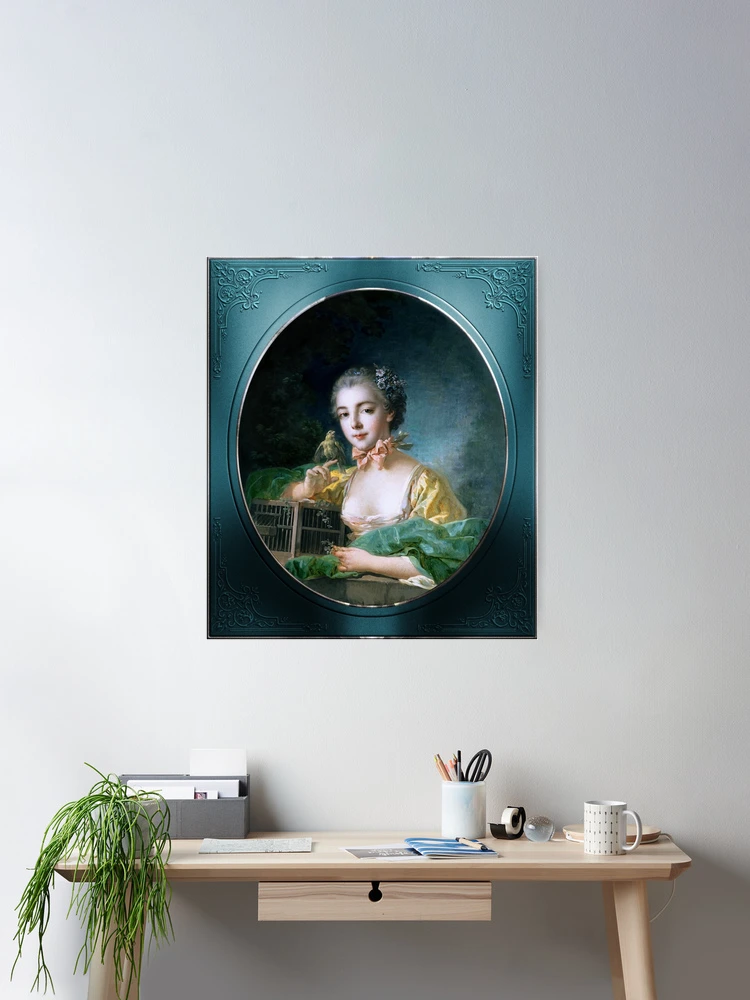
This artwork by the celebrated French Rococo painter François Boucher captures an exquisite moment of elegance and grace. This painting is a prime example of the Rococo style, which flourished in France during the early to mid-18th century, characterized by its lightness, elegantie, and use of soft, pastelkleuren.
The subject of the portrait is Madame Badouin, the artist’s daughter, who is depicted with remarkable sensitivity and beauty. De zachte, delicate nature of her features, her youthful countenance, and her serene expression all embody the grace and poise that were idealized in the Rococo period. The portrait has a gentle, intimate quality, inviting the viewer into the subject’s personal space.
In het midden van de compositie, Madame Badouin is presented in a three-quarter view, her head slightly turned as if she is caught in a moment of quiet contemplation. Her gaze is directed slightly off to the side, creating an impression of introspection, yet there is a subtle connection with the viewer, as if she is aware of being observed.
Her facial features are rendered with delicate precision: her fair skin is soft and smooth, her lips slightly parted in a demure expression, and her large, expressive eyes reflect a sense of intelligence and calm. The artist has emphasized the softness of her features, using subtle transitions between light and shadow to create a lifelike, almost ethereal appearance.
Madame Badouin’s attire is a masterful representation of the Rococo fashion of the time. She is dressed in an opulent gown of pale yellow and soft green hues, with layers of sheer fabric that flow gracefully around her. The gown’s texture is depicted with meticulous detail, showing the fine, almost weightless nature of the materials.
The artist has captured the flow and drape of the fabric with a sense of fluidity, suggesting the movement of the fabric as the subject sits serenely. A large pink ribbon is tied loosely at her throat, adding a touch of playful color that contrasts with the softness of the gown and further enhances the light, airy quality of the portrait.
Her coiffed hair, which is styled in soft waves and adorned with delicate flowers, is another hallmark of the Rococo period. The careful attention to detail in her hairstyle not only highlights the fashion trends of the time but also adds a sense of natural beauty, as though her appearance is effortlessly graceful. The flowers in her hair seem to symbolize youth and femininity, enhancing the overall sense of delicacy and refinement.
One of the most striking aspects of this portrait is the bird perched on the artist’s daughter’s finger. This small detail plays an important symbolic role in the painting, contributing to the overall theme of innocence and natural beauty.

The bird, with its muted plumage, contrasts with the lushness of the surrounding landscape and the softness of Madame Badouin’s attire. It also suggests a connection to nature, a recurring theme in Rococo art, which often celebrated the beauty of the natural world, the pastoral, and the idealized version of life in harmony with nature.
The background of the painting is equally carefully constructed. Achter de figuur, a dark, lush landscape unfolds, with trees and foliage softly blurring into the distance. The use of a rich, muted green palette creates an almost dreamlike effect, enhancing the ethereal mood of the portrait.
This natural setting not only contrasts with the softness of the figure but also symbolizes a connection between Madame Badouin and the world around her. The painter’s skillful rendering of light and shadow creates depth and atmosphere, giving the scene a tranquil, almost timeless quality.
The overall mood of the portrait is one of calm elegance. De kleuren zijn zacht en harmonieus, with pastel shades predominating in both the subject’s attire and the background. The figure is illuminated in such a way that the face and hands are gently highlighted, creating a subtle focal point that draws the viewer’s attention to the subject’s expression and demeanor. There is a serene quality to the painting, one that evokes the idealized virtues of youth, schoonheid, and grace that were central to the Rococo aesthetic.
François Boucher’s technique in this painting is exemplary of his mastery of the Rococo style. His brushwork is fluid and refined, creating a soft, luminous texture that enhances the delicate nature of the subject. His use of light and color is equally sophisticated, with the artist skillfully capturing the interplay of natural light and shadow on Madame Badouin’s face and clothing. The soft transitions between colors and the subtle blending of tones demonstrate Boucher’s expertise in creating a smooth, polished finish.
Tot slot, François Boucher “Portrait of Madame Badouin, The Artist’s Daughter” is a stunning example of Rococo portraiture, where the subject’s beauty, elegantie, and connection to nature are captured with sensitivity and elegance. The soft palette, delicate detailing, and serene mood of the painting convey the idealized qualities of youth and femininity that were highly valued during the Rococo period. Via dit portret, Boucher not only immortalizes his daughter but also provides a glimpse into the Rococo vision of beauty and refinement.
Portret van Madame Badouin is een geretoucheerde digitale kunst oude meesters reproductie van een afbeelding uit het publieke domein.
Info hieronder afgeleid van Wikipedia.org
Een inwoner van Parijs, Boucher was de zoon van een minder bekende schilder Nicolas Boucher, die hem zijn eerste artistieke opleiding gaf. Op de leeftijd van zeventien, een schilderij van Boucher werd bewonderd door de schilder François Lemoyne. Lemoyne benoemde later Boucher als zijn leerling, maar na slechts drie maanden, hij ging werken voor de graveur Jean-François Cars.
In 1720, hij won de elite Grand Prix de Rome voor schilderen, maar maakte pas vijf jaar later gebruik van de daaruit voortvloeiende kans om in Italië te studeren, vanwege financiële problemen bij de Koninklijke Academie voor Schilderkunst en Beeldhouwkunst.[1] Bij zijn terugkeer van zijn studie in Italië werd hij toegelaten tot de opnieuw opgerichte Académie de peinture et de sculpture on 24 november 1731. Zijn receptie stuk (receptie stuk) was zijn Rinaldo en Armida van 1734.
Boucher huwde Marie-Jeanne Buzeau in 1733. Het echtpaar kreeg samen drie kinderen. Boucher werd een faculteitslid in 1734 en zijn carrière versnelde vanaf dit punt toen hij werd gepromoveerd tot hoogleraar en vervolgens tot rector van de Academie, inspecteur worden bij de Royal Gobelins Manufactory en uiteindelijk Premier Peintre du Roi (Eerste schilder van de koning) in 1765. Portret van Marie-Louise O'Murphy c. 1752
Boucher stierf op 30 Kunnen 1770 in zijn geboorteland Parijs. Zijn naam, samen met die van zijn beschermheer Madame de Pompadour, synoniem was geworden met de Franse Rococo-stijl, de gebroeders Goncourt ertoe brengen te schrijven: “Boucher is een van die mannen die de smaak van een eeuw vertegenwoordigen, wie uiten, personifiëren en belichamen.”
Boucher staat erom bekend dat de natuur dat is “te groen en slecht verlicht” (te groen en slecht verlicht).
Boucher werd geassocieerd met de edelsteengraveur Jacques Guay, wie hij leerde tekenen. Hij begeleidde ook de Moravisch-Oostenrijkse schilder Martin Ferdinand Quadal en de neoklassieke schilder Jacques-Louis David in 1767.[4] Later, Boucher maakte een reeks tekeningen van werken van Guay, die Madame de Pompadour vervolgens graveerde en als een mooi gebonden boekdeel verspreidde onder bevoorrechte hovelingen