

Portrett af Charlotte prinsessu af Belgíu
Portrett af Charlotte prinsessu af Belgíu (1840 – 1927) c1845 eftir þýska málarann Franz Xaver Winterhalter (1805 – 1873); older brother of German painter Hermann Fidel Winterhalter (1808 – 1891), is known for his portraits of mid nineteenth century royalty.
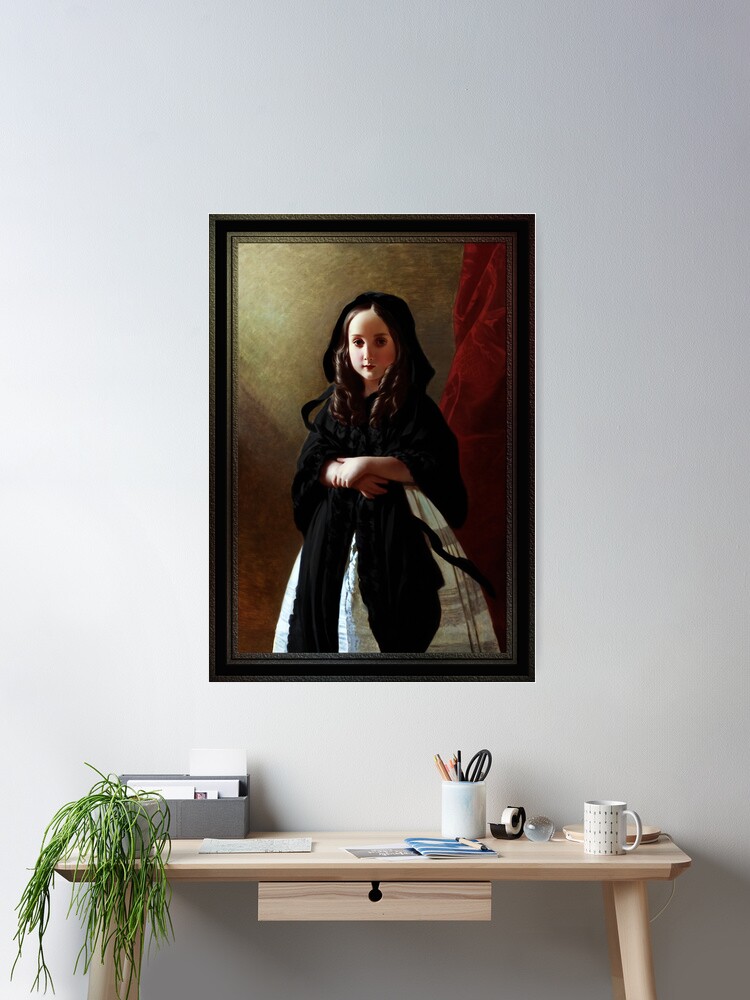
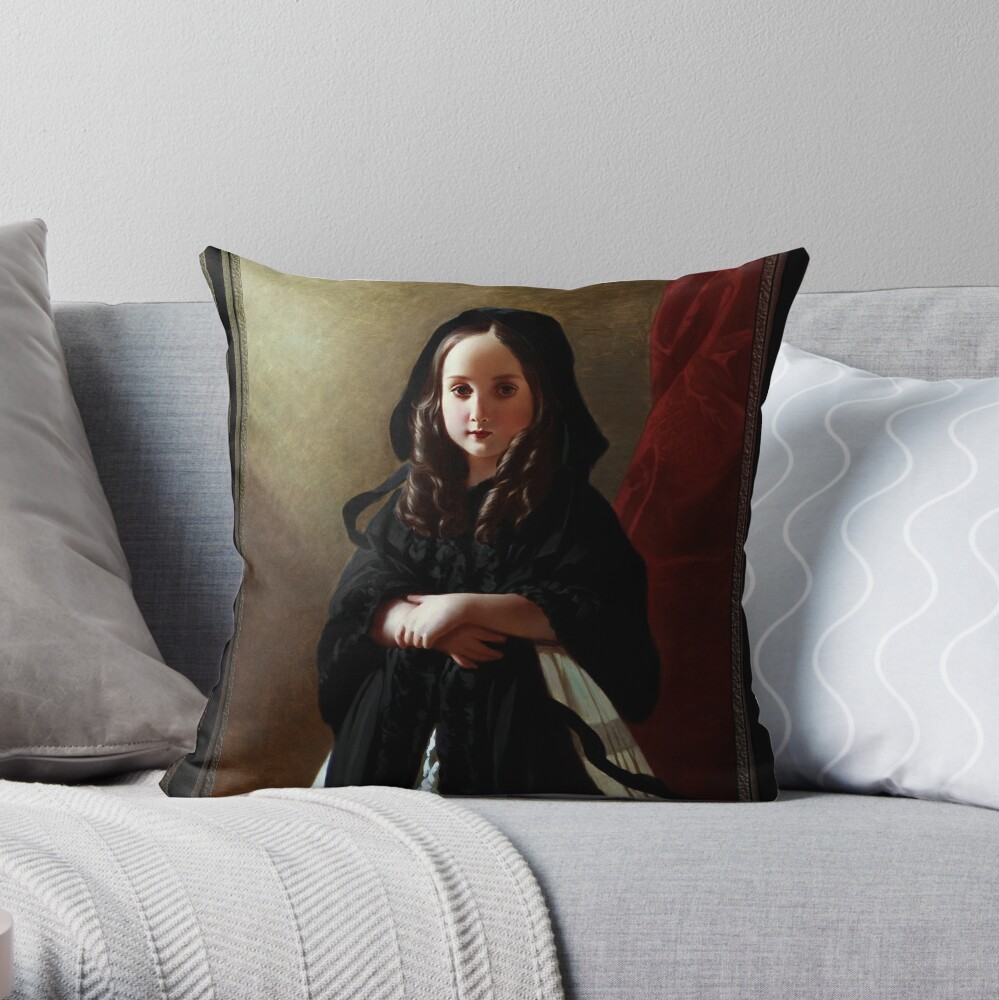
This is a Portrait of Charlotte prinsessa frá Belgíu as a young girl 5 ára aldri (I have another retouched artwork of her when she was 2 years of age on the site as well – use the link above); she is wearing a black hooded cloak of a white dress with with large horizontal stripes running around it.
Her long beautiful brown hair is partially revealed from under the cloak as she is illuminated by the light that is coming from her right side at a high angle with a large red velvet drape to the left behind her, as an accent piece.
This Portrait of Princess Charlotte of Belgium is a retouched digital art old masters reproduction of a public domain image, and as with all the artwork that can be found on the Xzendor7 website is available for purchase online in a variety of material formats including canvas prints, akrýl prentun, málmprentun, viðarprentanir, innrömmuð prentun, veggspjöld, og sem upprúlluð strigaprentun í ýmsum stærðum frá 12 tommur til 72 inches depending on the size of the actual artwork and the print on demand shop you choose to buy the art from..
Upplýsingar hér að neðan fengnar af Wikipedia.org
Franz Xaver Winterhalter was born in the small village of Menzenschwand, (nú hluti af Sankt Blasien), í Svartaskógi Þýskalands í kjördæminu Baden, á 20 apríl 1805. He was the sixth child of Fidel Winterhalter (1773–1863), a farmer and resin producer in the village, and his wife Eva Meyer (1765–1838), a member of a long established Menzenschwand family.
His father was of peasant stock and was a powerful influence in his life. Of the eight brothers and sisters, only four survived infancy. Throughout his life Franz Xaver remained very close to his family, in particular to his brother Hermann (1808–1891), sem einnig var málari.
After attending school at a Benedictine monastery in St. Blasien, Winterhalter left Menzenschwand in 1818 á aldrinum 13 to study drawing and engraving.[4] He trained as a draughtsman and lithographer in the workshop of Karl Ludwig Schüler (1785–1852) in Freiburg im Breisgau. Í 1823, á aldrinum 18, he went to Munich, sponsored by the industrialist Baron von Eichtal (1775–1850).
Í 1825, he was granted a stipend by Ludwig I, Grand Duke of Baden (1763–1830) and began a course of study at the Academy of Arts in Munich with Peter von Cornelius (1783–1867), whose academic methods made him uncomfortable. Winterhalter found a more congenial mentor in the fashionable portraitist Joseph Karl Stieler (1781–1858). During this time, he supported himself working as lithographer.
Winterhalter entered court circles when in 1828 he became drawing master to Sophie Margravine of Baden, at Karlsruhe.[6] His opportunity to establish himself beyond southern Germany came in 1832 when he was able to travel to Italy, 1833–1834, with the support of Grand Duke Leopold of Baden.
In Rome he composed romantic genre scenes in the manner of Louis Léopold Robert and attached himself to the circle of the director of the French Academy, Horace Vernet. On his return to Karlsruhe he painted portraits of the Grand Duke Leopold of Baden and his wife, and was appointed painter to the grand-ducal court.
Nevertheless, he left Baden to move to France, where his Italian genre scene Il dolce Farniente attracted notice at the Salon of 1836. Il Decameron a year later was also praised; both paintings are academic compositions in the style of Raphael. In the Salon of 1838 he exhibited a portrait of the Prince of Wagram with his young daughter.
His career as a portrait painter was soon secured when in the same year he painted Louise Marie of Orleans, Queen of the Belgians, and her son. It was probably through this painting that Winterhalter came to the notice of Maria Amalia of the Two Sicilies, Queen of the French, mother of the Queen of the Belgians.