

Portrét mladé dívky, která si myslela, že je princezna Essling
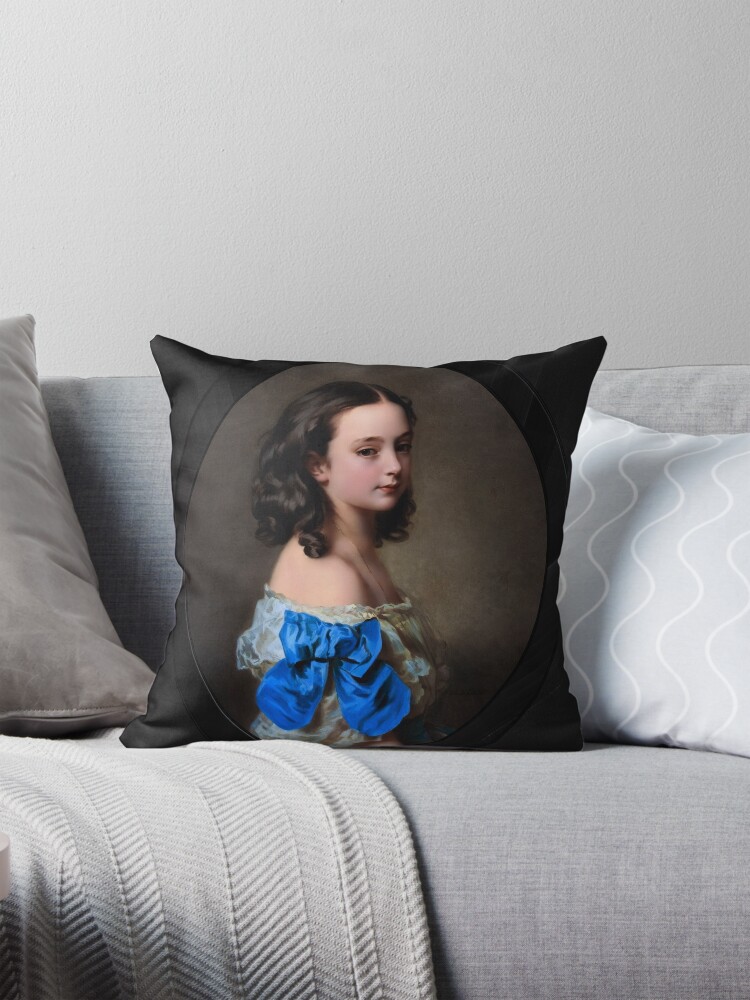
The portrait titled Portrait of a Young Girl Thought to Be Paula, Princezna Essling, Duchess of Rivoli, dated circa 1850, was created by the esteemed German-Swiss painter Hermann Winterhalter (1808 – 1891); mladší bratr portrétisty Franze Xavera Winterhaltera.
Known for his exquisite depictions of aristocratic figures and delicate portraits, Winterhalter captured the essence of high society through his refined techniques and detailed brushwork. Na tomto konkrétním portrétu, the artist conveys both the youthful innocence and noble grace of a young girl believed to be Paula, Princess Essling, Duchess of Rivoli, a prominent member of European aristocracy during the 19th century.
Obsah
Hlavní předmět: The Young Girl
The central focus of the painting is a young girl, her head turned slightly toward the viewer, presenting a demure yet confident gaze. She exudes an aura of quiet nobility, despite the simplicity of her attire. With soft curls framing her face, her youthful features are rendered with an extraordinary sense of realism, highlighting the artist’s skill in capturing delicate details.
The girl is portrayed with an air of gentle grace, suggesting a harmonious blend of innocence and maturity. Her gaze seems both contemplative and serene, offering a glimpse into the composure expected of one of her status. The delicacy of her expression is a hallmark of Winterhalter’s ability to portray his subjects not just as they appeared, but as they were perceived by the social elite of the time.
The young girl’s features are classical in style, her oval face, rosy cheeks, and soft lips embody the delicate beauty typical of aristocratic women in the mid-19th century. Její tma, voluminous hair is arranged in soft waves, cascading down her shoulders. The subtlety of Winterhalter’s work allows the viewer to feel the texture of her hair, as though one could almost reach out and touch the smooth, dark strands.
The Attire and Symbolism of Clothing
The girl is dressed in a soft, off-the-shoulder white gown, which is complemented by a large, striking blue bow tied at the back of her waist. This garment, while modest in design, speaks volumes about her social standing, as the quality of the fabric and the precision of the bow suggest fine craftsmanship and noble origins. The white gown, a common symbol of purity and grace, juxtaposed with the bold, yet refined blue bow, conveys an interesting balance between youthful innocence and the emerging authority that the girl will likely inherit in her adulthood.
The blue bow, central to her attire, serves as a key element of the composition. Its vibrant hue contrasts beautifully with the neutral tones of the dress, creating visual interest and drawing attention to the girl’s back and the curves of her form. In many aristocratic portraits of the era, such symbolic details in clothing were often used to accentuate the subject’s stature and to impart a sense of individuality. The meticulous treatment of the fabric and its placement further reinforces the sense of elegance and order that Winterhalter aimed to capture in his portraits.
The Mood and Atmosphere of the Portrait
The mood of the painting is one of quiet introspection. The girl’s expression, combined with her delicate attire and the smooth, serene background, creates an atmosphere that is both intimate and regal. The soft light falling across her face lends a subtle glow to her skin, further enhancing the youthful, angelic qualities of her features. This softness is contrasted by the formality of her clothing and her poised demeanor, suggesting that she is not merely a child, but someone being prepared for the weight of noble responsibilities.
The background is soft and unobtrusive, a pale, gradient wash of color that allows the viewer to focus entirely on the girl herself. The absence of detailed scenery or any distractions in the backdrop directs the attention to the subject’s face, emphasizing her expression and the nuanced way in which her character is conveyed. Winterhalter’s choice to keep the background minimal also ensures that the viewer remains engaged with the subject’s humanity, her delicate form highlighted against the simplicity of the space surrounding her.
The Technique and Materials
Winterhalter’s technique is characterized by its meticulous attention to detail and its smooth, almost flawless surface. His use of oil paints allows for depth in the rendering of light and shadow, creating a lifelike representation of the girl’s skin and the soft textures of her gown.
The portrait is imbued with a sense of realism that speaks to Winterhalter’s mastery of chiaroscuro—his ability to depict light and shadow in a way that adds dimensionality to the two-dimensional surface of the canvas.
The skin tones are rendered with a soft palette, giving the young girl an ethereal quality. The transitions between light and shadow on her face are subtle but precise, suggesting that Winterhalter had an acute understanding of human anatomy and the ways in which light interacts with different surfaces.
The delicate brushstrokes used for the hair convey its fine texture, while the folds of her gown are portrayed with a soft, yet careful hand, capturing the flow of the fabric as it drapes around her form.
Závěr: A Portrait of Youth and Nobility
v Portrait of a Young Girl Thought to Be Paula, Princess Essling, Duchess of Rivoli, Hermann Winterhalter encapsulates not only the physical beauty of the young girl but also the essence of aristocratic poise and refinement. The painting serves as a window into the world of European nobility during the 19th century, where youth and beauty were highly revered, yet accompanied by an underlying expectation of grace and responsibility.
Through his careful portrayal of this young girl, Winterhalter provides not just a likeness but a glimpse into the nobility of the era, presenting a figure poised to step into a world of authority while still possessing the innocence of childhood.
Portrét mladé dívky, která byla považována za princeznu Esslingovou, je retušovaná digitální umělecká reprodukce obrazu ve veřejném vlastnictví starých mistrů..
Životopis umělce
Info níže z Wikipedia.org
Franz Xaver Winterhalter se narodil v malé vesnici Menzenschwand, (nyní součástí Sankt Blasien), v německém Černém lese[1] v Bádenském kurfiřtství, na 20 duben 1805.[2] Byl šestým dítětem Fidela Winterhaltera (1773–1863), farmář a výrobce pryskyřice v obci, a jeho manželky Evy Meyerové (1765–1838), člen dlouho zavedené rodiny Menzenschwand.[2] Jeho otec byl rolníka a měl na jeho život velký vliv. Z osmi bratrů a sester, pouze čtyři přežili dětství. Franz Xaver byl po celý svůj život velmi blízko své rodině, zejména svému bratru Hermannovi (1808–1891), který byl také malířem.
Po návštěvě školy v benediktinském klášteře v St.. Blasien, Winterhalter nechal Menzenschwand 1818 ve věku 13 studovat kresbu a rytí.[4] Vyučil se kreslířem a litografem v dílně Karla Ludwiga Schülera (1785–1852) ve Freiburgu im Breisgau. v 1823, ve věku 18, odjel do Mnichova, sponzorovaný průmyslníkem baronem von Eichtal (1775–1850).
v 1825, od Ludwiga I. mu bylo uděleno stipendium, Velkovévoda badenský (1763–1830) a zahájil studium na Akademii umění v Mnichově u Petera von Cornelius (1783–1867), jehož akademické metody mu byly nepříjemné. Winterhalter našel příjemnějšího mentora v módním portrétistovi Josephu Karlovi Stielerovi (1781–1858). Během této doby, živil se jako litograf.
Winterhalter vstoupil do soudních kruhů, když byl dovnitř 1828 stal se kreslířským mistrem Sophie Margravine z Badenu, v Karlsruhe.[6] Jeho příležitost prosadit se mimo jižní Německo přišla 1832 když mohl cestovat do Itálie, 1833–1834, za podpory velkovévody Leopolda z Badenu. V Římě skládal romantické žánrové scény na způsob Louise Léopolda Roberta a připojil se ke kruhu ředitele Francouzské akademie, Horace Vernet. Po návratu do Karlsruhe namaloval portréty velkovévody Leopolda z Badenu a jeho manželky, a byl jmenován malířem velkovévodského dvora.
Nicméně, opustil Baden, aby se přestěhoval do Francie, kde jeho italská žánrová scéna Il dolce Farniente upoutala pozornost v Salonu 1836. Il Decameron o rok později byl také chválen; oba obrazy jsou akademické kompozice ve stylu Raphaela. V salonu 1838 vystavil portrét prince z Wagramu se svou malou dcerou.
Jeho kariéra portrétisty byla brzy zajištěna, když v témže roce namaloval Louise Marie Orleánskou, Královna Belgičanů, a jejího syna. Pravděpodobně díky tomuto obrazu se Winterhalter dostal k Marii Amalii z Obojí Sicílie, Francouzská královna, matka belgické královny.