

Muotokuva nuoresta tytöstä, jonka ajateltiin olevan prinsessa Essling
The portrait titled Portrait of a Young Girl Thought to Be Paula, Prinsessa Essling, Duchess of Rivoli, dated circa 1850, was created by the esteemed German-Swiss painter Hermann Winterhalter (1808 – 1891); muotokuvamaalari Franz Xaver Winterhalterin nuorempi veli.
Known for his exquisite depictions of aristocratic figures and delicate portraits, Winterhalter captured the essence of high society through his refined techniques and detailed brushwork. Tässä nimenomaisessa muotokuvassa, the artist conveys both the youthful innocence and noble grace of a young girl believed to be Paula, Prinsessa Essling, Duchess of Rivoli, a prominent member of European aristocracy during the 19th century.
Sisällysluettelo
Pääaihe: The Young Girl
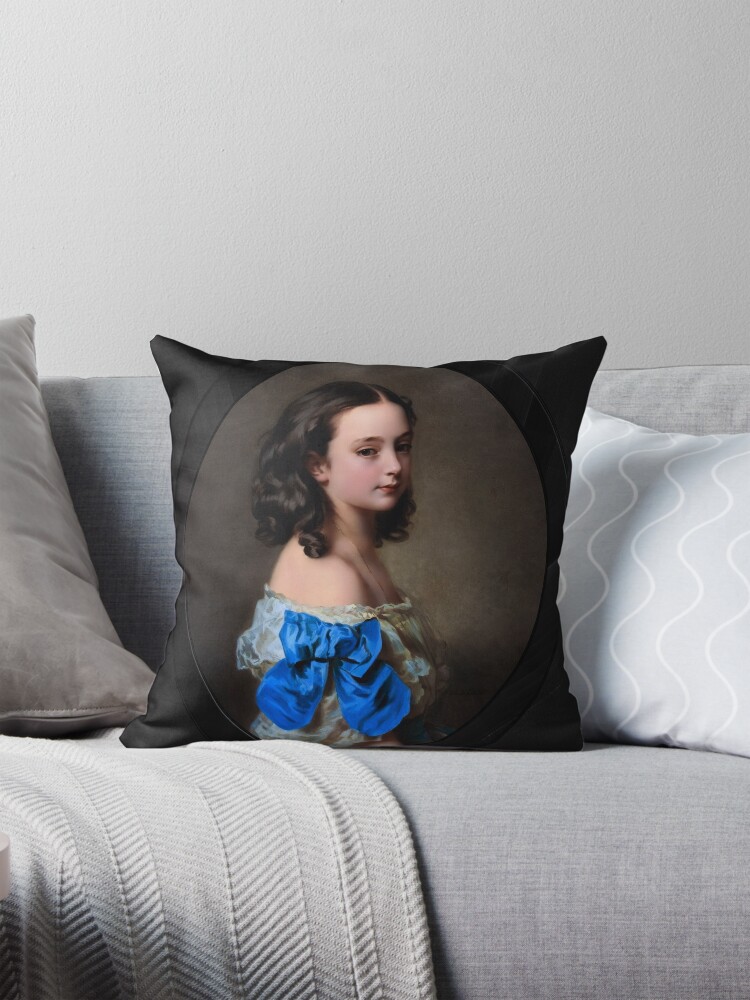
The central focus of the painting is a young girl, her head turned slightly toward the viewer, presenting a demure yet confident gaze. She exudes an aura of quiet nobility, despite the simplicity of her attire. With soft curls framing her face, her youthful features are rendered with an extraordinary sense of realism, highlighting the artist’s skill in capturing delicate details.
The girl is portrayed with an air of gentle grace, suggesting a harmonious blend of innocence and maturity. Her gaze seems both contemplative and serene, offering a glimpse into the composure expected of one of her status. The delicacy of her expression is a hallmark of Winterhalter’s ability to portray his subjects not just as they appeared, but as they were perceived by the social elite of the time.
The young girl’s features are classical in style, her oval face, rosy cheeks, and soft lips embody the delicate beauty typical of aristocratic women in the mid-19th century. Hänen tumma, voluminous hair is arranged in soft waves, cascading down her shoulders. The subtlety of Winterhalter’s work allows the viewer to feel the texture of her hair, as though one could almost reach out and touch the smooth, dark strands.
The Attire and Symbolism of Clothing
The girl is dressed in a soft, off-the-shoulder white gown, which is complemented by a large, striking blue bow tied at the back of her waist. This garment, while modest in design, speaks volumes about her social standing, as the quality of the fabric and the precision of the bow suggest fine craftsmanship and noble origins. The white gown, a common symbol of purity and grace, juxtaposed with the bold, yet refined blue bow, conveys an interesting balance between youthful innocence and the emerging authority that the girl will likely inherit in her adulthood.
The blue bow, central to her attire, serves as a key element of the composition. Its vibrant hue contrasts beautifully with the neutral tones of the dress, creating visual interest and drawing attention to the girl’s back and the curves of her form. In many aristocratic portraits of the era, such symbolic details in clothing were often used to accentuate the subject’s stature and to impart a sense of individuality. The meticulous treatment of the fabric and its placement further reinforces the sense of elegance and order that Winterhalter aimed to capture in his portraits.
The Mood and Atmosphere of the Portrait
The mood of the painting is one of quiet introspection. The girl’s expression, combined with her delicate attire and the smooth, serene background, creates an atmosphere that is both intimate and regal. The soft light falling across her face lends a subtle glow to her skin, further enhancing the youthful, angelic qualities of her features. This softness is contrasted by the formality of her clothing and her poised demeanor, suggesting that she is not merely a child, but someone being prepared for the weight of noble responsibilities.
The background is soft and unobtrusive, a pale, gradient wash of color that allows the viewer to focus entirely on the girl herself. The absence of detailed scenery or any distractions in the backdrop directs the attention to the subject’s face, emphasizing her expression and the nuanced way in which her character is conveyed. Winterhalter’s choice to keep the background minimal also ensures that the viewer remains engaged with the subject’s humanity, her delicate form highlighted against the simplicity of the space surrounding her.
The Technique and Materials
Winterhalter’s technique is characterized by its meticulous attention to detail and its smooth, almost flawless surface. His use of oil paints allows for depth in the rendering of light and shadow, creating a lifelike representation of the girl’s skin and the soft textures of her gown.
The portrait is imbued with a sense of realism that speaks to Winterhalter’s mastery of chiaroscuro—his ability to depict light and shadow in a way that adds dimensionality to the two-dimensional surface of the canvas.
The skin tones are rendered with a soft palette, giving the young girl an ethereal quality. The transitions between light and shadow on her face are subtle but precise, suggesting that Winterhalter had an acute understanding of human anatomy and the ways in which light interacts with different surfaces.
The delicate brushstrokes used for the hair convey its fine texture, while the folds of her gown are portrayed with a soft, yet careful hand, capturing the flow of the fabric as it drapes around her form.
Johtopäätös: A Portrait of Youth and Nobility
Sisään Portrait of a Young Girl Thought to Be Paula, Prinsessa Essling, Duchess of Rivoli, Hermann Winterhalter encapsulates not only the physical beauty of the young girl but also the essence of aristocratic poise and refinement. The painting serves as a window into the world of European nobility during the 19th century, where youth and beauty were highly revered, yet accompanied by an underlying expectation of grace and responsibility.
Through his careful portrayal of this young girl, Winterhalter provides not just a likeness but a glimpse into the nobility of the era, presenting a figure poised to step into a world of authority while still possessing the innocence of childhood.
Nuoren tytön muotokuva, jonka ajateltiin olevan prinsessa Essling, on retusoitu digitaalisen taiteen vanhojen mestarien kopio julkisesta kuvasta.
Taiteilijabio
Tiedot alla Wikipedia.org
Franz Xaver Winterhalter syntyi pienessä Menzenschwandin kylässä, (nyt osa Sankt Blasienia), Saksan Schwarzwaldissa[1] Badenin vaalilautakunnassa, päällä 20 huhtikuu 1805.[2] Hän oli Fidel Winterhalterin kuudes lapsi (1773- 1863), viljelijä ja hartsin tuottaja kylässä, ja hänen vaimonsa Eva Meyer (1765- 1838), vakiintuneen Menzenschwand -perheen jäsen.[2] Hänen isänsä oli talonpoikaista ja hänellä oli voimakas vaikutus hänen elämäänsä. Kahdeksasta veljestä ja sisaresta, vain neljä selviytyi lapsuudesta. Franz Xaver pysyi koko elämänsä ajan hyvin lähellä perhettään, erityisesti veljelleen Hermannille (1808–1891), joka oli myös maalari.
Koulun jälkeen benediktiiniläisessä luostarissa St.. Blasien, Winterhalter jätti Menzenschwandin sisään 1818 iässä 13 opiskelemaan piirtämistä ja kaiverruksia.[4] Hän valmistui piirtäjäksi ja litografiksi Karl Ludwig Schülerin työpajassa (1785- 1852) Freiburg im Breisgaussa. Sisään 1823, iässä 18, hän meni Müncheniin, sponsoroi teollisuusmies Baron von Eichtal (1775- 1850).
Sisään 1825, Ludwig I myönsi hänelle stipendin, Badenin suurherttua (1763- 1830) ja aloitti opinnot Münchenin taideakatemiassa Peter von Corneliuksen johdolla (1783- 1867), jonka akateemiset menetelmät tekivät hänestä epämukavan. Winterhalter löysi miellyttävämmän mentorin muodikkaasta muotokuvaaja Joseph Karl Stieleristä (1781–1858). Tänä aikana, hän tuki itseään litografina.
Winterhalter tuli tuomioistuimen piireihin sisään tullessaan 1828 hänestä tuli piirustusmestari Sophie Margravine Badenista, Karlsruhessa.[6] Hänen tilaisuutensa sijoittua Etelä -Saksan ulkopuolelle tuli 1832 kun hän matkusti Italiaan, 1833- 1834, Badenin suuriruhtinas Leopoldin tuella. Roomassa hän sävelsi romanttisia genre -kohtauksia Louis Léopold Robertin tapaan ja liittyi Ranskan akatemian johtajan piiriin, Horace Vernet. Palattuaan Karlsruheen hän maalasi muotokuvia Badenin suurherttuasta Leopoldista ja hänen vaimostaan, ja hänet nimitettiin maalariksi suurherttuakunnassa.
tästä huolimatta, hän lähti Badenista muuttaakseen Ranskaan, jossa hänen italialainen genre -kohtaus Il dolce Farniente herätti huomiota Salon of 1836. Il Decameron vuotta myöhemmin sai myös kiitosta; Molemmat maalaukset ovat Raphaelin tyylistä akateemisia sävellyksiä. Salonissa 1838 hän esitteli muotokuvan Wagramin prinssistä nuoren tyttärensä kanssa.
Hänen uransa muotokuvamaalarina varmistettiin pian, kun samana vuonna hän maalasi Louise Marie Orleansista, Belgian kuningatar, ja hänen poikansa. Todennäköisesti tämän maalauksen kautta Winterhalter huomasi Maria Amalian kahdesta Sisiliasta, Ranskan kuningatar, belgian kuningattaren äiti.