

Portrait of a Young Girl Thought To Be Princess Essling
The portrait titled Portrait of a Young Girl Thought to Be Paula, Bana-phrionnsa Essling, Duchess of Rivoli, dated circa 1850, was created by the esteemed German-Swiss painter Hermann Winterhalter (1808 – 1891); bràthair nas òige den pheantair dhealbhan Franz Xaver Winterhalter.
Known for his exquisite depictions of aristocratic figures and delicate portraits, Winterhalter captured the essence of high society through his refined techniques and detailed brushwork. Anns an dealbh shònraichte seo, the artist conveys both the youthful innocence and noble grace of a young girl believed to be Paula, Bana-phrionnsa Essling, Duchess of Rivoli, a prominent member of European aristocracy during the 19th century.
Clàr-innse
Prìomh chuspair: An Nighean Òg
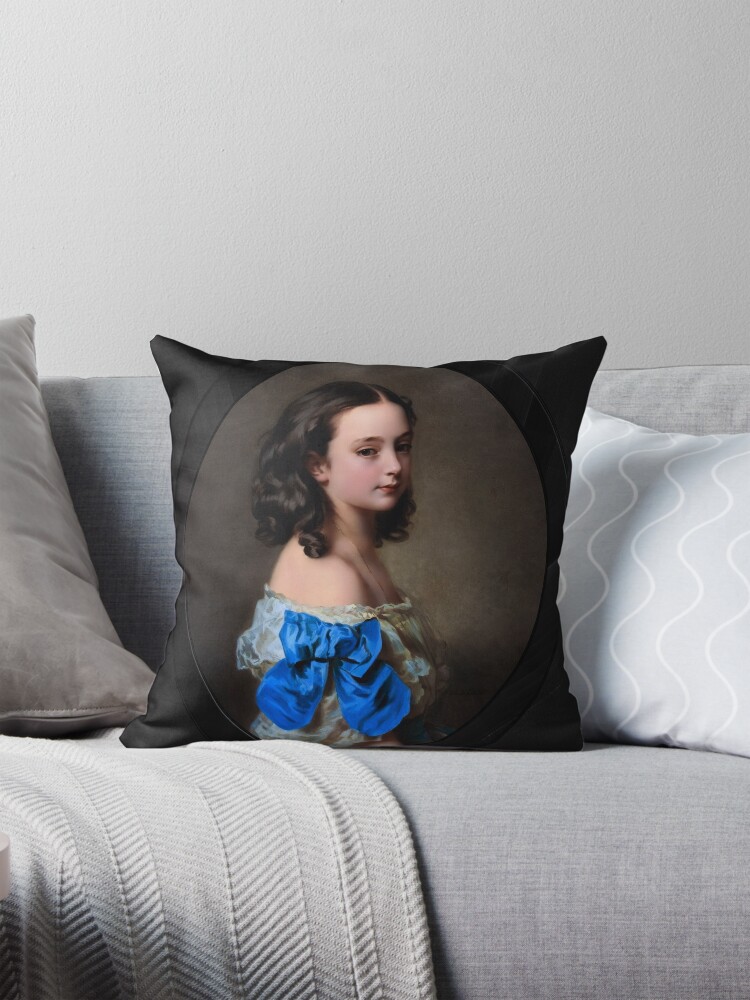
The central focus of the painting is a young girl, her head turned slightly toward the viewer, presenting a demure yet confident gaze. She exudes an aura of quiet nobility, despite the simplicity of her attire. With soft curls framing her face, her youthful features are rendered with an extraordinary sense of realism, highlighting the artist’s skill in capturing delicate details.
The girl is portrayed with an air of gentle grace, suggesting a harmonious blend of innocence and maturity. Her gaze seems both contemplative and serene, offering a glimpse into the composure expected of one of her status. The delicacy of her expression is a hallmark of Winterhalter’s ability to portray his subjects not just as they appeared, but as they were perceived by the social elite of the time.
The young girl’s features are classical in style, her oval face, rosy cheeks, and soft lips embody the delicate beauty typical of aristocratic women in the mid-19th century. Tha i dorcha, voluminous hair is arranged in soft waves, a' casadaich sìos a guailnean. The subtlety of Winterhalter’s work allows the viewer to feel the texture of her hair, as though one could almost reach out and touch the smooth, dark strands.
The Attire and Symbolism of Clothing
The girl is dressed in a soft, off-the-shoulder white gown, which is complemented by a large, striking blue bow tied at the back of her waist. This garment, while modest in design, speaks volumes about her social standing, as the quality of the fabric and the precision of the bow suggest fine craftsmanship and noble origins. The white gown, a common symbol of purity and grace, juxtaposed with the bold, yet refined blue bow, conveys an interesting balance between youthful innocence and the emerging authority that the girl will likely inherit in her adulthood.
The blue bow, central to her attire, serves as a key element of the composition. Its vibrant hue contrasts beautifully with the neutral tones of the dress, creating visual interest and drawing attention to the girl’s back and the curves of her form. In many aristocratic portraits of the era, such symbolic details in clothing were often used to accentuate the subject’s stature and to impart a sense of individuality. The meticulous treatment of the fabric and its placement further reinforces the sense of elegance and order that Winterhalter aimed to capture in his portraits.
The Mood and Atmosphere of the Portrait
The mood of the painting is one of quiet introspection. The girl’s expression, combined with her delicate attire and the smooth, serene background, creates an atmosphere that is both intimate and regal. The soft light falling across her face lends a subtle glow to her skin, further enhancing the youthful, angelic qualities of her features. This softness is contrasted by the formality of her clothing and her poised demeanor, suggesting that she is not merely a child, but someone being prepared for the weight of noble responsibilities.
The background is soft and unobtrusive, a pale, gradient wash of color that allows the viewer to focus entirely on the girl herself. The absence of detailed scenery or any distractions in the backdrop directs the attention to the subject’s face, emphasizing her expression and the nuanced way in which her character is conveyed. Winterhalter’s choice to keep the background minimal also ensures that the viewer remains engaged with the subject’s humanity, her delicate form highlighted against the simplicity of the space surrounding her.
The Technique and Materials
Winterhalter’s technique is characterized by its meticulous attention to detail and its smooth, almost flawless surface. His use of oil paints allows for depth in the rendering of light and shadow, creating a lifelike representation of the girl’s skin and the soft textures of her gown.
The portrait is imbued with a sense of realism that speaks to Winterhalter’s mastery of chiaroscuro—his ability to depict light and shadow in a way that adds dimensionality to the two-dimensional surface of the canvas.
The skin tones are rendered with a soft palette, giving the young girl an ethereal quality. The transitions between light and shadow on her face are subtle but precise, suggesting that Winterhalter had an acute understanding of human anatomy and the ways in which light interacts with different surfaces.
The delicate brushstrokes used for the hair convey its fine texture, while the folds of her gown are portrayed with a soft, yet careful hand, capturing the flow of the fabric as it drapes around her form.
Co-dhùnadh: A Portrait of Youth and Nobility
Ann an Portrait of a Young Girl Thought to Be Paula, Bana-phrionnsa Essling, Duchess of Rivoli, Hermann Winterhalter encapsulates not only the physical beauty of the young girl but also the essence of aristocratic poise and refinement. The painting serves as a window into the world of European nobility during the 19th century, where youth and beauty were highly revered, yet accompanied by an underlying expectation of grace and responsibility.
Through his careful portrayal of this young girl, Winterhalter provides not just a likeness but a glimpse into the nobility of the era, presenting a figure poised to step into a world of authority while still possessing the innocence of childhood.
Tha dealbh de nighean òg a thathar a ’smaoineachadh a bhith na bana-phrionnsa Essling na ath-riochdachadh seann mhaighstirean ealain didseatach ath-riochdachadh de ìomhaigh raon poblach.
Neach-ealain Bio
Fiosrachadh gu h-ìosal bho Wikipedia.org
Rugadh Franz Xaver Winterhalter ann am baile beag Menzenschwand, (a-nis na phàirt de Sankt Blasien), ann an Coille Dhubh na Gearmailt[1] ann an Luchd-taghaidh Bhàidean, air 20 A 'Ghiblean 1805.[2] B’ esan an siathamh leanabh aig Fidel Winterhalter (1773—1863), tuathanach agus riochdaire roisinn anns a’ bhaile, agus a bhean Eva Meyer (1765—1838), na bhall de theaghlach Menzenschwand a bha stèidhichte o chionn fhada.[2] Bha athair de luchd-tuatha agus bha buaidh chumhachdach aige na bheatha. De na h-ochdnar bhràithrean is pheathraichean, cha mhair ach ceathrar 'nan leanabachd. Fad a bheatha dh ’fhan Franz Xaver gu math faisg air a theaghlach, gu sònraichte dha bhràthair Hermann (1808–1891), a bha cuideachd na pheantair.
Às deidh dha a dhol dhan sgoil aig manachainn Bhenedictine ann an St.. Blasien, Dh ’fhàg Winterhalter Menzenschwand a-steach 1818 aig aois 13 sgrùdadh a dhèanamh air tarraing agus gràbhaladh.[4] Rinn e trèanadh mar neach-dealbhaidh agus lithographer ann am bùth-obrach Karl Ludwig Schüler (1785–1852) ann am Freiburg im Breisgau. Ann an 1823, aig aois 18, chaidh e gu Munich, le taic bhon neach-gnìomhachais Baron von Eichtal (1775–1850).
Ann an 1825, chaidh stìpean a thoirt dha le Ludwig I., Grand Duke of Baden (1763–1830) agus thòisich e air cùrsa sgrùdaidh aig Acadamaidh nan Ealan ann am Munich còmhla ri Peter von Cornelius (1783–1867), bha na dòighean acadaimigeach aige ga fhàgail mì-chofhurtail. Lorg Winterhalter comhairliche nas congenial anns an dealbhadair fasanta Eòsaph Karl Stieler (1781–1858). Rè na h-ùine seo, thug e taic dha fhèin ag obair mar lithographer.
Chaidh Winterhalter a-steach do chearcaill cùirte nuair a bha e a-staigh 1828 thàinig e gu bhith na mhaighstir dealbhaidh gu Sophie Margravine à Baden, aig Karlsruhe.[6] Thàinig an cothrom aige e fhèin a stèidheachadh taobh a-muigh ceann a deas na Gearmailt 1832 nuair a bha e comasach dha siubhal dhan Eadailt, 1833–1834, le taic bho Grand Duke Leopold à Baden. Anns an Ròimh rinn e seallaidhean gnè romansach ann an dòigh Louis Léopold Robert agus cheangail e e fhèin ri cearcall stiùiriche Acadamaidh na Frainge, Horace Vernet. Nuair a thill e gu Karlsruhe, pheant e dealbhan de Grand Duke Leopold à Baden agus a bhean, agus chaidh ainmeachadh mar pheantair don chùirt grand-ducal.
A dh'aindeoin sin, dh ’fhàg e Baden gus gluasad dhan Fhraing, far an do tharraing an sealladh gnè Eadailteach Il dolce Farniente fios aig Salon of 1836. Chaidh Il Decameron bliadhna an dèidh sin a mholadh cuideachd; tha an dà dhealbh nan sgrìobhaidhean acadaimigeach ann an stoidhle Raphael. Ann an Salon of 1838 sheall e dealbh de Phrionnsa Wagram còmhla ri a nighean òg.
Cha b’ fhada gus an deach a chùrsa-beatha mar pheantair dhealbhan a dhèanamh cinnteach nuair a pheant e Louise Marie à Orleans san aon bhliadhna, Banrigh na Beilge, agus a mac. Is dòcha gur ann tron dealbh seo a thàinig Winterhalter gu aire Maria Amalia às an Dà Sicilies, Banrigh na Frainge, màthair Banrigh na Beilge.