

Ritratto di una giovane ragazza pensata per essere la principessa Essling
The portrait titled Portrait of a Young Girl Thought to Be Paula, Principessa Essling, Duchess of Rivoli, dated circa 1850, was created by the esteemed German-Swiss painter Hermann Winterhalter (1808 – 1891); fratello minore del ritrattista Franz Xaver Winterhalter.
Known for his exquisite depictions of aristocratic figures and delicate portraits, Winterhalter captured the essence of high society through his refined techniques and detailed brushwork. In questo particolare ritratto, the artist conveys both the youthful innocence and noble grace of a young girl believed to be Paula, Principessa Essling, Duchess of Rivoli, a prominent member of European aristocracy during the 19th century.
Sommario
Argomento principale: The Young Girl
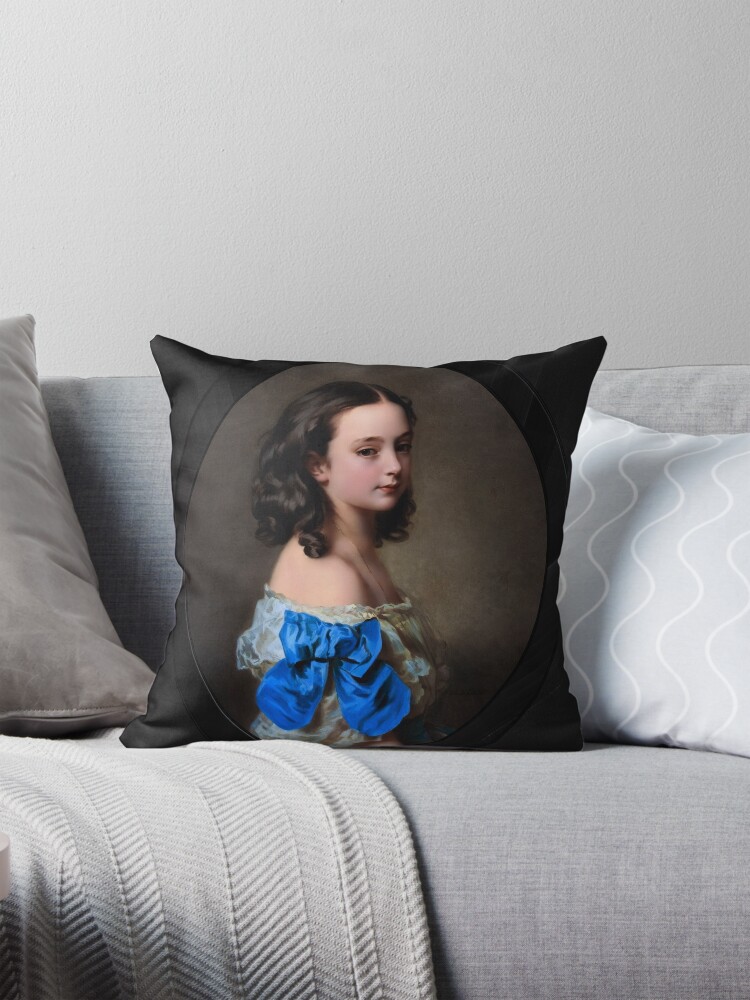
The central focus of the painting is a young girl, her head turned slightly toward the viewer, presenting a demure yet confident gaze. She exudes an aura of quiet nobility, despite the simplicity of her attire. With soft curls framing her face, her youthful features are rendered with an extraordinary sense of realism, highlighting the artist’s skill in capturing delicate details.
The girl is portrayed with an air of gentle grace, suggesting a harmonious blend of innocence and maturity. Her gaze seems both contemplative and serene, offering a glimpse into the composure expected of one of her status. The delicacy of her expression is a hallmark of Winterhalter’s ability to portray his subjects not just as they appeared, but as they were perceived by the social elite of the time.
The young girl’s features are classical in style, her oval face, rosy cheeks, and soft lips embody the delicate beauty typical of aristocratic women in the mid-19th century. Il suo buio, voluminous hair is arranged in soft waves, cascading down her shoulders. The subtlety of Winterhalter’s work allows the viewer to feel the texture of her hair, as though one could almost reach out and touch the smooth, dark strands.
The Attire and Symbolism of Clothing
The girl is dressed in a soft, off-the-shoulder white gown, which is complemented by a large, striking blue bow tied at the back of her waist. This garment, while modest in design, speaks volumes about her social standing, as the quality of the fabric and the precision of the bow suggest fine craftsmanship and noble origins. The white gown, a common symbol of purity and grace, juxtaposed with the bold, yet refined blue bow, conveys an interesting balance between youthful innocence and the emerging authority that the girl will likely inherit in her adulthood.
The blue bow, central to her attire, serves as a key element of the composition. Its vibrant hue contrasts beautifully with the neutral tones of the dress, creating visual interest and drawing attention to the girl’s back and the curves of her form. In many aristocratic portraits of the era, such symbolic details in clothing were often used to accentuate the subject’s stature and to impart a sense of individuality. The meticulous treatment of the fabric and its placement further reinforces the sense of elegance and order that Winterhalter aimed to capture in his portraits.
The Mood and Atmosphere of the Portrait
The mood of the painting is one of quiet introspection. The girl’s expression, combined with her delicate attire and the smooth, serene background, creates an atmosphere that is both intimate and regal. The soft light falling across her face lends a subtle glow to her skin, further enhancing the youthful, angelic qualities of her features. This softness is contrasted by the formality of her clothing and her poised demeanor, suggesting that she is not merely a child, but someone being prepared for the weight of noble responsibilities.
The background is soft and unobtrusive, a pale, gradient wash of color that allows the viewer to focus entirely on the girl herself. The absence of detailed scenery or any distractions in the backdrop directs the attention to the subject’s face, emphasizing her expression and the nuanced way in which her character is conveyed. Winterhalter’s choice to keep the background minimal also ensures that the viewer remains engaged with the subject’s humanity, her delicate form highlighted against the simplicity of the space surrounding her.
The Technique and Materials
Winterhalter’s technique is characterized by its meticulous attention to detail and its smooth, almost flawless surface. His use of oil paints allows for depth in the rendering of light and shadow, creating a lifelike representation of the girl’s skin and the soft textures of her gown.
The portrait is imbued with a sense of realism that speaks to Winterhalter’s mastery of chiaroscuro—his ability to depict light and shadow in a way that adds dimensionality to the two-dimensional surface of the canvas.
The skin tones are rendered with a soft palette, giving the young girl an ethereal quality. The transitions between light and shadow on her face are subtle but precise, suggesting that Winterhalter had an acute understanding of human anatomy and the ways in which light interacts with different surfaces.
The delicate brushstrokes used for the hair convey its fine texture, while the folds of her gown are portrayed with a soft, yet careful hand, capturing the flow of the fabric as it drapes around her form.
Conclusione: A Portrait of Youth and Nobility
Nel Portrait of a Young Girl Thought to Be Paula, Principessa Essling, Duchess of Rivoli, Hermann Winterhalter encapsulates not only the physical beauty of the young girl but also the essence of aristocratic poise and refinement. The painting serves as a window into the world of European nobility during the 19th century, where youth and beauty were highly revered, yet accompanied by an underlying expectation of grace and responsibility.
Through his careful portrayal of this young girl, Winterhalter provides not just a likeness but a glimpse into the nobility of the era, presenting a figure poised to step into a world of authority while still possessing the innocence of childhood.
Ritratto di una giovane ragazza pensata per essere la principessa Essling è una riproduzione di vecchi maestri di arte digitale ritoccata di un'immagine di pubblico dominio.
Biografia dell'artista
Informazioni sotto da Wikipedia.org
Franz Xaver Winterhalter è nato nel piccolo villaggio di Menzenschwand, (ora parte di Sankt Blasien), nella Foresta Nera in Germania[1] nell'elettorato di Baden, sopra 20 aprile 1805.[2] Era il sesto figlio di Fidel Winterhalter (1773–1863), un agricoltore e produttore di resina nel villaggio, e sua moglie Eva Meyer (1765–1838), un membro di una famiglia Menzenschwand di lunga data.[2] Suo padre era di stirpe contadina ed ebbe una forte influenza nella sua vita. Degli otto fratelli e sorelle, solo quattro sopravvissero all'infanzia. Per tutta la vita Franz Xaver è rimasto molto vicino alla sua famiglia, in particolare al fratello Hermann (1808–1891), che era anche pittore.
Dopo aver frequentato la scuola in un monastero benedettino a St. Blasien, Winterhalter lasciò Menzenschwand in 1818 all'età di 13 studiare disegno e incisione.[4] Si è formato come disegnatore e litografo nella bottega di Karl Ludwig Schüler (1785–1852) a Friburgo in Brisgovia. Nel 1823, all'età di 18, è andato a Monaco di Baviera, sponsorizzato dall'industriale barone von Eichtal (1775–1850).
Nel 1825, gli fu concesso uno stipendio da Ludwig I, Granduca di Baden (1763–1830) e iniziò un corso di studi presso l'Accademia delle Arti di Monaco di Baviera con Peter von Cornelius (1783–1867), i cui metodi accademici lo mettevano a disagio. Winterhalter trovò un mentore più congeniale nel ritrattista alla moda Joseph Karl Stieler (1781–1858). Durante questo periodo, si manteneva lavorando come litografo.
Winterhalter entrò nei circoli di corte quando in 1828 divenne maestro di disegno di Sophie Margravine di Baden, a Karlsruhe.[6] È arrivata la sua opportunità di affermarsi al di fuori della Germania meridionale 1832 quando poté viaggiare in Italia, 1833–1834, con il sostegno del Granduca Leopoldo di Baden. A Roma compose scene di genere romantico alla maniera di Louis Léopold Robert e si unì alla cerchia del direttore dell'Accademia di Francia, Orazio Vernet. Al suo ritorno a Karlsruhe dipinse i ritratti del Granduca Leopoldo di Baden e di sua moglie, e fu nominato pittore alla corte granducale.
tuttavia, lasciò Baden per trasferirsi in Francia, dove la sua scena di genere italiana Il dolce Farniente ha attirato l'attenzione al Salon of 1836. Anche Il Decameron un anno dopo fu elogiato; entrambi i dipinti sono composizioni accademiche nello stile di Raffaello. Nel Salone di 1838 espose un ritratto del principe di Wagram con la sua giovane figlia.
La sua carriera come ritrattista fu presto assicurata quando nello stesso anno dipinse Louise Marie of Orleans, Regina dei Belgi, e suo figlio. Fu probabilmente attraverso questo dipinto che Winterhalter venne a conoscenza di Maria Amalia delle Due Sicilie, Regina dei Francesi, madre della regina dei belgi.