

Portrait of a Young Girl Thought To Be Princess Essling
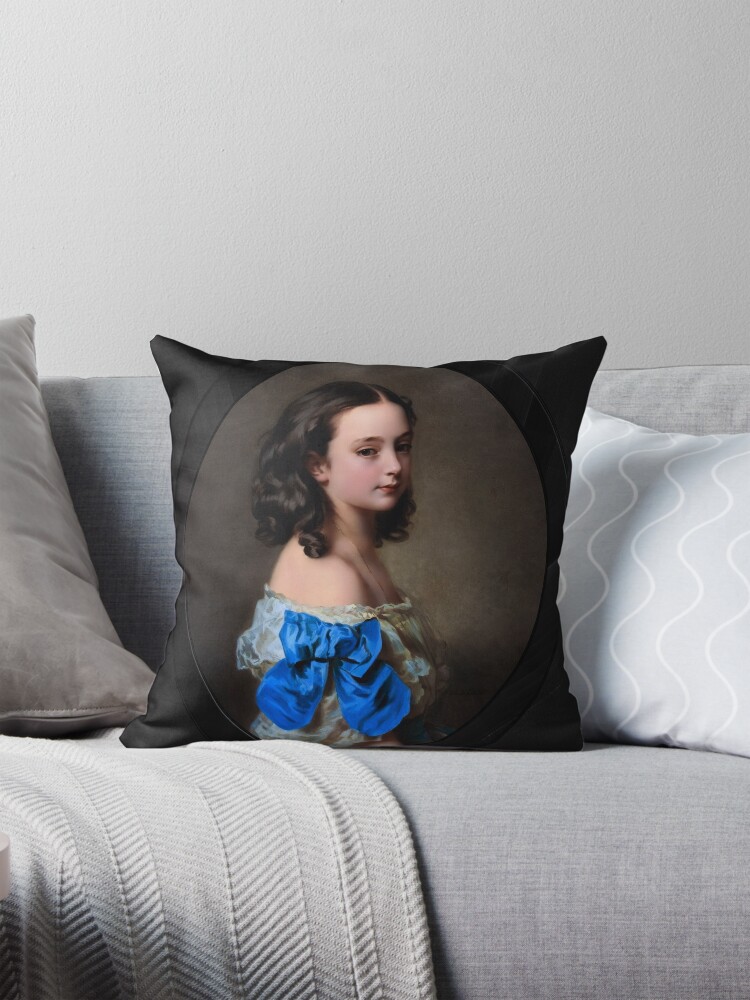
The portrait titled Portrait of a Young Girl Thought to Be Paula, 공주 Essling, Duchess of Rivoli, dated circa 1850, was created by the esteemed German-Swiss painter Hermann Winterhalter (1808 – 1891); younger brother of portrait painter Franz Xaver Winterhalter.
Known for his exquisite depictions of aristocratic figures and delicate portraits, Winterhalter captured the essence of high society through his refined techniques and detailed brushwork. 이 특별한 초상화에서, the artist conveys both the youthful innocence and noble grace of a young girl believed to be Paula, Princess Essling, Duchess of Rivoli, a prominent member of European aristocracy during the 19th century.
목차
주제: The Young Girl
The central focus of the painting is a young girl, her head turned slightly toward the viewer, presenting a demure yet confident gaze. She exudes an aura of quiet nobility, despite the simplicity of her attire. With soft curls framing her face, her youthful features are rendered with an extraordinary sense of realism, highlighting the artist’s skill in capturing delicate details.
The girl is portrayed with an air of gentle grace, suggesting a harmonious blend of innocence and maturity. Her gaze seems both contemplative and serene, offering a glimpse into the composure expected of one of her status. The delicacy of her expression is a hallmark of Winterhalter’s ability to portray his subjects not just as they appeared, but as they were perceived by the social elite of the time.
The young girl’s features are classical in style, her oval face, rosy cheeks, and soft lips embody the delicate beauty typical of aristocratic women in the mid-19th century. 그녀의 어둠, voluminous hair is arranged in soft waves, cascading down her shoulders. The subtlety of Winterhalter’s work allows the viewer to feel the texture of her hair, as though one could almost reach out and touch the smooth, dark strands.
The Attire and Symbolism of Clothing
The girl is dressed in a soft, off-the-shoulder white gown, which is complemented by a large, striking blue bow tied at the back of her waist. This garment, while modest in design, speaks volumes about her social standing, as the quality of the fabric and the precision of the bow suggest fine craftsmanship and noble origins. The white gown, a common symbol of purity and grace, juxtaposed with the bold, yet refined blue bow, conveys an interesting balance between youthful innocence and the emerging authority that the girl will likely inherit in her adulthood.
The blue bow, central to her attire, serves as a key element of the composition. Its vibrant hue contrasts beautifully with the neutral tones of the dress, creating visual interest and drawing attention to the girl’s back and the curves of her form. In many aristocratic portraits of the era, such symbolic details in clothing were often used to accentuate the subject’s stature and to impart a sense of individuality. The meticulous treatment of the fabric and its placement further reinforces the sense of elegance and order that Winterhalter aimed to capture in his portraits.
The Mood and Atmosphere of the Portrait
The mood of the painting is one of quiet introspection. The girl’s expression, combined with her delicate attire and the smooth, serene background, creates an atmosphere that is both intimate and regal. The soft light falling across her face lends a subtle glow to her skin, further enhancing the youthful, angelic qualities of her features. This softness is contrasted by the formality of her clothing and her poised demeanor, suggesting that she is not merely a child, but someone being prepared for the weight of noble responsibilities.
The background is soft and unobtrusive, a pale, gradient wash of color that allows the viewer to focus entirely on the girl herself. The absence of detailed scenery or any distractions in the backdrop directs the attention to the subject’s face, emphasizing her expression and the nuanced way in which her character is conveyed. Winterhalter’s choice to keep the background minimal also ensures that the viewer remains engaged with the subject’s humanity, her delicate form highlighted against the simplicity of the space surrounding her.
The Technique and Materials
Winterhalter’s technique is characterized by its meticulous attention to detail and its smooth, almost flawless surface. His use of oil paints allows for depth in the rendering of light and shadow, creating a lifelike representation of the girl’s skin and the soft textures of her gown.
The portrait is imbued with a sense of realism that speaks to Winterhalter’s mastery of chiaroscuro—his ability to depict light and shadow in a way that adds dimensionality to the two-dimensional surface of the canvas.
The skin tones are rendered with a soft palette, giving the young girl an ethereal quality. The transitions between light and shadow on her face are subtle but precise, suggesting that Winterhalter had an acute understanding of human anatomy and the ways in which light interacts with different surfaces.
The delicate brushstrokes used for the hair convey its fine texture, while the folds of her gown are portrayed with a soft, yet careful hand, capturing the flow of the fabric as it drapes around her form.
결론: A Portrait of Youth and Nobility
에 Portrait of a Young Girl Thought to Be Paula, Princess Essling, Duchess of Rivoli, Hermann Winterhalter encapsulates not only the physical beauty of the young girl but also the essence of aristocratic poise and refinement. The painting serves as a window into the world of European nobility during the 19th century, where youth and beauty were highly revered, yet accompanied by an underlying expectation of grace and responsibility.
Through his careful portrayal of this young girl, Winterhalter provides not just a likeness but a glimpse into the nobility of the era, presenting a figure poised to step into a world of authority while still possessing the innocence of childhood.
Portrait of a Young Girl Thought To Be Princess Essling is a retouched digital art old masters reproduction of a public domain image.
아티스트 약력
아래 정보 Wikipedia.org
Franz Xaver Winterhalter는 Menzenschwand의 작은 마을에서 태어났습니다., (이제 Sankt Blasien의 일부), in Germany’s Black Forest[1] in the Electorate of Baden, ~에 20 4 월 1805.[2] 그는 Fidel Winterhalter의 여섯 번째 자녀였습니다. (1773–1863), 마을의 농부이자 수지 생산자, 그의 아내 에바 메이어 (1765–1838), a member of a long established Menzenschwand family.[2] 그의 아버지는 소작농이었고 그의 삶에 강력한 영향을 미쳤습니다.. 여덟 남매 중, 4명만이 유아기에서 살아남았다. 평생 동안 Franz Xaver는 가족과 매우 가깝게 지냈습니다., 특히 그의 형제 헤르만에게 (1808–1891), 화가이기도 했던.
성 베네딕토회 수도원에서 학교를 마치고. 거품, 빈터할터는 멘젠슈반트를 떠났다. 1818 세의 나이에 13 to study drawing and engraving.[4] 그는 Karl Ludwig Schüler의 작업장에서 제도가이자 석판가로 훈련을 받았습니다. (1785–1852) 프라이부르크 임 브리스가우에서. 에 1823, 세의 나이에 18, 그는 뮌헨에 갔다, 기업가 Baron von Eichtal 후원 (1775–1850).
에 1825, 그는 루트비히 1세로부터 봉급을 받았다., 바덴 대공 (1763–1830) Peter von Cornelius와 함께 뮌헨 예술 아카데미에서 공부를 시작했습니다. (1783–1867), 그의 학업 방식이 그를 불편하게 만들었습니다.. Winterhalter는 패셔너블한 초상화가 Joseph Karl Stieler에게서 더 마음에 맞는 멘토를 찾았습니다. (1781–1858). 이 시간 동안, 그는 석판 작가로 일하면서 자신을 지원했습니다..
Winterhalter는 법정에 들어섰습니다. 1828 그는 바덴의 소피 마그레빈(Sophie Margravine of Baden)의 드로잉 마스터가 되었습니다., at Karlsruhe.[6] 독일 남부를 넘어 자리를 잡을 기회가 찾아왔다. 1832 그가 이탈리아를 여행할 수 있었을 때, 1833–1834, 바덴의 레오폴드 대공의 지원으로. 로마에서 그는 루이 레오폴드 로베르의 방식으로 낭만적인 장르의 장면을 작곡하고 프랑스 아카데미 원장 서클에 합류했습니다., 호레이스 베르네. 카를스루에로 돌아온 그는 바덴의 레오폴드 대공과 그의 아내의 초상화를 그렸습니다., 그리고 대공법의 화가로 임명되었다..
그럼에도 불구하고, he left Baden to move to France, 그의 이탈리아 장르 장면 Il dolce Farniente가 살롱에서 주목을 받았던 곳 1836. Il Decameron a year later was also praised; both paintings are academic compositions in the style of Raphael. 살롱에서 1838 그는 어린 딸과 함께 Wagram 왕자의 초상화를 전시했습니다..
His career as a portrait painter was soon secured when in the same year he painted Louise Marie of Orleans, 벨기에의 여왕, 그리고 그녀의 아들. Winterhalter가 두 시칠리아의 Maria Amalia를 알게 된 것은 아마도 이 그림을 통해서였을 것입니다., 프랑스의 여왕, 벨기에 여왕의 어머니.