

Primrose
Primrose c1899 by Czech Painter Alphonse Mucha (1860 – 1939); bem como um ilustrador e artista gráfico talentoso que foi uma grande força do período Art Nouveau; conhecido por seu estilizado, pôsteres teatrais ornamentados e decorativos.
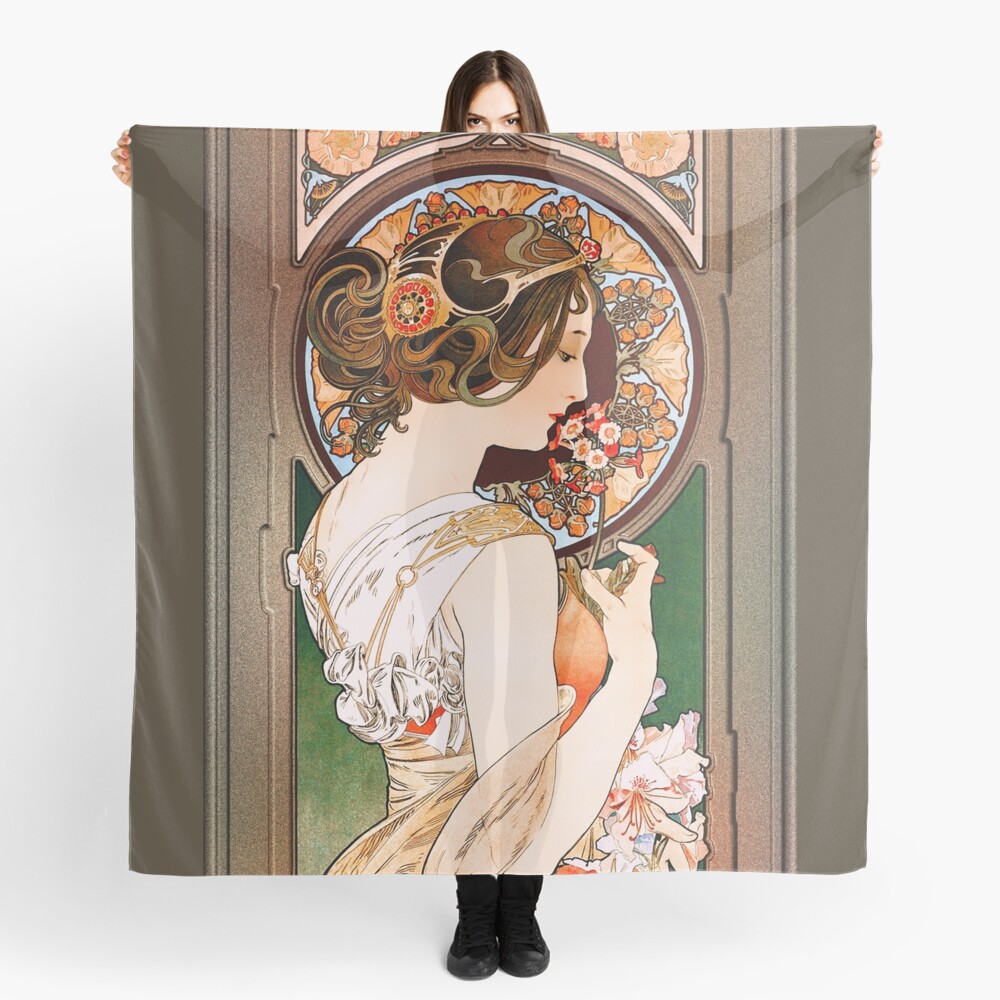
This is a lavish art nouveau portrait of a young woman wearing an orange dress with a white top and a tan shawl, with body jewelry straps that go over her shoulder and terminate at her center back.
She has an elaborate jewelry headpiece that fits over her entire head with a flowing form that follows the contours of a looping brown hair.
She is holding against her body several large flowers with her left hand, while holding a smaller collection of flowers in her right hand, in which she is smelling there fragrance.
Behind her head which is in side profile is a blue disc with an arrangement of more orange flowers that are triangular in shape, that conform to the perimeter of the disc, along with smaller flowers to fill in the gaps.
Above the disc is an arch with more floral arrangements and above the art a rectangle with rounded corners with a five bundle red and green floral arrange that are stacked side by side.

Esta é uma reprodução de mestres antigos de arte digital remasterizada de uma imagem de domínio público que está disponível para compra on-line como um impressão em tela enrolada.
Informações abaixo de Wikipedia.org
Alfons Maria Mucha julho 24, 1860 – julho 14, 1939), era conhecido internacionalmente como Alphonse Mucha. Ele era um pintor checo proeminente, ilustrador e artista gráfico, morando em Paris durante o período Art Nouveau, e é mais conhecido por seus pôsteres teatrais distintamente estilizados e decorativos, particularmente aqueles de Sarah Bernhardt.
Ele produziu ilustrações, propagandas, painéis decorativos, e designs, que se tornou uma das imagens mais conhecidas do período.
Na segunda parte de sua carreira, na idade de 43, ele voltou para sua terra natal, a região da Boêmia-Morávia, na Áustria, e se dedicou à pintura de uma série de vinte telas monumentais conhecidas como A Epopéia Eslava, retratando a história de todos os povos eslavos do mundo, que ele pintou entre 1912 e 1926.
Dentro 1928, no 10º aniversário da independência da Tchecoslováquia, ele apresentou a série para a nação tcheca. Ele considerou seu trabalho mais importante. Agora está em exibição em Praga.