

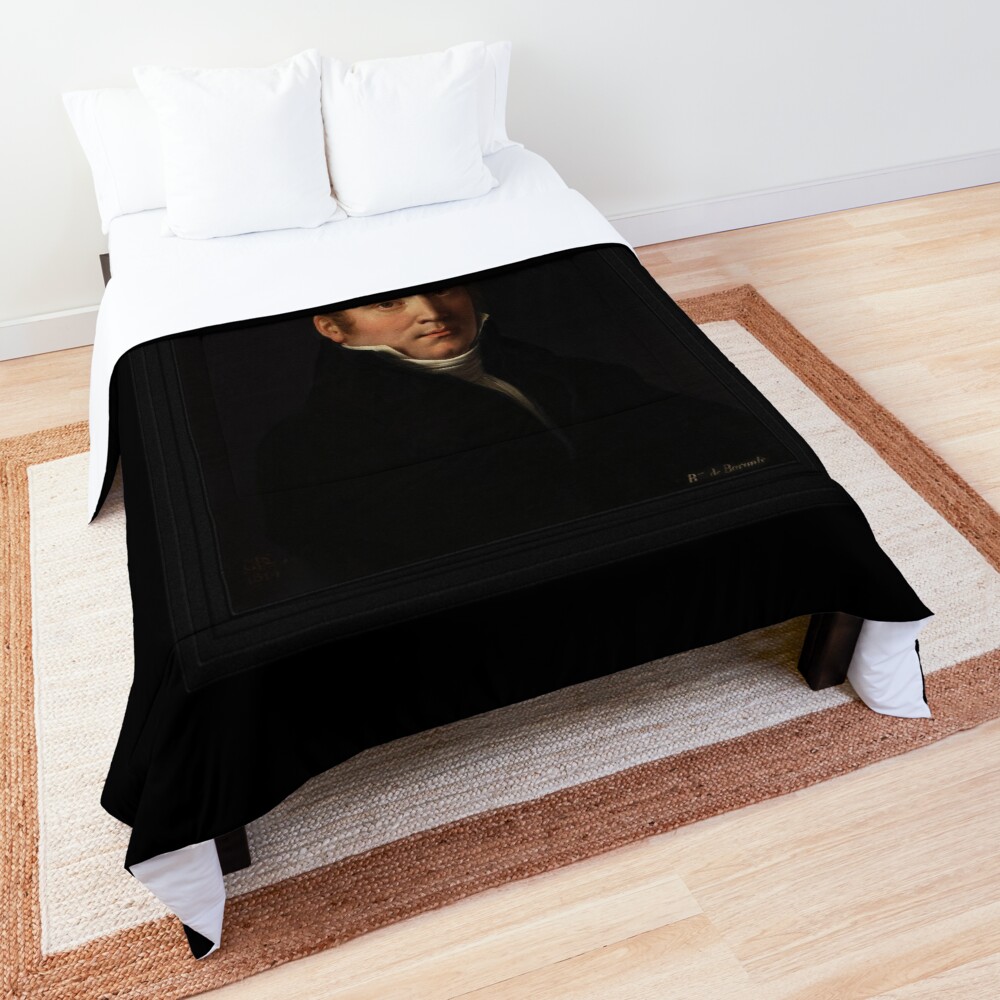
Portrait de Prosper de Barante
Portráid de Prosper de Barante c1814 le Anne-Louis Girodet de Roussy-Trioson (1767 – 1824); a bhí ina mhac léinn ag Jacques-Louis David (is féidir leat cuid dá shaothar ealaíne a fheiceáil sa bhailiúchán) agus bhí sé mar chuid den Ghluaiseacht Rómánsúil luath. Tá sé suntasach mar gheall ar a stíl shoiléir bheacht agus ar phictiúir an teaghlaigh Napoleon.

Seo é portráid de Amable Guillaume Prosper Brugière (1782 – 1866), Barún de Barante; Státóir agus Staraí Francach a bhí mar chuid den lár ar chlé agus Liobrálach féinfhógartha.
He is posed against a solid dark wall wearing a white high collar shirt with a white scarf wrapped around the collar and a black coat or jacket that also has a high collar.
Seo atáirgeadh seanmháistrí ealaíne digiteach athshuite d’íomhá fearainn phoiblí atá ar fáil le díol ar líne mar priontáil chanbhás rollta.
Info Below Derived From Wikipedia.org https://wikipedia.org
Girodet was a French painter and pupil of Jacques-Louis David, who participated in the early Romantic movement by including elements of eroticism in his paintings. Girodet is remembered for his precise and clear style and for his paintings of members of the Napoleonic family.
Girodet was born at Montargis. Both of his parents died when he was a young adult. The care of his inheritance and education fell to his guardian, a prominent physician named Benoît-François Trioson, “médecin-de-mesdames”, who later adopted him. The two men remained close throughout their lives and Girodet took the surname Trioson in 1812.
In school he first studied architecture and pursued a military career. He changed to the study of painting under a teacher named Luquin and then entered the school of Jacques-Louis David.
Ag aois 22 he successfully competed for the Prix de Rome with a painting of the Story of Joseph and his Brethren.
Ó 1789 chun 1793 he lived in Italy and while in Rome he painted his Hippocrate refusant les presents d’Artaxerxes and Endymion-dormant (now in the Louvre), a work which gained him great acclaim at the Salon of 1793 and secured his reputation as a leading painter in the French school.
Once he returned to France, Girodet painted many portraits, including some of members of the Bonaparte family. I 1806, in competition with the Sabines of David, he exhibited his Scène de déluge (Bhí sé ar dhuine de na daltaí ba mhó clú agus ba lú seirbhís le Le Brun), which was awarded the decennial prize.
I 1808 he produced the Reddition de Vienne and Atala au tombeau, a work which won immense popularity, by its fortunate choice of subject, François-René de Chateaubriand’s novel Atala, first published in 1801; and its remarkable departure from the theatricality of Girodet’s usual manner. He would return to his theatrical style in La Révolte du Caire (1810).