

Psyche c1786
L'œuvre intitulée Psyche de 1786, créé par un peintre français Jean-Baptiste Greuze (1725 – 1805), depicts an emotional and intimate moment in mythological storytelling. This painting captures the mythical figure Psyche in a delicate and poignant portrayal, showcasing Greuze’s mastery of light, texture, et profondeur émotionnelle. Dans cette pièce, Greuze uses soft hues and detailed expressions to bring to life the timeless myth of Psyche, a mortal woman whose beauty was so extraordinary that it led her into a series of trials that ultimately resulted in her becoming immortal.
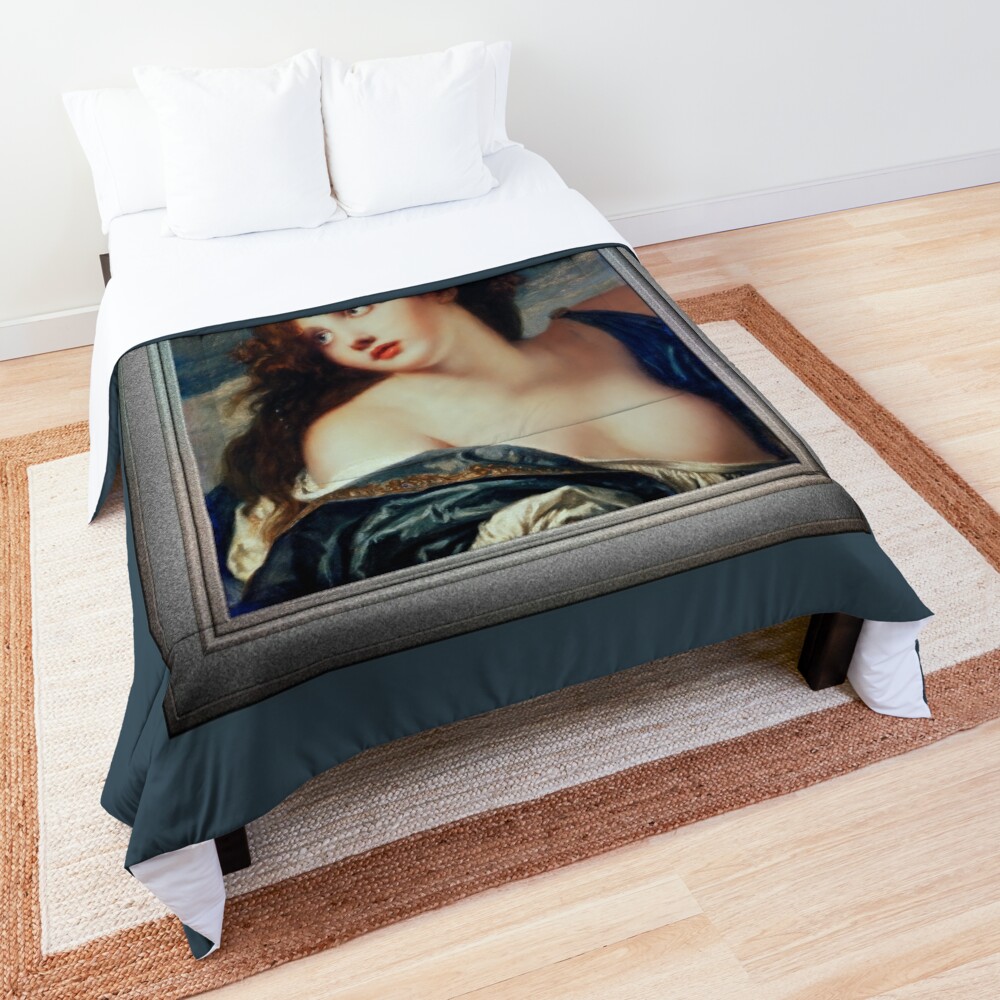
Table des matières
Le sujet principal: Psyche’s Emotional Expression
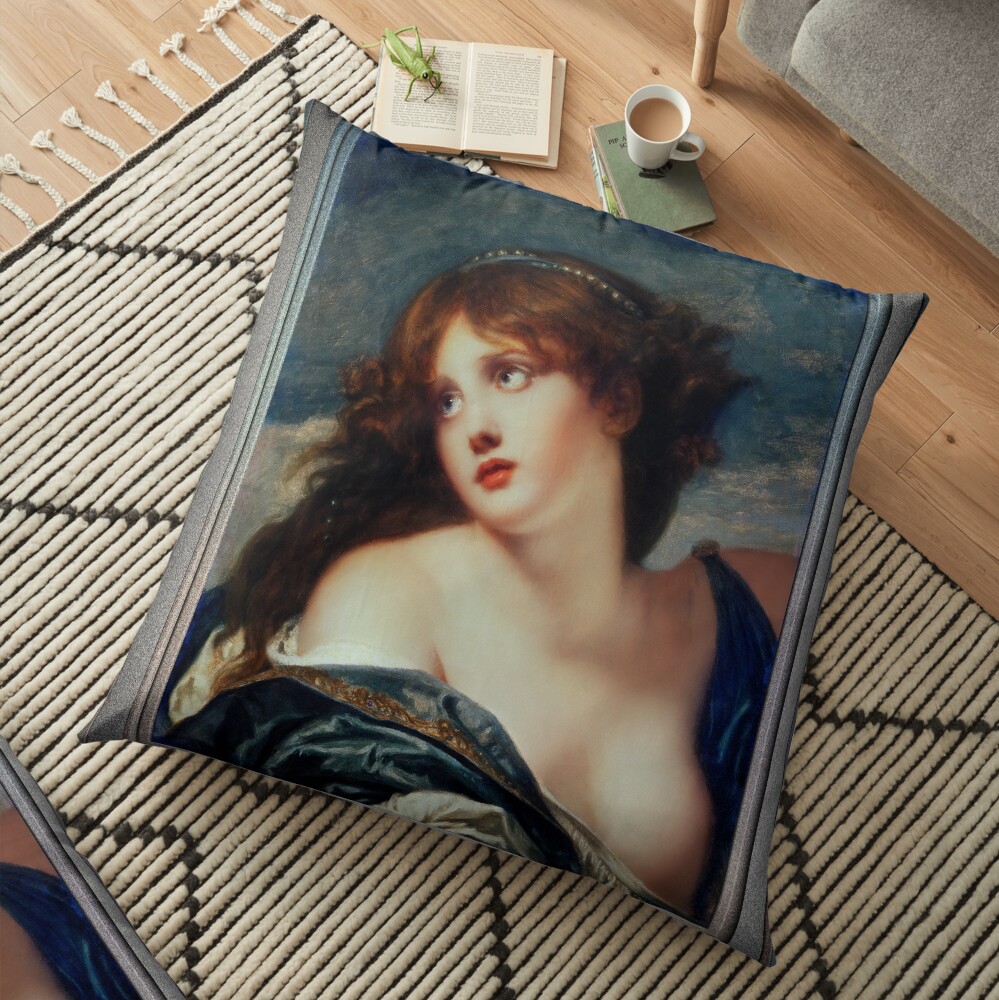
Psyche is the central figure of the composition, rendered with grace and sensuality. She is portrayed in a moment of quiet contemplation, her eyes gazing upward with an expression that reflects both vulnerability and longing. Her delicate features—rounded cheeks, soft lips, et grand, expressive eyes—are painted with such fine detail that they evoke a sense of realism, almost lifelike in their intensity. This is characteristic of Greuze’s style, where he excelled in capturing human emotion with a remarkable sense of tenderness and psychological depth.
Psyche’s long, flowing hair is styled in loose curls that cascade over her shoulders, adding to her ethereal and delicate appearance. A pearl headband adorns her hair, symbolizing both her beauty and her connection to the divine. The way her hair is painted suggests movement, as though caught in a gentle breeze. The artist’s attention to such fine details not only enhances her beauty but also reinforces the dreamlike quality of the scene.
The Clothing and Materials
Psyche is dressed in a lavish garment of blue and gold. The fabric flows elegantly around her shoulders and neck, rendered with Greuze’s characteristic skill at depicting textures. The deep blue of the robe contrasts beautifully with the soft white of her exposed skin, creating a striking visual balance. The robe is adorned with golden trims, which enhance its luxurious appearance, symbolizing the celestial and divine nature of Psyche herself. Greuze’s treatment of the fabric is particularly noteworthy, with light and shadow playing across the material in such a way that it almost seems tangible, as though the viewer could reach out and touch the smoothness of the silk.
The fine texture of the fabric serves as a metaphor for the vulnerability and fragility of Psyche’s character, amplifying her emotional turmoil. Les vêtements, with its soft folds and the shimmering sheen of the material, adds a layer of complexity to the emotional tone of the painting. The robe’s rich colors and sumptuous fabric reflect Psyche’s dual nature—both mortal and divine, human and otherworldly.
Le contexte et le cadre
The background of the painting is a soft, atmospheric blend of cool blues and whites. It lacks any overt detail, but it works to emphasize Psyche’s figure. The simple, almost abstract background contrasts with the highly detailed foreground, concentrer entièrement l’attention du spectateur sur le sujet. This technique reflects Greuze’s ability to create intimacy within his compositions, drawing the viewer into the emotional state of the subject without distraction.
The sky-like backdrop also evokes the idea of vastness and infinity, suggesting the mythological setting from which Psyche originates. The gentle gradients of color create a sense of space and airiness, adding to the dreamlike atmosphere of the painting. Psyche’s figure appears almost suspended in space, as though she is caught in a moment between earth and the heavens.
Le style et la technique
Jean-Baptiste Greuze was known for his ability to capture human emotion through his mastery of light and shadow, as well as his use of soft, couleurs harmonieuses. Dans Psyche, the artist’s use of soft, glowing light on the figure’s face creates a sense of naturalism, drawing attention to the emotional expression of the subject. The light falls gently on Psyche’s skin, highlighting her delicate features while creating a contrast with the darker tones of her hair and clothing. This use of light and shadow is not just a stylistic choice but serves to emphasize the psychological depth of the painting, imbuing Psyche with a sense of inner conflict and longing.
Greuze’s technique in handling the human form is another striking element of this work. The artist captures the natural curves of Psyche’s body with fluid lines, giving her an air of graceful motion even though she is seated in stillness. The folds of her robe, the movement of her hair, and the nuanced expression on her face all combine to create a portrait that is both emotionally compelling and visually arresting.
L'ambiance et le thème
L'ambiance de Psyche is one of wistful longing and quiet contemplation. The expression on Psyche’s face suggests a deep emotional turmoil, possibly related to the trials and tribulations she faces in the myth. There is a sense of sadness and resignation in her gaze, as though she is caught between hope and despair. The artist captures this emotional complexity through his careful rendering of her facial expression and posture, conveying a sense of vulnerability that resonates deeply with the viewer.
The theme of the painting—Psyche’s journey from mortal to divine—adds layers of meaning to the artwork. The mythological tale of Psyche and her eventual union with Cupid, le dieu de l'amour, is one of transformation, l'amour, et des sacrifices. Greuze’s portrayal of Psyche’s emotional state hints at the internal conflict she faces as she navigates these challenges. Dans ce travail, Greuze does not focus on the grandiose or heroic elements of the myth but rather on the human, emotional aspect of the character, making the figure of Psyche relatable and deeply human.
Conclusion
Psyche c1786 by Jean-Baptiste Greuze is a masterpiece that captures both the beauty and the emotional depth of its mythological subject. Through his delicate rendering of Psyche’s form, expressive face, and elegant attire, Greuze has created a timeless portrayal of a woman caught between the mortal and divine worlds. The emotional resonance of the painting, combined with its technical mastery, places this work among the finest examples of Greuze’s career and offers a powerful exploration of human emotion within the context of classical mythology.
Il s'agit d'une reproduction de maîtres anciens d'art numérique remasterisée d'une image du domaine public qui est disponible en tant que impression sur toile.
Cette création d'art numérique, comme toutes les œuvres d'art disponibles sur le site Web Xzendor7, elles sont disponibles à l'achat en ligne dans une variété de formats de matériaux, y compris des impressions sur toile., impressions acryliques, impressions métalliques, gravures sur bois, impressions encadrées, affiches, et sous forme d'impressions sur toile roulées dans une variété de tailles de 12 pouces à 72 pouces en fonction de la taille de l'œuvre d'art réelle et de la boutique d'impression à la demande auprès de laquelle vous choisissez d'acheter l'art.
L’œuvre d’art est également disponible sur une large gamme de vêtements pour hommes et femmes., tasses, fourre-tout, écharpes, cahiers et journaux et de nombreux produits de décoration intérieure.
À propos de l'artiste
Les informations ci-dessous sont dérivées de NGA.gov
Jean est né à Tournus, France en 1725 comme le sixième fils d'un maître carreleur qui a reconnu son talent dès son plus jeune âge; l'envoyer à Lyon, La France étudie avec le portraitiste français Charles Grandon (1691 – 1762).
Vers l'âge de 30 il a quitté Lyon, et a voyagé à Paris, France pour étudier à l'Académie royale de peinture et de sculpture ou à l'Académie royale de peinture et de sculpture; qui était à l'époque la première institution artistique de France pendant la dernière partie de l'Ancien Régime (Ancien Régime ~1500 à 1789), jusqu'à sa suppression en 1793 pendant la Révolution française.
Bien que très talentueux et très réussi au cours des années 1760 et 1770, avoir des mécènes comme la marquise de Pompadour (1721 – 1764), Impératrice Catherine II de Russie (r. 1762 – 1796), and Ange Laurent de La Live de Jully (1725 – 1779); sa nature rebelle et ses conflits avec les responsables de l'Académie et du Salon se révéleront être son malheur; surtout après son mariage avec Anne Marie Babuty en 1759; ce qui s'avérerait être un désastre pour lui, comme elle était connue pour avoir eu diverses affaires avec ses élèves et ses baby-sitters, ce qui lui a causé une perte de revenus et une humiliation publique.
Quand le mariage a pris fin 34 des années plus tard, sa femme a reçu un règlement substantiel, qui l'a laissé dans une situation financière difficile et au moment de sa mort en 1805 à l'âge de 80 il était presque fauché.