

Psyche c1786
An obair ealain le tiotal Psyche bho 1786, created by French painter Jean-Baptiste Greuze (1725 – 1805), depicts an emotional and intimate moment in mythological storytelling. This painting captures the mythical figure Psyche in a delicate and poignant portrayal, showcasing Greuze’s mastery of light, inneach, agus doimhneachd faireachail. Anns a 'phìos seo, Greuze uses soft hues and detailed expressions to bring to life the timeless myth of Psyche, a mortal woman whose beauty was so extraordinary that it led her into a series of trials that ultimately resulted in her becoming immortal.
Clàr-innse
Am Prìomh Chuspair: Psyche’s Emotional Expression
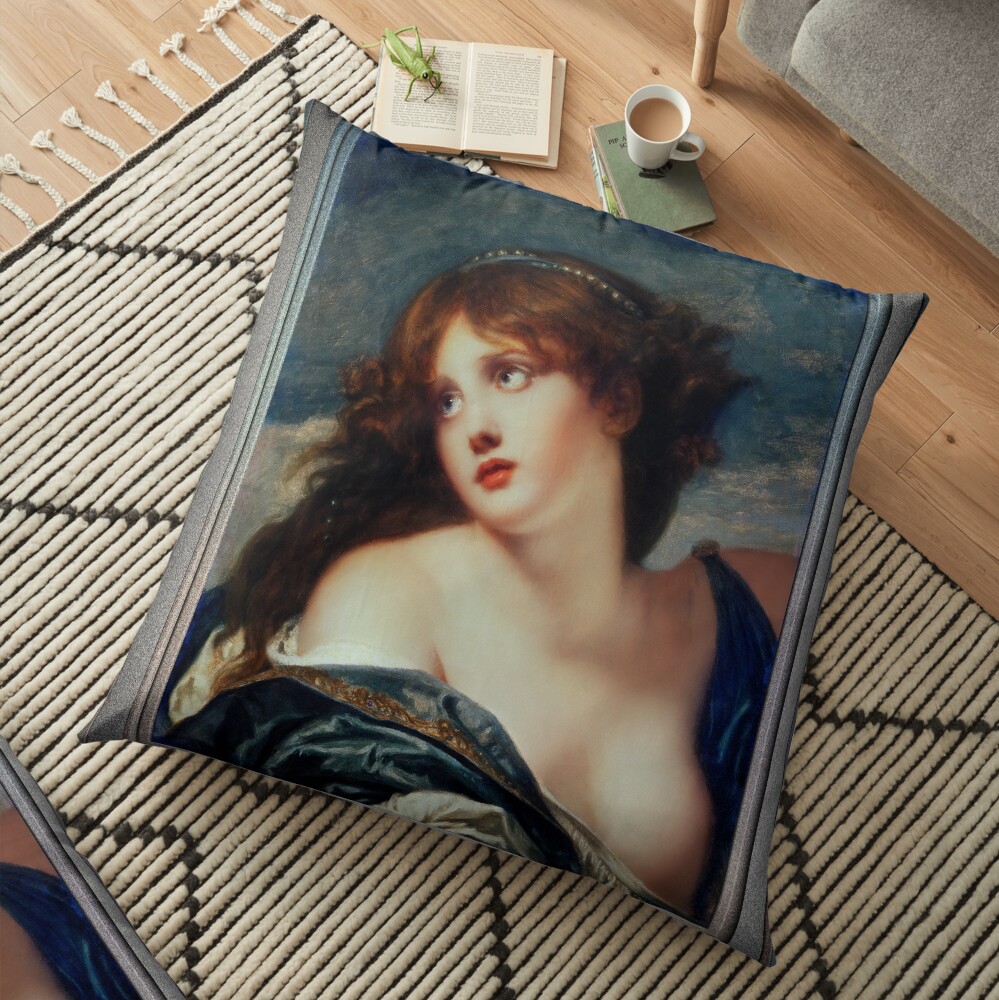
Psyche is the central figure of the composition, rendered with grace and sensuality. She is portrayed in a moment of quiet contemplation, her eyes gazing upward with an expression that reflects both vulnerability and longing. Her delicate features—rounded cheeks, soft lips, agus mòr, expressive eyes—are painted with such fine detail that they evoke a sense of realism, almost lifelike in their intensity. This is characteristic of Greuze’s style, where he excelled in capturing human emotion with a remarkable sense of tenderness and psychological depth.
Psyche’s long, flowing hair is styled in loose curls that cascade over her shoulders, adding to her ethereal and delicate appearance. A pearl headband adorns her hair, symbolizing both her beauty and her connection to the divine. The way her hair is painted suggests movement, as though caught in a gentle breeze. The artist’s attention to such fine details not only enhances her beauty but also reinforces the dreamlike quality of the scene.
The Clothing and Materials
Psyche is dressed in a lavish garment of blue and gold. The fabric flows elegantly around her shoulders and neck, rendered with Greuze’s characteristic skill at depicting textures. The deep blue of the robe contrasts beautifully with the soft white of her exposed skin, creating a striking visual balance. The robe is adorned with golden trims, which enhance its luxurious appearance, symbolizing the celestial and divine nature of Psyche herself. Greuze’s treatment of the fabric is particularly noteworthy, with light and shadow playing across the material in such a way that it almost seems tangible, as though the viewer could reach out and touch the smoothness of the silk.
The fine texture of the fabric serves as a metaphor for the vulnerability and fragility of Psyche’s character, amplifying her emotional turmoil. An t-aodach, with its soft folds and the shimmering sheen of the material, adds a layer of complexity to the emotional tone of the painting. The robe’s rich colors and sumptuous fabric reflect Psyche’s dual nature—both mortal and divine, human and otherworldly.
Cùl-fhiosrachadh agus suidheachadh
Tha cùl an deilbh bog, atmospheric blend of cool blues and whites. It lacks any overt detail, but it works to emphasize Psyche’s figure. The simple, almost abstract background contrasts with the highly detailed foreground, focusing the viewer’s attention entirely on the subject. This technique reflects Greuze’s ability to create intimacy within his compositions, drawing the viewer into the emotional state of the subject without distraction.
The sky-like backdrop also evokes the idea of vastness and infinity, suggesting the mythological setting from which Psyche originates. The gentle gradients of color create a sense of space and airiness, A 'cur ris an àile Dreamlikere an dealbh. Psyche’s figure appears almost suspended in space, as though she is caught in a moment between earth and the heavens.
An stoidhle agus an teicneòlas
Jean-Baptiste Greuze was known for his ability to capture human emotion through his mastery of light and shadow, as well as his use of soft, dathan co-chòrdail. Ann an Psyche, the artist’s use of soft, glowing light on the figure’s face creates a sense of naturalism, tarraing aire gu faireachdainn tòcail a’ chuspair. Bidh an solas a’ tuiteam gu socair air craiceann Psyche, a’ soilleireachadh na feartan fìnealta aice agus aig an aon àm a’ cruthachadh eadar-dhealachadh le tònaichean nas dorcha na falt is an aodaich aice. Chan e a-mhàin gu bheil an cleachdadh seo de sholas is dubhar na roghainn stoidhle ach tha e a’ cur cuideam air doimhneachd inntinn an deilbh, a’ toirt buaidh air Psyche le mothachadh air còmhstri a-staigh agus cianalas.
Tha innleachd Greuze ann a bhith a’ làimhseachadh cruth daonna na eileamaid iongantach eile den obair seo. Bidh an neach-ealain a’ glacadh lùban nàdarra bodhaig Psyche le loidhnichean siùbhlach, a' toirt dhi àile de ghluasad gràsmhor ged a tha i na suidhe ann an sàmhchair. Na pasgain a chulaidh, gluasad a falt, and the nuanced expression on her face all combine to create a portrait that is both emotionally compelling and visually arresting.
Am faireachdainn agus an cuspair
Faireachdainn de Psyche is one of wistful longing and quiet contemplation. The expression on Psyche’s face suggests a deep emotional turmoil, possibly related to the trials and tribulations she faces in the myth. There is a sense of sadness and resignation in her gaze, as though she is caught between hope and despair. The artist captures this emotional complexity through his careful rendering of her facial expression and posture, conveying a sense of vulnerability that resonates deeply with the viewer.
The theme of the painting—Psyche’s journey from mortal to divine—adds layers of meaning to the artwork. The mythological tale of Psyche and her eventual union with Cupid, dia a' ghràidh, is one of transformation, gaol, agus ìobairt. Greuze’s portrayal of Psyche’s emotional state hints at the internal conflict she faces as she navigates these challenges. Anns an obair seo, Greuze does not focus on the grandiose or heroic elements of the myth but rather on the human, emotional aspect of the character, making the figure of Psyche relatable and deeply human.
Co-dhùnadh
Psyche c1786 by Jean-Baptiste Greuze is a masterpiece that captures both the beauty and the emotional depth of its mythological subject. Through his delicate rendering of Psyche’s form, expressive face, and elegant attire, Greuze has created a timeless portrayal of a woman caught between the mortal and divine worlds. The emotional resonance of the painting, combined with its technical mastery, places this work among the finest examples of Greuze’s career and offers a powerful exploration of human emotion within the context of classical mythology.
Is e seo ath-riochdachadh seann mhaighstirean ealain didseatach ath-leasaichte de ìomhaigh raon poblach a tha ri fhaighinn mar a clò-bhualadh canabhas air-loidhne.
An cruthachadh ealain didseatach seo, mar a tha leis a h-uile obair-ealain a gheibhear air làrach-lìn Xzendor7 ri fhaighinn airson a cheannach air-loidhne ann an grunn chruthan stuth a’ gabhail a-steach clò-bhualaidhean canabhas, dealbhan acrylic, clò-bhualaidhean meatailt, clò-bhualaidhean fiodha, lèileagan frèam, postairean, agus mar chlò-bhualadh canabhas air a roiligeadh ann an grunn mheudan bho 12 òirlich gu 72 òirlich a rèir meud an fhìor obair-ealain agus a’ bhùth clò-bhualaidh air iarrtas a thaghas tu airson an ealain a cheannach.
Tha an obair-ealain cuideachd ri fhaighinn air raon farsaing de dh’ aodach fireannaich is boireannaich, mugaichean, toitean, sgarfaichean, leabhraichean notaichean agus irisean agus mòran stuthan sgeadachaidh dachaigh.
Mu dheidhinn an Neach-ealain
Tha am fiosrachadh gu h-ìosal a’ tighinn bho NGA.gov
Rugadh Sìne ann an Tournus, anns an Fhraing 1725 mar an t-siathamh mac aig maighstir tiler a dh'aithnich a thàlant aig aois glè òg; a chuir gu Lyon e, An Fhraing gus sgrùdadh a dhèanamh leis a’ pheantair dhealbhan Frangach Charles Grandon (1691 – 1762).
Aig mu aois a 30 dh'fhàg e Lyon, agus chaidh e gu Paris, An Fhraing gus sgrùdadh a dhèanamh aig an Académie royale de peinture et de deilbheadh no Acadamaidh Rìoghail Peantadh is Deilbhidh; a bha aig an àm na phrìomh ionad ealain na Frainge anns a’ phàirt mu dheireadh den Ancien Régime (Old Regiem ~ 1500 gu 1789), gus an do chuireadh as dha ann an 1793 aig àm Ar-a-mach na Frainge.
Ged a bha e air leth tàlantach agus air leth soirbheachail anns na 1760an agus 1770an, le luchd-taic do leithid am Marquise de Pompadour (1721 – 1764), Bana-phrionnsa Catherine II na Ruis (r. 1762 – 1796), agus Ange Laurent bho La Live de Jully (1725 – 1779); bhiodh a nàdar ceannairceach agus a chòmhstri ri oifigearan na h-Acadamaidh agus an Salon na mhì-fhortan dha; gu sònraichte às deidh a phòsadh ri Anne Marie Babuty ann an 1759; a bhiodh 'na thubaist dha, oir bha fios aice gu robh diofar chùisean aice leis na h-oileanaich agus na suidheadairean aige, a thug air teachd a-steach a chall agus irioslachd poblach.
Nuair a thàinig am pòsadh gu crìch 34 bliadhnaichean an dèidh sin fhuair a bhean tuineachadh susbainteach, a dh'fhàg e ann an droch ionmhas agus aig àm a bhàis ann 1805 aig aois 80 cha mhòr nach robh e briste.