

Pygmalion Agus an Ìomhaigh aige c1777
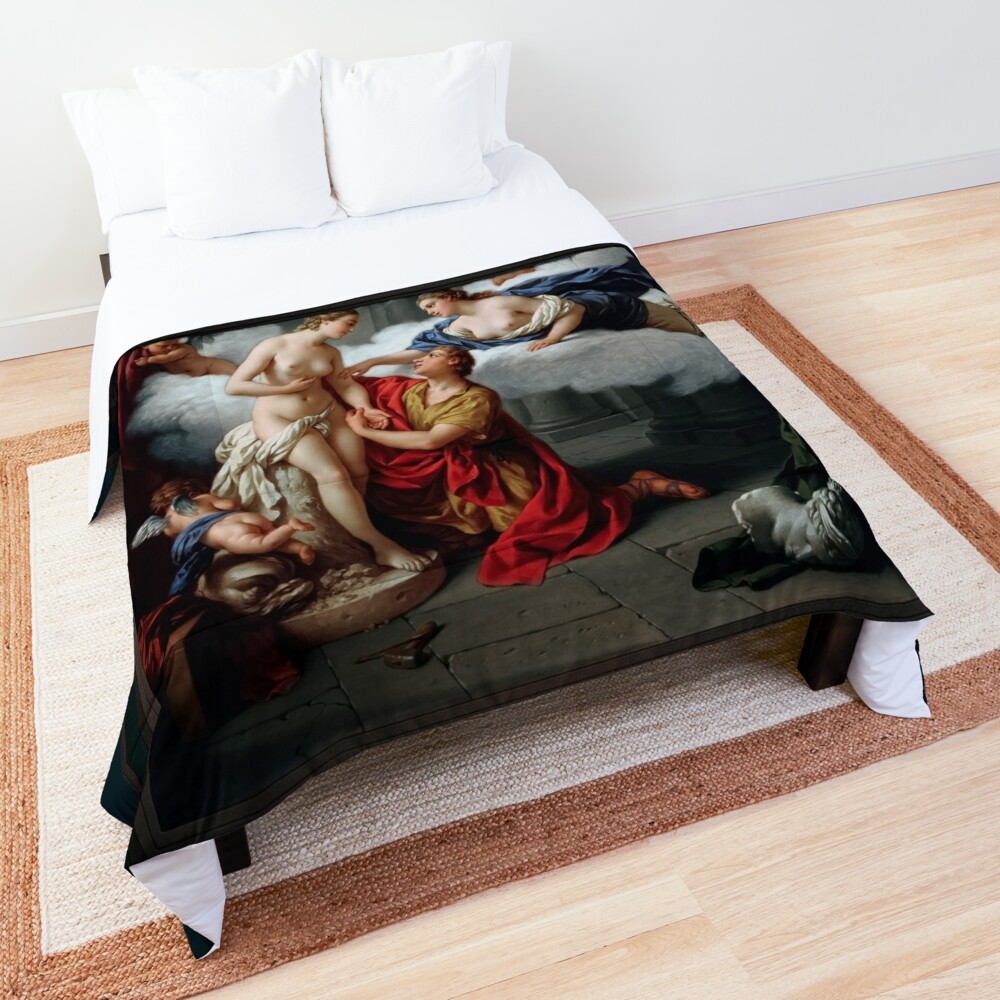
Pygmalion Agus an Ìomhaigh aige c1777 na dheagh eisimpleir de ealain Neoclassical, air a chruthachadh leis an neach-ealain Frangach Louis-Jean-François Lagrenée (1725 – 1805). Am pìos, a chaidh a chrìochnachadh timcheall 1777, stèidhichte air sgeulachd miotas-eòlasach Pygmalion, an snaidheadair a thuiteas ann an gaol leis an ìomhaigh de bhoireannach a chruthaich e, agus a mhiann air an iomhaigh gu teachd beò. Tha an aithris a rinn Lagrenée den uirsgeul seo a’ measgachadh bheachdan clasaigeach le faireachdainn, càileachd cha mhòr diadhaidh, a’ toirt a-steach an ceangal domhainn tòcail eadar duine agus ealain.
Tha cothlamadh an deilbh air a lìonadh le mion-fhiosrachadh toinnte, bho aodach beairteach gu dealbhachadh ethereal de na diathan agus feartan beatha na h-ìomhaigh. Tha cleachdadh fìnealta Lagrenée de sholas is dubhar a’ cruthachadh eadar-dhealachadh beòthail, enhancing the sensuality of the figures and elevating the moment of transformation. The presence of figures like Cupid and other deities introduces a sense of divine intervention, as if to witness the miraculous event unfolding.
Clàr-innse
Am prìomh chuspair agus figearan
The focal point of the painting is the statue of a woman, sculpted by Pygmalion, who is positioned at the center of the composition. She is depicted with grace and beauty, her form idealized according to classical standards. A corp, crafted from stone, exudes a sense of life-like stillness, as if she is about to come to life. Surrounding her are gods and cherubs, including a prominent angel-like figure with wings. This celestial being appears to gently touch the statue’s face, imbuing it with divine life.
Pygmalion, portrayed as a man of classic beauty, kneels beside his creation, his expression one of awe and adoration. His posture suggests both reverence and longing, as he gazes at the statue, perhaps waiting for the moment when his wish will be granted. His drapery is depicted with naturalistic folds, emphasizing his connection to the classical world and the nobility of his craft.
In the upper-left corner of the painting, a group of angels and gods, including Cupid with a bow, can be seen playing their roles as divine messengers. These figures serve as symbols of love and transformation, emphasizing the mythological theme of the piece. The surrounding clouds are symbolic of the ethereal realm, and their soft billowing forms contrast with the rigidity of the human figures below.
Rudan agus Cruth-tìre
The setting is an idealized classical ruin. The architecture in the background includes crumbling columns and stonework, giving a sense of antiquity to the scene. This placement in ruins suggests the decline of earthly things and the transcendence of love and artistry to the divine. The ground is rough and weathered, further enhancing the contrast between the physical and the metaphysical. These architectural elements allude to classical temples and the world of ancient Greece and Rome, grounding the narrative in a timeless and mythic space.
The objects in the foreground, including a marble pedestal and draped cloth, reinforce the theme of artistry and creation. Pygmalion’s tools, perhaps a chisel or brush, are suggested by the scattered objects near his feet, symbolizing the artist’s devotion to his craft and his ability to mold life from inanimate matter. The rich textures of the cloth draped around the figures, with its flowing and billowing folds, further highlight the sensuality and grace of the scene.
Stuthan agus dhòighean
Lagrenée’s technique in Pygmalion And His Statue reveals a mastery of oil painting, showcasing a precise yet fluid application of paint. The skin tones of both Pygmalion and his statue are rendered with remarkable subtlety, each figure’s form modeled with chiaroscuro, which enhances the three-dimensionality of the figures. The use of light and shadow contrasts beautifully, especially on the statue, whose smooth, polished surface is illuminated in a way that accentuates its lifelike appearance.
The artist’s careful attention to texture is evident in the treatment of the fabrics. The soft drapery is contrasted against the harder surfaces of stone and marble, giving the scene a sense of depth and tactile richness. Lagrenée’s use of color is also noteworthy, with the pale hues of the statue and the soft pinks and blues of the surrounding figures bringing a serene yet dramatic vibrancy to the overall composition.
The figures themselves are modeled in a classical style, embodying the elegance and grace of Greek and Roman statuary. Pygmalion’s muscular form and the curvaceous, idealized features of the statue reflect the artistic values of the time. The softer, feartan bruadar nan sgòthan mun cuairt agus na figearan nèamhaidh, còmhla ris na h-eileamaidean nas bunaitiche de na figearan daonna agus tobhtaichean ailtireachd, cruthaich co-sheirm eadar an duine talmhaidh agus an Dia.
Stoidhle, Cuspair, agus Mood
Pygmalion And His Statue gun teagamh a’ toirt buaidh air beachdan na h-ùine Neoclassical. Tilleadh gu cuspairean clasaigeach, còmhla ri urram do sheannachd Ghreugach agus Ròmanach, ri fhaicinn anns an dealbh de Pygmalion mar ghaisgeach miotas. An cuspair cruth-atharrachadh, an dà chuid corporra agus spioradail, aig cridhe na h-aithris, a’ soilleireachadh cumhachd ealain agus gràidh gus faighinn thairis air suidheachadh daonna. Tha Lagrenée a’ toirt buaidh air an t-sealladh le faireachdainn de dh’ urram agus de dh’ iongnadh, mar a bheir na diathan am beannachd air an neach-ealain agus air a chruthachadh. Tha na smuaintean romansach agus ciallach air an teannachadh le mothachadh air eadar-theachd diadhaidh, a’ moladh nach urrainn fìor ghràdh agus cruthachadh a bhith air an làn choileanadh ach le suathadh na diadhachd.
Tha faireachdainn iomlan an deilbh mar aon de mhothachadh sàmhach agus iongnadh. Sealladh fada Pygmalion agus an tairgse, Tha eadar-obrachadh cha mhòr naomh eadar an ìomhaigh agus na creutairean celestial a 'cruthachadh mothachadh air gràdh diadhaidh, a’ cur an cuimhne an neach-coimhead an eadar-ghearradh eadar ealain daonna agus na diathan’ eadar-theachd ann an cùisean bàsmhor. Tha an obair seo a’ bruidhinn ri cumhachd maireannach miotas, gaol, agus cruthachadh.
Obair-ealain cùl-taic
Is e seo dealbh tarraingeach eile de sgeulachd Miotas-eòlas na Grèige Pygmalion agus Galatea; anns a bheil an deilbheadh cloiche a chruthaich Pygmalion air a shealbhachadh le beatha Bana-dia a’ ghràidh, Aphrodite, mar fhreagradh do urnuigh a rinn e.
Anns an t-sealladh seo chì sinn Pygmalion air a ghlùin chlì, with his right arm around the back of Galatea and his left hand holding her left hand as she is transitioning from a beautiful woman of stone into a beautiful woman of flesh and blood.
By Galatea to her right and near to her leg is a cherub floating above the head of a sculpted fish which makes up part of the sculpture from which Galatea has been created, adjusting part of a robe that is affixed to her waist and between her legs.
Behind her is another cherub floating on a large white cloud that is also supporting the Goddess of Love, Aphrodite and another cherub above her; this cherub is pushing a deep wine red drape to the side and looking at the marvel that is taking place.
Pygmalion And His Statue Before and After Remastering Video View
Behind and to the right of Pygmalion is Aphrodite, laying down on the cloud and touch Galatea so that the sculpture can turn into a human being; and above her on the other part of the cloud is the third cherub that is holding a gold torch that is ablaze, with smoke flowing in the direction of Galatea.
All this is occurring in the sculptors studio of Pygmalion, away from prying eyes and the open courtyard that is comprised of large stone columns, stone walls, and stone beams.
In his work area we can see a wooden stool to the right of sculpture, as well as a hammer and chisel on the floor in front of the sculpture; and to the right front of the scene is a wooden bench with a red cushion top with a green cloak draped over it and on the floor that as a partially broken stone bust of the Goddess Aphrodite resting on it.
Pygmalion And His Statue is a remastered digital art old masters reproduction of a public domain image that is available as canvas, acrylic wood and metal prints online.
Neach-ealain Bio
Fiosrachadh gu h-ìosal a thàinig bho Wikipedia.org
Louis was born in Paris, anns an Fhraing 1724, and was the eldest of two brothers, both destined to become noted French painters; and from an early age demonstrated an aptitude for drawing and painting.
Louis started his artistic through the École royale des élèves protégés or Royal School for Protected Pupils, a chaidh a stèidheachadh ann an 1748 under the direction of Charles Antoine Coypel (1694 – 1752) by the King of France Louis XV.
Thabhainn prìomh pheantairean Acadamaidh Rìoghail na Frainge cùrsa ealain don phoball airson cosgais ainmichte ann an tarraing agus prionnsapalan agus dòighean ealain; leigeadh seo leis na maighstirean taghadh bhon fheadhainn a chlàraich a’ chùrsa, sianar de na daoine as tàlantaich gach bliadhna a gheibheadh oideachadh an-asgaidh agus stìpean beag airson trì bliadhna; agus ullaich na h-oileanaich airson farpaisean Prix de Rome.
Às deidh dha a bhith air a thaghadh airson a’ phrògram, Thòisich Louis air an trèanadh aige fo stiùireadh Carle van Loo (1705 – 1765); agus air a cheud oidhirp a steach 1749 choisinn e am Prix de Rome leis an dealbh Bhìoballach aige “Ioseph ag eadar-mhìneachadh aislingean Pharaoh”.
Rè a chuid ùine aig Acadamaidh na Frainge anns an Ròimh bhiodh Louis a 'toirt seachad a chuid ùine don stoidhle peantaidh Baróc; a chaidh a bhrosnachadh le Sgoil Bolognese agus obair peantairean Eadailteach Francesco Albani (1578 – 1660) agus Guido Reni (1575-1642).
Ceithir bliadhna an dèidh sin thill e dhan Fhraing, agus thòisich e ag obair air Fuadach Dejaneira leis an Centaur Nessus; air crìoch a chur air a’ phìos 2 bliadhnaichean an dèidh sin 1755, choisinn e bhòt aona-ghuthach dha, ballrachd don Acadamaidh Peantadh is Deilbhidh; ga stèidheachadh mar pheantair follaiseach.
Bhon àm seo a-mach gheibheadh Louis mòran choimiseanan bho luchd-taic cliùiteach, buill den choimhearsnachd ionmhais a tha a’ fàs, a bharrachd air rìoghalachd; nuair a ghlac e aire Ealasaid Petrovna, Bana-phrionnsa na Ruis, WHO, a-steach 1760, chuir e an dreuchd e na pheantair cùirte agus na stiùiriche air an Acadamaidh aig St. Petersburg.