

Reading Woman ~c1866
Ivan Kramskoi’s painting Femme lisant (c. ~1866) is a tender and intimate portrait of his wife, embodying the quiet, reflective moments that so often elude the public eye in art history. Created during the latter part of Kramskoi’s life, the artwork highlights his mastery in capturing emotional depth through the use of light, texture, et détail. Kramskoi, né dans 1837 et passant 1887, was a renowned Russian painter, known for his contribution to the Russian realist movement and his delicate portrayals of women, often using them as symbols of moral and intellectual pursuit.
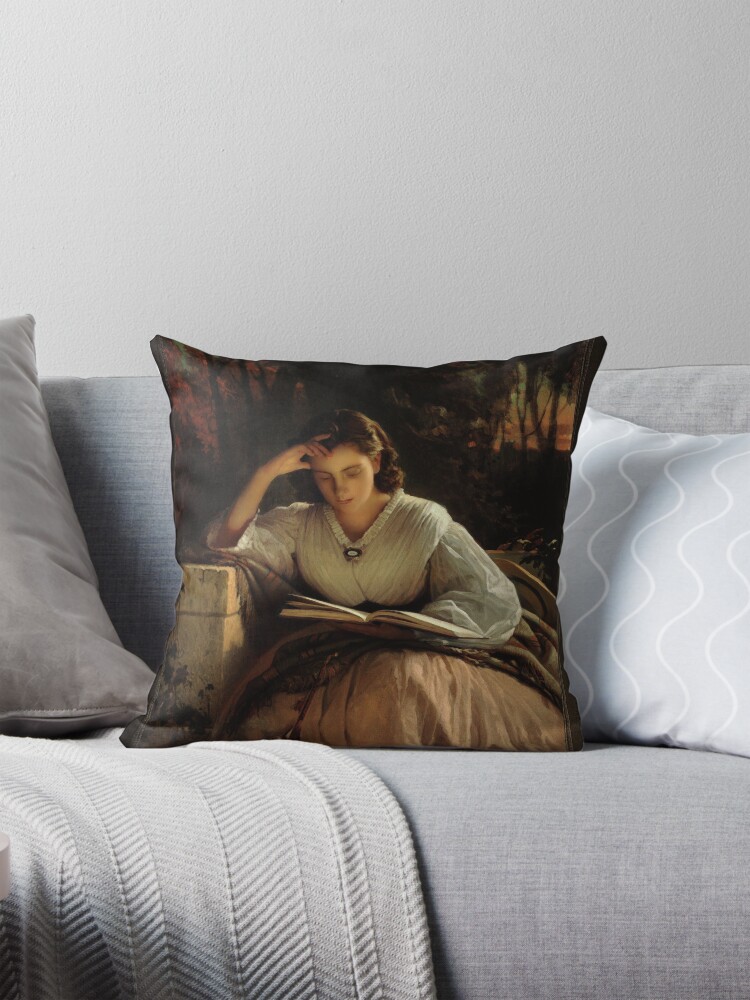
Table des matières
Sujet et composition
Le personnage central du tableau est une jeune femme, portrayed deeply immersed in a book. She is seated comfortably outdoors, leaning slightly forward with one hand resting against her forehead, as if pondering or reflecting on the contents of her reading. The book, though not the focal point, serves as a subtle nod to intellectual engagement and personal contemplation. The woman’s posture conveys a sense of quiet introspection and concentration, emphasizing a theme of solitude and intellectual pursuit that was cherished during the 19th century, particularly by the Russian intelligentsia.
Le modèle, widely accepted as Kramskoi’s wife, is depicted in the calm serenity of her private space, a setting far removed from the public world. She is dressed in a simple, elegant white gown, indicative of modesty and respectability, with a deep neckline that subtly hints at the fashionable yet reserved Victorian style. The fabric of her dress flows gently over the armrest, suggesting her stillness and composure. The light source, likely natural sunlight, illuminates the subject’s face, highlighting her soft features and youthful expression. This soft light contributes to the painting’s intimate mood, suggesting a moment frozen in time.
Setting and Surroundings
The painting is set in a lush outdoor environment, possibly a garden or a secluded courtyard. Behind the seated woman, the landscape is gently blurred, filled with warm autumnal tones of red and brown, the edges softened to create a dreamy, almost ethereal backdrop. This background, though not highly detailed, complements the subject’s mood and highlights the calm tranquility of the scene. The surrounding foliage and the faint suggestion of trees offer a peaceful and contemplative atmosphere, subtly drawing the viewer’s attention back to the subject, rather than the surroundings.
À gauche, a stone structure or seat appears, possibly an architectural element of the garden. This feature serves not only as an anchor for the figure but also symbolizes a certain permanence and timelessness, as though the woman is a part of this natural world—grounded and enduring. The greenery that surrounds her suggests both natural beauty and a harmonious coexistence with the world around her.
Ambiance et thème
L'ambiance de Femme lisant is one of quiet contemplation and intellectual solitude. There is an air of serenity and introspection, evoking a sense of deep thought and emotional reflection. The woman’s gaze is focused, her mind fully absorbed in the pages before her, while her posture suggests that this is a moment of peaceful solitude rather than active engagement with the outside world.
Kramskoi’s choice of a woman as the subject aligns with his broader thematic explorations of the inner lives of women. The painting’s theme may suggest the delicate balance between the external world and inner reflection, offering a glimpse into the private, intellectual world of a woman during the 19th century. The contemplative nature of the painting speaks to the broader social ideals of the time, where intellectual pursuits were increasingly recognized as a valuable part of a woman’s role, despite the constraints placed upon her in the public sphere.
Technique and Style
Kramskoi’s style is marked by precision and meticulous attention to detail, characteristics that are evident in Femme lisant. The artist uses light with great sensitivity, allowing it to both highlight and soften the subject’s features. The subtle interplay between light and shadow emphasizes the texture of the woman’s clothing, her facial features, and the depth of her emotions. Her delicate features are rendered with exquisite care, from the softness of her skin to the expression in her eyes, suggesting a depth of thought and a quiet beauty.
The artist’s use of color is restrained but impactful. The muted tones of the figure’s clothing contrast with the warmth of the surrounding landscape, subtly drawing attention to the subject without overpowering the natural beauty of the setting. The earth tones, such as the browns and reds in the background, create a harmonious atmosphere that ties the figure to the land and suggests a timelessness about the scene.
Kramskoi’s realism is apparent in his treatment of texture, lumière, and shadow, but his approach is softened by the romantic undercurrent of his subjects. Le contexte, rendered with softer brushstrokes, contrasts with the more sharply defined woman, drawing the viewer’s focus to her as the central figure. The result is a balanced composition, where the subject is the clear focal point, yet the surrounding environment is fully integrated into the narrative of the painting.
Conclusion
Femme lisant (Portrait de la femme de l'artiste) by Ivan Kramskoi is a masterpiece of 19th-century Russian art that combines intimate portraiture with the intellectual themes of its time. Through the serene depiction of his wife, Kramskoi explores the intersection of private life, intellectual curiosity, and emotional depth. The painting offers a glimpse into the quiet, reflective moments of the subject’s life, underscoring the artist’s ability to render the subtle complexities of human emotion. Kramskoi’s skillful use of light, texture, and color adds layers of depth to this otherwise simple scene, creating a powerful narrative that continues to resonate with viewers.
Femme lisant (Portrait de la femme de l'artiste) par c~1866 par Peintre russe Ivan Kramskoï (1837 – 1887); et un leader intellectuel du mouvement artistique démocratique russe (The Wanderers ou The Itinerants en anglais: Un groupe d'artistes réalistes russes qui ont formé un groupe d'artistes’ coopérative pour protester contre les restrictions académiques) de 1860 – 1880
C'est magnifique portrait d'une jeune femme dans un jardin (qui est la femme du peintre); à l'approche du crépuscule, reposez son bras droit sur le rebord d'un grand banc de pierre sur lequel elle est assise, qui a des vignes sur sa face avant; tandis qu'elle appuie son front sur les doigts de sa main droite, avec la tête légèrement inclinée vers l'avant.
Sa main gauche ouverte repose sur ses genoux au-dessus d'un châle vert clair à rayures rouges qui se trouve également sous son bras droit sur le rebord de pierre; soutenant un grand livre ouvert qu'elle lit dans la lumière du soleil déclinante à l'approche du soir.
Elle porte un chemisier blanc avec un col à volants et un pendentif au centre de la ligne du col en V, ainsi qu'une ceinture de couleur foncée autour de sa taille et une grande jupe marron pleine longueur.
Sur le devant de la jupe, il y a un parapluie appuyé contre elle et derrière elle se trouve un chapeau de paille à large bord avec une bande sombre autour de la base; et quelques plantes.
En arrière-plan, nous pouvons voir des arbres aux feuilles rouges ainsi que des arbres aux feuilles vertes et le soleil assis alors que le ciel bleu avec des nuages passe à une couleur orange.
Il s'agit d'une reproduction de maîtres anciens d'art numérique remasterisée d'une image du domaine public qui est disponible sous forme d'impression sur toile en ligne.