

Sarah Bernhardt In La Princesse Lointaine
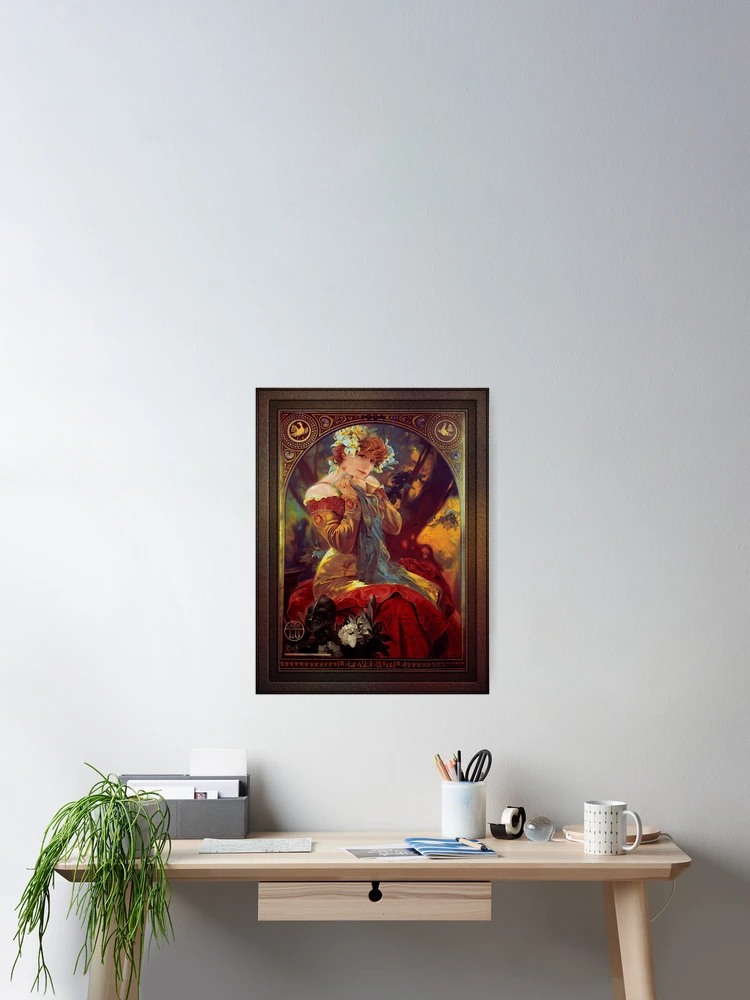
“Sarah Bernhardt in La Princesse Lointaine c1904 – Lefevre-Utile” is a striking poster artwork created by Czech artist Alfonso Mucha (1860 – 1939). This artwork was produced to promote the play “La Princesse Lointaine,” in which Sarah Bernhardt, one of the most renowned actresses of the late 19th and early 20th centuries, performed.
The piece captures the elegance and mystique of Bernhardt, portrayed in a dramatic yet graceful manner, representing her as an ethereal and regal figure. The poster, kreita en 1904, is a masterful example of Mucha’s distinctive Art Nouveau style, characterized by flowing lines, intricate floral patterns, and a harmonious balance between figure and decorative elements. The work is a visual testament to Mucha’s ability to blend commercial art with fine art, creating an iconic image that represents both the art of the period and the cultural significance of the actress.
Enhavtabelo
Ĉefa temo: Sarah Bernhardt as La Princesse Lointaine
The main subject of the artwork is Sarah Bernhardt herself, depicted as the central figure of the piece, enveloped in opulence and grace. She is shown in a romantic pose, standing serenely against a background of soft, ethereal light that suggests a mythical or dreamlike setting. Bernhardt’s facial expression is one of gentle contemplation, with her hand lightly clutching a piece of fabric, which drapes over her shoulders. This pose, along with her elegantly dressed appearance, emphasizes her noble and otherworldly persona, drawing attention to her as both an actress and a symbol of femininity and beauty.
Ŝia vesto, a richly detailed gown, is rendered in soft, flowing lines that enhance the fluidity of the composition. The gown’s colors—primarily golden hues accented with deep reds—add a sense of grandeur and sophistication to the portrayal, aligning with her role as a royal or princess in the play. The floral motif woven throughout her gown suggests both beauty and nature, further reinforcing the themes of grace and elegance. The flowers are not only part of the decorative elements of the composition but also tie into the symbolism of purity, beleco, and femininity that pervades the artwork.
Decorative and Symbolic Elements
Surrounding Sarah Bernhardt are a series of detailed and carefully constructed decorative elements, characteristic of Mucha’s Art Nouveau style. The arches and rounded edges framing the piece create a sense of harmony and enclosure, focusing the viewer’s attention on Bernhardt. The flowing, curvilinear lines that move outward from the central figure evoke the organic, natural forms seen in Mucha’s signature style. These lines are accompanied by intricate, stylized floral patterns that fill the space, creating a sense of movement that contrasts with the stillness of Bernhardt herself.
At the top of the composition, we see two symbolic emblems, a bird and a crescent moon, both recurring motifs in Mucha’s work, representing themes of transcendence, spiriteco, and the eternal. The bird may symbolize freedom or an ethereal connection, while the crescent moon often reflects the feminine and mystical aspects of the work. These symbols enhance the dreamlike quality of the scene, giving it an almost otherworldly atmosphere that elevates the portrayal of Bernhardt to a mythic status.
Tereno kaj fono
The background of the artwork is subtly painted, kun mola, muted colors that contrast against the vivid detailing of the central figure and surrounding elements. The use of an organic, flowing backdrop with indistinct shapes suggests a natural environment, perhaps a garden or a distant landscape. While the background does not contain any hard, detailed elements that draw attention away from Bernhardt, it still serves to reinforce the overall mood of the piece, which is tranquil and reverent. The lack of detailed realism in the background contrasts with the detailed figure of the actress, allowing her to remain the focal point of the piece while the background softly recedes into abstraction.
Style and Mood
Mucha’s style in this artwork is quintessentially Art Nouveau, characterized by elegant curves, fluantaj linioj, and a sense of natural harmony. The fine detail of the clothing, the delicate patterns of the flowers, and the symmetrical framing all contribute to a sense of balance and beauty. La koloroj, while rich and deep, are applied in a way that suggests softness rather than harsh contrast, reinforcing the graceful, dreamlike atmosphere of the image.
The mood of the artwork is one of reverence and ethereal beauty. The central figure of Bernhardt is not merely an actress but a figure elevated to the status of a princess, embodying qualities of nobility, Eleganteco, kaj transcendeco. There is a calm and serene quality to the portrayal, with the actress seemingly existing in a moment of quiet contemplation. This tranquil mood, combined with the flowing design and symbolic elements, creates an atmosphere of romanticism and otherworldliness.
Materialoj kaj teknikoj
As was typical for Mucha’s commercial work, the poster would have been created using lithographic techniques, which allowed for mass production of the artwork. This method would have enabled the poster to be reproduced and distributed widely, ensuring its visibility in public spaces and its role in promoting the play. Despite the commercial nature of the piece, Mucha’s artistic approach ensures that the image remains a work of fine art. His use of color, Kompleksaj Detaloj, and symbolic motifs all contribute to the aesthetic beauty of the piece, making it a work that transcends its advertising purpose.
Konkludo
“Sarah Bernhardt in La Princesse Lointaine c1904” is a quintessential example of Mucha’s Art Nouveau style, blending intricate design with the graceful portrayal of one of the most famous actresses of the time. Through the use of flowing lines, symbolic elements, and a harmonious color palette, the artwork evokes a sense of beauty, Eleganteco, kaj mistikismo. The depiction of Sarah Bernhardt, elevated to the status of a regal figure, underscores her status as an icon of femininity and allure. This piece remains an important example of Mucha’s mastery of the Art Nouveau style and his ability to elevate commercial art to the level of fine art.
Ĉi tio estas retuŝita cifereca arto malnova majstra reproduktaĵo de publika domajno bildo.
Artisto Bio
Informoj Malsupre De Vikipedio.org
Alfons Maria Mucha Julio 24, 1860 – julio 14, 1939), estis konata internacie kiel Alphonse Mucha. Li estis eminenta ĉeĥa pentristo, ilustristo kaj grafikisto, vivante en Parizo dum la Secesio-periodo, kaj estas plej konata pro siaj klare stiligitaj kaj dekoraciaj teatraj afiŝoj, precipe tiuj de Sarah Bernhardt.
Li produktis ilustraĵojn, reklamoj, ornamaj paneloj, kaj dezajnoj, kiu iĝis inter la plej konataj bildoj de la periodo.
En la dua parto de lia kariero, en la aĝo de 43, li revenis al sia patrujo de Bohemia-Moravia regiono en Aŭstrio kaj dediĉis sin al pentrado de serio de dudek monumentaj kanvasoj konataj kiel La Slava Epopeo., prezentante la historion de ĉiuj slavaj popoloj de la mondo, kiujn li pentris inter 1912 kaj 1926.
En 1928, en la 10-a datreveno de la sendependiĝo de Ĉeĥoslovakio, li prezentis la serion al la ĉeĥa nacio. Li konsideris ĝin lia plej grava verko. Ĝi nun estas elmontrita en Prago.