

Satin Rose
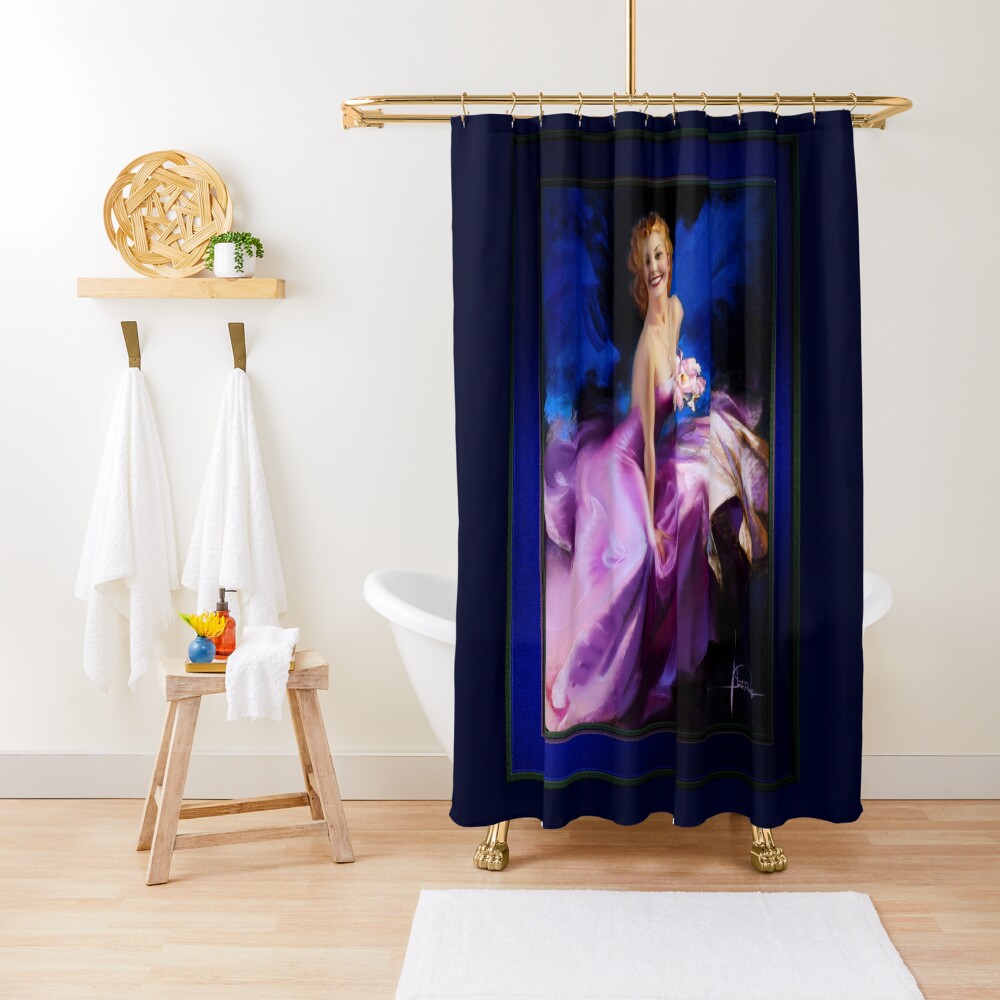
“Satin Rose” (1930), painted by the renowned American artist Rolf Armstrong (1889-1960), is an exemplary piece of early 20th-century American portraiture. Known for his luminous depictions of women in fashionable attire, Armstrong’s work captures a sense of beauty and elegance that resonates with the spirit of the Jazz Age and the Art Deco period. In this particular piece, Armstrong presents an image of femininity and grace, illustrating the intricate details of a woman in a soft, satin gown.
Taula de continguts
El tema principal
“Satin Rose” is a young woman poised gracefully, her figure rendered with a delicate balance of light and shadow. She is the embodiment of youthful beauty, wearing a gown that flows and ripples around her in soft waves. El vestit, primarily a lavender satin, gleams in the light, its smooth fabric accentuated by folds and creases that give it a rich, almost tactile quality. Armstrong’s mastery of texture is evident in his treatment of the satin fabric, which shimmers with the soft sheen that is characteristic of this luxurious material.
Estil, Tècnica, i Mitjana
The woman’s face is full of vitality, exuding joy and warmth. Her smile is subtle but confident, and her eyes are directed toward the viewer, establishing a sense of direct engagement. Ella suau, wavy blonde hair frames her face in an effortless, yet elegant manner. The roses she holds in her right hand, delicately grasped, add a touch of romance and softness to the composition, their pale pink petals mirroring the delicate hues of the gown. Armstrong’s use of flowers is not just ornamental; they symbolize beauty, feminitat, i gràcia, further emphasizing the overall theme of the painting.
The background of the piece is richly colored with abstract brushstrokes that suggest a dreamy, almost ethereal quality. The deep blue tones of the background contrast with the soft, lighter shades of the woman’s gown, helping her figure to stand out as the central focus. This contrast between the warm lavender tones of the figure and the cool blues of the background creates a sense of depth and dimension, which enhances the realism of the portrait. The soft gradations of color contribute to the overall serene atmosphere of the work, where the light seems to caress the surface of the satin fabric, further enhancing the mood of elegance.
Objectes i composició
The composition is tightly focused on the figure, capturing her in a moment of serene joy. Armstrong’s decision to leave the background somewhat abstract and blurred directs the viewer’s attention entirely to the subject. This emphasis on the figure over the surroundings is a characteristic feature of many of Armstrong’s works, where the human form is celebrated in its natural beauty.
Armstrong’s style in “Satin Rose” exemplifies his signature technique of blending realism with a certain idealized quality. The portraiture is not merely a representation of a woman but rather an exploration of beauty, elegància, i gràcia. The artist’s use of light and shadow is subtle yet effective, highlighting the contours of the woman’s face and the folds of her gown in a way that gives the painting a sense of dimensionality. Armstrong’s skill in capturing fabric, en particular, is unparalleled, and the way the satin gown appears to catch and reflect the light gives it a fluid, almost living quality.
Tema i estat d’ànim
El tema de “Satin Rose” is deeply rooted in the early 20th century’s appreciation for beauty and fashion, reflecting the cultural preoccupations of the time. The 1930s was an era that celebrated glamour, sofisticació, and modern femininity, and Armstrong’s work is an embodiment of these ideals. The use of satin fabric, the emphasis on luxurious textures, and the delicate portrayal of a young woman’s radiant beauty all speak to the high regard for elegance that permeated the social and artistic landscapes of the time.
The mood of the painting is one of warmth and serenity. The woman’s gentle smile, the soft folds of her gown, and the serene blue backdrop create an atmosphere of calm elegance. There is a sense of intimacy in the work, as if the viewer is being invited into a private moment with the subject, who stands before us in a poised yet approachable manner. The artist does not present her as an unattainable ideal but as a woman of grace and dignity, who radiates an inner beauty as much as the external qualities the painting depicts.
Conclusió
Pel que fa als materials, Armstrong employed traditional oil paints, using the medium to build up layers of color that add depth and texture to the scene. The painting’s surface, rich in color and form, highlights Armstrong’s ability to create smooth, almost luminescent textures, particularly in the depiction of fabric and skin. The piece is framed in a classical style, with a rich blue border that complements the tones of the background and further enhances the visual impact of the work.
Satin Rose is a remastered digital art old masters reproduction of a public domain image that is available as a canvas, acrílic i impressió metàl·lica en línia.
Biografia de l'artista derivada de Wikipedia.org
Rolf Armstrong va néixer John Scott Armstrong a Bay City, Michigan l’abril 21, 1889, a Richard i Harriet (Scott) Armstrong. El seu pare era propietari de la Boy-Line Fire Boat Company, que incloïa una línia de vaixells de passatgers. Alguns es van desplegar a Chicago per utilitzar-los a la Fira Mundial de Chicago, allà 1893.
malgrat això, els negocis i la família del pare tenien problemes, i la propietat familiar es va perdre a causa de l'execució hipotecària. En 1899, la família es va traslladar a Detroit, Michigan. El pare de Rolf va morir a 1903, i un any després, ell i la seva mare es van traslladar a Seattle, Washington, seguint els passos del seu germà gran, Guillem, que s’hi havia mudat un any abans. A hores d’ara, els interessos artístics de Rolf emergien a més d’un plaer a temps parcial.
Es va traslladar a Chicago a 1908, on posteriorment va estudiar a l'Institut d'Art. Després va anar a Nova York, on va estudiar amb Robert Henri. Després d 'un viatge a París a París 1919 per estudiar a l'Académie Julian, va tornar a Nova York i va establir un estudi. En 1921 he went to Minneapolis to study calendar production at Brown & Bigelow.
Durant els anys 1920 i 1930, la seva obra va aparèixer en moltes partitures, així com a les portades de moltes revistes, més famós per a revistes de fans de cinema com Photoplay i Screenland. La seva obra està formada majoritàriament per dones; Mary Pickford, Beu Daniels, i Greta Garbo són només alguns dels nombrosos que va pintar.
Armstrong’s work for the Pictorial Review was largely responsible for that magazine achieving a circulation of more than two million by 1926. Un any després, va ser l'artista de calendari més venut a Brown & Bigelow. En 1930, RCA el va contractar per pintar pin-ups per anunciar els seus productes, i dins 1933 el Thomas D. Murphy Calendar Company el va signar per produir una sèrie de pintures per a la seva línia.
In March 1940, Jewel Flowers, a girl from Lumberton, North Carolina, sent a picture of herself to Armstrong in response to an advert he had placed in the New York Times. Armstrong, 50 at the time, had been based at the Hotel des Artistes on West 67th Street in Manhattan since 1939, and was looking for new models.
He invited Flowers for an interview. On March 25, 1940, Flowers started modeling for Armstrong. Their professional collaboration and friendship lasted for two decades. El primer quadre, titulat “Com estic??”, segons es diu, perquè Flowers, poc acostumat a modelar, -va preguntar repetidament a Armstrong “Com estic??” durant la sessió de modelatge, es va publicar per primera vegada després de començar la Segona Guerra Mundial.
Era Brown & El calendari més venut de Bigelow per a 1942 en un moment en què la companyia venia milions de calendaris a Amèrica, i es va convertir en una de les imatges d’Armstrong més reproduïdes. Flowers va ser popular entre els militars nord-americans durant la Segona Guerra Mundial, alguns dels quals li van enviar cartes proposant-li matrimoni. Els calendaris i les siluetes de Flors d’Armstrong es van copiar a bombarders i altres avions com a art nasal i es van pintar sobre torretes de tancs.
Es va fer tan coneguda durant la guerra, encara que més com una cara famosa que per nom, que la carta d’un militar s’adreçava simplement com “Jewel Flowers, Nova York” s'ha lliurat correctament. Per a molts militars nord-americans a l'estranger, va representar el “Per què lluitem?” esperit. nosaltres. El president Franklin D.. El govern de Roosevelt la va contractar per ajudar a promoure els bons de guerra.
El gener 1, 1945 edition of TIME magazine included Armstrong’s “Toast of the Town” painting of Flowers in an article about Calendar Art. The article noted that calendars with “girl paintings” were “bought heavily by foundries, machine shops, auto-supply dealers.”
Flowers married in 1946. She and her husband lived in several places while he tried a number of business ventures, including Laguna Beach, California, Greenville, South Carolina, Reno, Nevada, where she reportedly worked in as a card dealer for a time, and New York City. According to Michael Wooldridge, coauthor of Pin up Dreams: The Glamour Art of Rolf Armstrong, Armstrong called her a number of times during the period she was following her husband from place to place, to try to persuade her to return to New York and model for him.
Her modeling career ended with Armstrong’s death in 1960. He left a large proportion of his personal wealth to Flowers. In total, Armstrong created around fifty to sixty works using Flowers as the model.
Rolf Armstrong va morir a 1960 a l'illa d'Oahu, Hawaii as one of the best “pin-up” artistes de la primera meitat del segle XX.