

Satin Rose
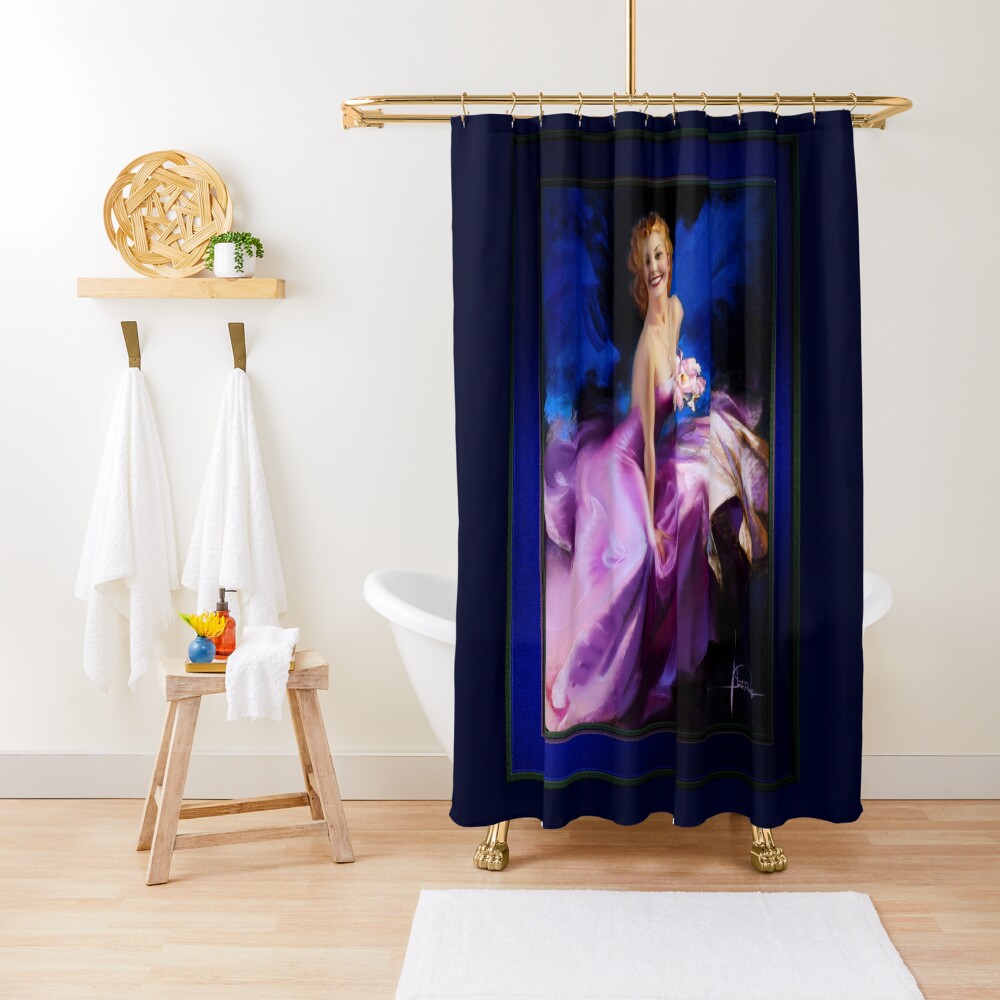
“Satin Rose” (1930), painted by the renowned American artist Rolf Armstrong (1889-1960), is an exemplary piece of early 20th-century American portraiture. Known for his luminous depictions of women in fashionable attire, Armstrong’s work captures a sense of beauty and elegance that resonates with the spirit of the Jazz Age and the Art Deco period. In this particular piece, Armstrong presents an image of femininity and grace, illustrating the intricate details of a woman in a soft, satin gown.
Inhoudsopgave
Het belangrijkste onderwerp
“Satin Rose” is a young woman poised gracefully, her figure rendered with a delicate balance of light and shadow. She is the embodiment of youthful beauty, wearing a gown that flows and ripples around her in soft waves. De jurk, primarily a lavender satin, gleams in the light, its smooth fabric accentuated by folds and creases that give it a rich, bijna tastbare kwaliteit. Armstrong’s mastery of texture is evident in his treatment of the satin fabric, which shimmers with the soft sheen that is characteristic of this luxurious material.
Stijl, Techniek, and Medium
The woman’s face is full of vitality, exuding joy and warmth. Her smile is subtle but confident, and her eyes are directed toward the viewer, establishing a sense of direct engagement. Haar zacht, wavy blonde hair frames her face in an effortless, yet elegant manner. The roses she holds in her right hand, delicately grasped, add a touch of romance and softness to the composition, their pale pink petals mirroring the delicate hues of the gown. Armstrong’s use of flowers is not just ornamental; they symbolize beauty, vrouwelijkheid, en genade, further emphasizing the overall theme of the painting.
The background of the piece is richly colored with abstract brushstrokes that suggest a dreamy, bijna etherische kwaliteit. The deep blue tones of the background contrast with the soft, lighter shades of the woman’s gown, helping her figure to stand out as the central focus. This contrast between the warm lavender tones of the figure and the cool blues of the background creates a sense of depth and dimension, which enhances the realism of the portrait. The soft gradations of color contribute to the overall serene atmosphere of the work, where the light seems to caress the surface of the satin fabric, further enhancing the mood of elegance.
Objects and Composition
The composition is tightly focused on the figure, capturing her in a moment of serene joy. Armstrong’s decision to leave the background somewhat abstract and blurred directs the viewer’s attention entirely to the subject. This emphasis on the figure over the surroundings is a characteristic feature of many of Armstrong’s works, where the human form is celebrated in its natural beauty.
Armstrong’s style in “Satin Rose” exemplifies his signature technique of blending realism with a certain idealized quality. The portraiture is not merely a representation of a woman but rather an exploration of beauty, elegantie, en genade. The artist’s use of light and shadow is subtle yet effective, highlighting the contours of the woman’s face and the folds of her gown in a way that gives the painting a sense of dimensionality. Armstrong’s skill in capturing fabric, in het bijzonder, is unparalleled, and the way the satin gown appears to catch and reflect the light gives it a fluid, almost living quality.
Thema en stemming
Het thema van “Satin Rose” is deeply rooted in the early 20th century’s appreciation for beauty and fashion, reflecting the cultural preoccupations of the time. The 1930s was an era that celebrated glamour, verfijning, and modern femininity, and Armstrong’s work is an embodiment of these ideals. The use of satin fabric, the emphasis on luxurious textures, and the delicate portrayal of a young woman’s radiant beauty all speak to the high regard for elegance that permeated the social and artistic landscapes of the time.
The mood of the painting is one of warmth and serenity. The woman’s gentle smile, the soft folds of her gown, and the serene blue backdrop create an atmosphere of calm elegance. There is a sense of intimacy in the work, as if the viewer is being invited into a private moment with the subject, who stands before us in a poised yet approachable manner. The artist does not present her as an unattainable ideal but as a woman of grace and dignity, who radiates an inner beauty as much as the external qualities the painting depicts.
Conclusie
In terms of materials, Armstrong employed traditional oil paints, using the medium to build up layers of color that add depth and texture to the scene. The painting’s surface, rich in color and form, highlights Armstrong’s ability to create smooth, almost luminescent textures, particularly in the depiction of fabric and skin. The piece is framed in a classical style, with a rich blue border that complements the tones of the background and further enhances the visual impact of the work.
Satin Rose is a remastered digital art old masters reproduction of a public domain image that is available as a canvas, acryl en metalen print online.
Bio van kunstenaar afgeleid van Wikipedia.org
Rolf Armstrong werd geboren als John Scott Armstrong in Bay City, Michigan in april 21, 1889, aan Richard en Harriet (Scott) Armstrong. Zijn vader was eigenaar van de Boy-Line Fire Boat Company, die een lijn van passagiersschepen omvatte. Sommige werden ingezet in Chicago voor gebruik op de Chicago World's Fair daar in 1893.
Echter, het bedrijf en het gezin van de vader hadden het moeilijk, en de familieboerderij ging verloren door afscherming. In 1899, het gezin verhuisde naar Detroit, Michigan. Rolf's vader stierf in 1903, en een jaar later verhuisden hij en zijn moeder naar Seattle, Washington, in de voetsporen treden van zijn oudste broer, Willem, die daar een jaar eerder was verhuisd. Inmiddels waren Rolfs artistieke interesses uitgegroeid tot meer dan een parttime plezier.
Hij verhuisde naar Chicago in 1908, waar hij later studeerde aan het Art Institute. Daarna ging hij naar New York, waar hij studeerde bij Robert Henri. Na een reis naar Parijs in 1919 studeren aan de Académie Julian, hij keerde terug naar New York en richtte een studio op. In 1921 hij ging naar Minneapolis om kalenderproductie te studeren bij Brown & Bigelow.
Tijdens de jaren 1920 en 1930, zijn werk verscheen op veel bladmuziek, evenals op de covers van vele tijdschriften, het meest bekend voor filmfanmagazines zoals Photoplay en Screenland. Zijn werk bestaat voornamelijk uit vrouwen; Mary Pickford, Bebe Daniels, en Greta Garbo zijn slechts enkele van de vele die hij schilderde.
Armstrongs werk voor de Pictorial Review was er grotendeels verantwoordelijk voor dat dat tijdschrift een oplage van meer dan twee miljoen per jaar bereikte 1926. Een jaar later, hij was de bestverkopende kalenderkunstenaar bij Brown & Bigelow. In 1930, RCA huurde hem in om pin-ups te schilderen om reclame te maken voor hun producten, en in 1933 de Thomas D. Murphy Calendar Company heeft hem getekend om een reeks schilderijen voor hun lijn te produceren.
In maart 1940, Juweel Bloemen, een meisje uit Lumberton, Noord Carolina, stuurde een foto van zichzelf naar Armstrong als reactie op een advertentie die hij in de New York Times had geplaatst. Armstrong, 50 op dat moment, was gevestigd in het Hotel des Artistes op West 67th Street in Manhattan sinds 1939, en was op zoek naar nieuwe modellen.
Hij nodigde Flowers uit voor een interview. op maart 25, 1940, Flowers begon te modelleren voor Armstrong. Hun professionele samenwerking en vriendschap duurde twee decennia. Het eerste schilderij, met een adellijke titel “Hoe gaat het met mij?”, naar verluidt omdat Flowers, niet gewend aan modellenwerk, herhaaldelijk gevraagd Armstrong “Hoe gaat het met mij?” tijdens de modellensessie, werd voor het eerst gepubliceerd nadat de Tweede Wereldoorlog was begonnen.
Het was Brown & De bestverkochte kalender van Bigelow voor 1942 in een tijd dat het bedrijf miljoenen kalenders in Amerika verkocht, en het werd een van Armstrongs meest gereproduceerde foto's. Flowers was populair bij Amerikaanse militairen tijdens de Tweede Wereldoorlog, van wie sommigen haar brieven stuurden met een huwelijksaanzoek. Armstrongs kalenders en silhouetten van bloemen werden gekopieerd op bommenwerpers en andere vliegtuigen als neuskunst en geschilderd op tankkoepels.
Ze werd zo bekend tijdens de oorlog, hoewel meer als een beroemd gezicht dan bij naam, dat de brief van een militair eenvoudig was geadresseerd als: “Juweel Bloemen, New York City” werd correct geleverd. Voor veel Amerikaanse militairen in het buitenland, zij vertegenwoordigde de “Waarom we vechten?” geest. ONS. President Franklin D. De regering van Roosevelt schakelde haar in om oorlogsobligaties te helpen bevorderen.
de januari 1, 1945 editie van TIME magazine inclusief Armstrong's “Toast van de stad” schilderij van bloemen in een artikel over kalenderkunst. Het artikel merkte op dat kalenders met “meisjes schilderijen” waren “zwaar gekocht door gieterijen, machine winkels, auto-supply dealers.”
Bloemen getrouwd in 1946. Zij en haar man woonden op verschillende plaatsen terwijl hij een aantal zakelijke ondernemingen probeerde, inclusief Laguna Beach, Californië, Greenville, zuid Carolina, Reno, Nevada, waar ze naar verluidt een tijdlang als kaartdealer heeft gewerkt, en New York City. Volgens Michael Wooldridge, co-auteur van Pin up Dreams: De glamourkunst van Rolf Armstrong, Armstrong belde haar een aantal keer tijdens de periode dat ze haar man van plaats tot plaats volgde, om te proberen haar over te halen terug te keren naar New York en voor hem te modelleren.
Haar modellencarrière eindigde met de dood van Armstrong in 1960. Hij liet een groot deel van zijn persoonlijke rijkdom na aan Flowers. In totaal, Armstrong maakte ongeveer vijftig tot zestig werken met Flowers als model.
Rolf Armstrong stierf in 1960 op het eiland Oahu, Hawaii als een van de beste “vastpinnen” kunstenaars uit de eerste helft van de twintigste eeuw.