

Sharing The News c1904
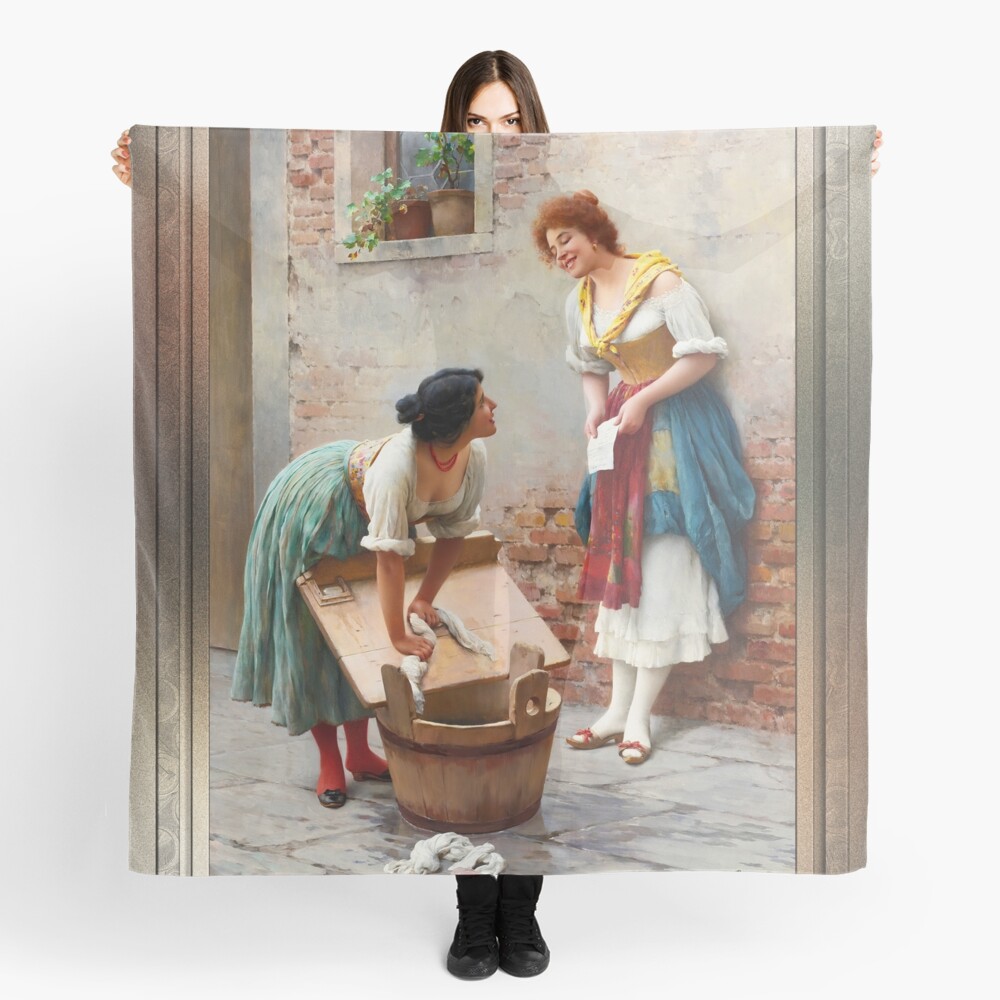
“Sharing The News,” vytvořeno v 1904 od známého italského malíře Eugen von Blaas (1843 – 1931), is a captivating scene that masterfully combines realism with an emotional narrative. The painting is an exquisite example of Blaas’ skill in portraying everyday life, particularly the lives of women in the early 20th century. Through his meticulous attention to detail, vivid color palette, and masterful brushwork, he creates a scene full of life and warmth, filled with vibrant storytelling.
Obsah
Main Subject and Figures
The central theme of the artwork revolves around two women in an intimate moment of conversation. One woman is bending over a large wooden tub, presumably to tend to laundry, while the other stands beside her with an expression of amusement or delight. The woman on the left, engaged in a domestic task, is depicted wearing a modest but vibrant dress with a loose blouse, typical of the time. Her dark hair is tied back, and her posture suggests a sense of modesty or perhaps humility in the act of doing chores. Her bare feet are planted firmly on the cobbled stone ground, adding to the realism of her portrayal.
The second woman, who stands on the right, is portrayed with a lively and spirited demeanor. She is dressed in an equally colorful outfit that reflects the vibrancy and dynamism of the era. The woman’s attire consists of a yellow shawl draped around her shoulders, paired with a flowing skirt that combines various colors including a deep red, modrý, and white. Her lively expression, highlighted by her slightly tilted head and a broad smile, suggests that she is sharing some joyful news with the other woman. V jejích rukou, she holds a piece of paper, likely a letter or message, indicating that the news is being shared in a written form, adding an element of anticipation and curiosity.
The interaction between the two women is central to the composition, with the body language and facial expressions emphasizing the warmth and familiarity between them. The bent-over figure, who appears to be in the act of listening, engages with the storyteller in a way that conveys both attentiveness and joy. The scene captures the nuances of human emotion, offering a glimpse into the personal world of these women during this period.
Předměty a materiály
The scene is set in a quaint outdoor courtyard, with rustic architectural elements that reinforce the sense of domestic life. A simple wooden tub, with laundry spilling out, occupies the foreground of the image. The tub is made from rough-hewn wood, suggesting the utilitarian nature of the objects involved. Nedaleko, laundry is scattered across the stone floor, including long lengths of rope and a few garments. The women’s task is clearly connected to their domestic responsibilities, yet the inclusion of the letter and the casual atmosphere gives a sense of lightness and joy to the scene.
V pozadí, a brick wall with small windows and a few scattered potted plants further grounds the setting in a traditional, rustic environment. The potted plants add a touch of life to the otherwise earthy and practical surroundings, helping to contrast with the more serious undertones of the labor-intensive task at hand. These potted plants, which are lush and green, further enhance the feeling of warmth and natural beauty, softening the more mundane aspects of the domestic chore.
Terén a pozadí
The terrain in the artwork features a cobbled stone path, weathered and worn by use. The stones appear smooth, rounded, and uneven, creating a rustic charm that is typical of many rural or traditional European settings. The stone path is likely part of an open-air courtyard or alley that leads toward a larger structure, possibly a home or a communal area. The light filtering through the surrounding plants and the diffuse sunlight suggest a bright, clear day, which adds an overall feeling of positivity to the scene.
The background is dominated by the aged brick wall of the building, where a single window with a simple pot of green plants is framed neatly in the composition. The window provides a hint of depth to the scene, creating a sense of an enclosed space while also allowing the viewer to perceive the broader world outside. The bricks are rendered with a realistic touch, their textures and subtle color variations showing Blaas’ skill in capturing light and shadow, lending the wall a sense of history and weathering.
Umělecký styl a technika
Eugen von Blaas’ painting style is deeply rooted in academic realism, A tento kus není výjimkou. The precise rendering of figures and objects, combined with his use of light and shadow, demonstrates his technical skill. Blaas was known for his ability to create lifelike textures, A tady, he employs his mastery in the depiction of fabric, skin tones, and natural elements. The folds of the women’s garments are beautifully executed, capturing both the movement of the fabric and its tactile quality. Podobně, the laundry in the wooden tub is painted with great attention to detail, its white fabric contrasting against the rich colors of the women’s attire.
The warm palette used in the piece enhances its lighthearted, joyful atmosphere. The bright colors of the women’s dresses—yellow, červený, blue—serve as a visual focal point that draws the viewer’s eye. These vivid colors are contrasted with the earthy tones of the stone ground and brick wall, grounding the composition in a more rustic, everyday setting. The background’s muted tones and the women’s dynamic, vibrant costumes contribute to a balanced composition.
The mood of the artwork is one of shared happiness, domestic intimacy, and camaraderie. It speaks to the close relationships women formed during the early 20th century, particularly in domestic settings where the act of sharing news—be it joyous or trivial—was an important part of social life. Blaas captures this moment of connection between the two figures, transforming an everyday chore into a narrative of friendship and community.
Závěr
“Sharing The News” by Eugen von Blaas stands as a testament to the artist’s ability to portray the subtleties of human interaction and domestic life. The scene is full of warmth, joy, and a sense of shared experience. Through his skilled technique, Blaas gives the viewer an intimate glimpse into a world of vibrant color, emotional connection, and traditional tasks, all while masterfully capturing the essence of early 20th-century life.
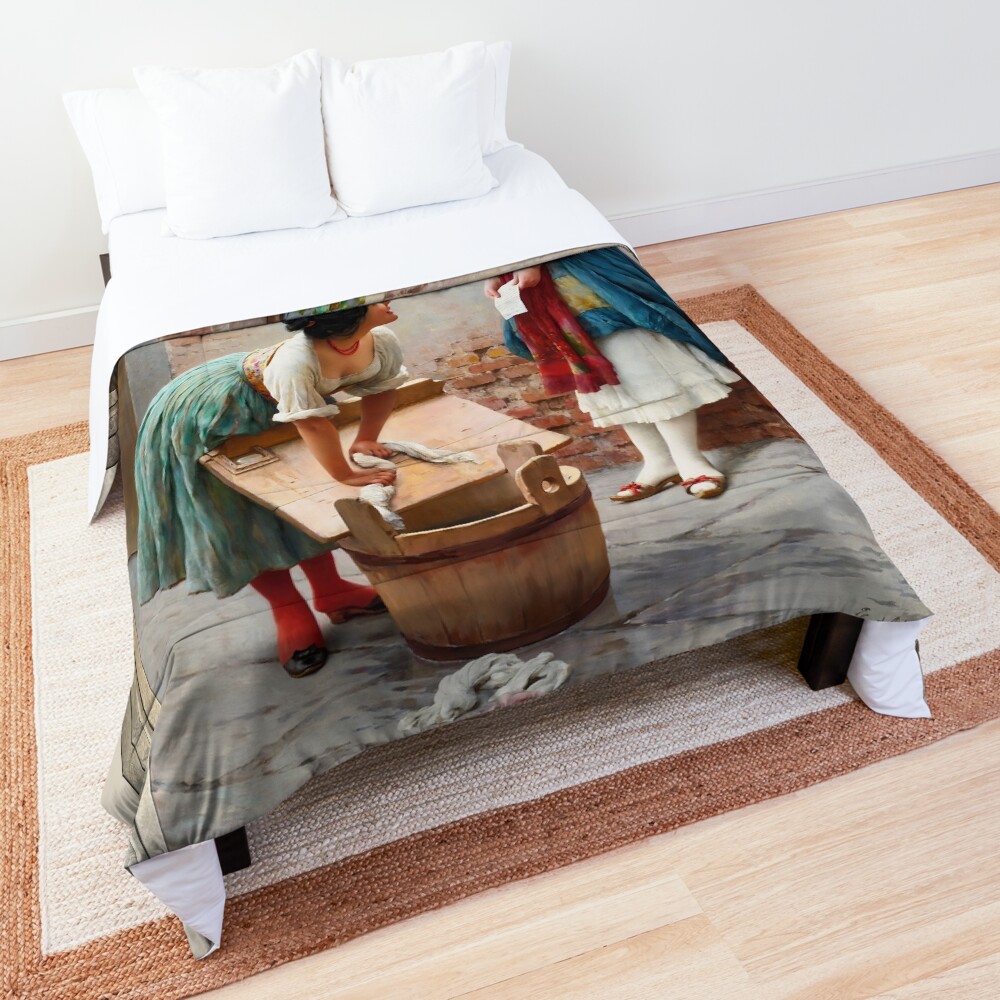
This is a remastered digital art old masters reproduction of a public domain image that is available for purchase online in a variety of material formats including canvas prints, akrylové tisky, kovové potisky, otisky dřeva, zarámované tisky, plakáty, a jako rolované obrazy na plátně v různých velikostech od 12 palce až 72 palce v závislosti na velikosti skutečného uměleckého díla a obchodu s tiskem na vyžádání, ve kterém se rozhodnete umění koupit.
Životopis umělce
Níže uvedené informace jsou odvozeny z Wikipedia.org
Eugen von Blaas was born at Albano, poblíž Říma, tirolskému otci a italské matce. Jeho otec Karl, také malíř, byl jeho učitel. Jeho matka, Agnesina Auda, byla dobře situovaná Římanka. Rodina se přestěhovala do Benátek, když se Karl stal profesorem Benátské akademie. Často maloval scény v Benátkách, ale také portréty a náboženské obrazy.
Mezi jeho díla patří Svatební forma v sakristii; Bingo v Benátkách Campielo; Loutková scéna ve škole; a La Ninetta. Umělecký kritik Luigi Chirtani, když byl obraz vystaven na Mostra Nazionale di Venezia, popsal to jako krásný, lichotivý, pěkný, pohladil, vyčištěné, leštěný, pradlena na obraze pana. Měchýř, oblíbený portrétista velkých benátských aristokratů, oblečená do gala saténů, zářící šperky, účesy bohatých.
Jeho barevné a spíše teatrální dobové obrazy benátské společnosti, např. Na Balkonu (1877; Soukromá sbírka), byly zcela odlišné ve srovnání s jemnými pastely a lepty nádvoří, balkon a kanály moderních Benátek.
Eugene de Blaas’ obrazy byly vystaveny v Královské akademii, Společnost výtvarného umění, New Gallery a Arthur Tooth and Sons Gallery v Londýně, a také v Walker Art Gallery v Liverpoolu