

She’ll String Along With You
Enoch Bolles, an influential American artist (1883–1976), created the painting She’ll String Along With You in the early to mid-20th century. The work captures a moment of playful flirtation and lighthearted sensuality, encapsulating the spirit of the Jazz Age and the glamour of 1920s advertising art. This painting reflects Bolles’ affinity for pin-up art, which often depicted alluring women in exaggerated, sometimes comedic, poses meant to evoke a sense of charm and innocence, tinged with suggestiveness. The image’s overall feel is one of both humor and seduction, offering an intimate yet whimsical glance into the era’s visual culture.
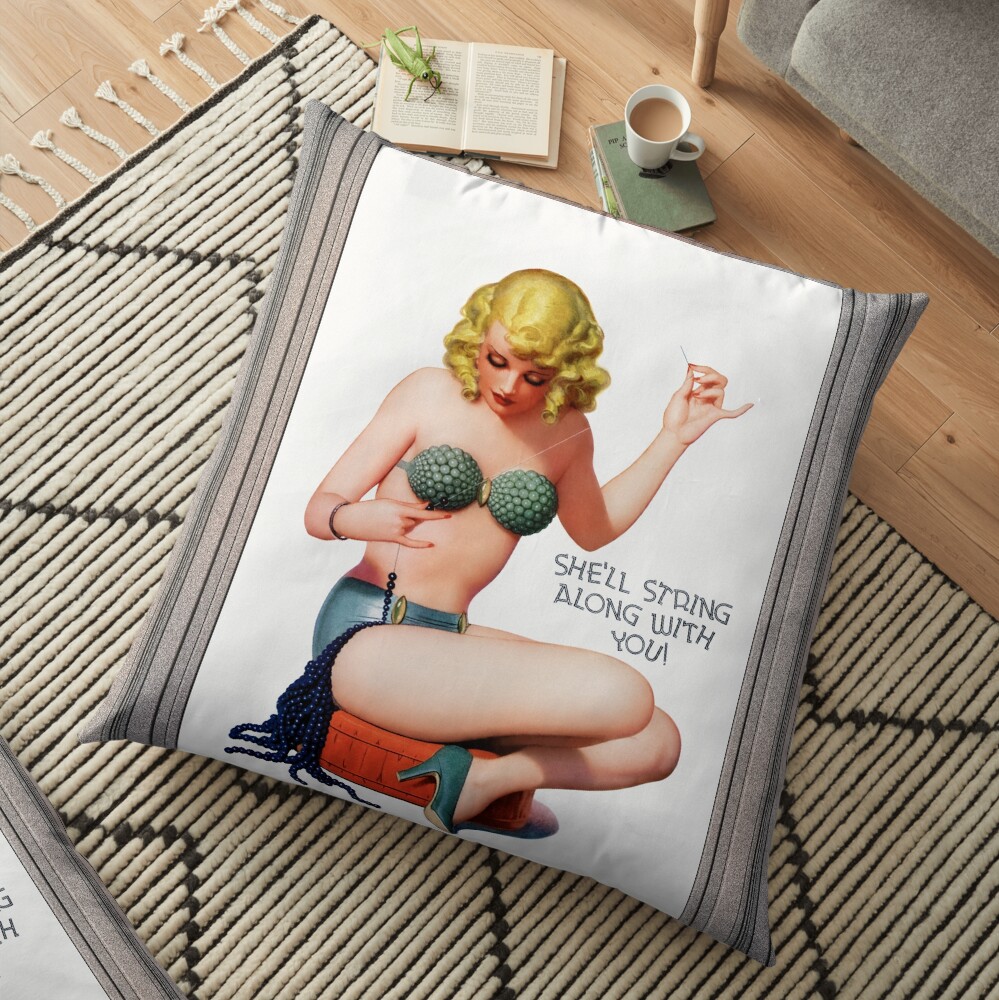
Table des matières
Sujet principal et composition
At the heart of the painting is a woman seated on a plush, red cushion, gazing down at the string of beads she is threading through a needle. Her expression is one of focused concentration, yet there is an undercurrent of playful engagement, as if she’s aware of the viewer’s attention. The subject is rendered in soft, warm tones that accentuate her beauty—her blonde curls cascade around her shoulders, framing a face that is both serene and inviting. Sa posture, while graceful, is casual, lending a sense of naturalness to her poise.
She is dressed in a revealing outfit made up of large, spherical beads that cover her breasts and a matching belt made of beads that encircle her waist. This design enhances the sensuality of the figure without over-exposing the subject, maintaining a playful yet tasteful aura.
The composition cleverly balances the boldness of her attire with the softness of her demeanor, suggesting a juxtaposition between allure and innocence. The bright colors used in the beads create a vivid contrast against her fair skin and the soft whites and creams of the background. The string of beads, being the object of her attention, links both the subject’s immediate actions and the overarching theme of the painting—engagement, séduire, and perhaps even a subtle invitation for interaction.
Objets et symbolisme
The beads, central to the composition, are both a literal and metaphorical device in the artwork. As the woman threads the beads onto a string, the act becomes symbolic of connection and continuity. Beads, often associated with adornment and femininity, here take on the role of creating something new—a string that will eventually be completed. This act of creation mirrors the viewer’s construction of meaning, linking the viewer’s eye with the subject’s sensual motion and inviting them to be a part of the process.
The background is a pristine white, which helps to isolate the subject in the foreground, giving the viewer no distractions other than her, the beads, and the quiet activity of sewing. This clean space around her brings a sense of purity and highlights the simplicity of the scene. Le doux, almost ethereal quality of the background contrasts with the tactile, almost tangible texture of the beads, emphasizing the juxtaposition of material versus immaterial.
Thematic Exploration
Le thème de She’ll String Along With You can be interpreted as a playful yet suggestive invitation. The use of the phrase “She’ll String Along With You,” displayed in bold lettering across the bottom of the frame, is a direct engagement with the viewer. Le terme “string along” can refer both to the literal activity of threading beads and to the colloquial expression of leading someone on in a flirtatious manner. Bolles masterfully plays on this double meaning, enhancing the work’s flirtatious and teasing nature.
The artwork’s flirtation is understated yet undeniable. The figure’s semi-nude posture is not overtly sexual but instead rendered in a manner that suggests allure through subtlety. The woman’s modesty in her pose and attire invites curiosity without being crude, echoing the sophisticated yet liberated sexuality of the 1920s. This period, which was marked by significant social change, embraced a new form of womanhood, one that was confident, independent, and playful, as reflected in Bolles’ artwork.
Style artistique et influence
Bolles’ style in She’ll String Along With You is grounded in the Art Deco movement, a popular visual style of the 1920s and 1930s. His use of clean lines, couleurs vibrantes, and stylized forms aligns with the elegance and modernity of the period.
The smoothness of the figure’s curves and the minimalistic backdrop are reminiscent of the streamlined aesthetic associated with Art Deco, which prized both beauty and efficiency in design. Le doux, flat colors and the focus on the woman’s figure exemplify Bolles’ ability to combine commercial art with fine art principles.
Bolles was known for his pin-up art, a genre that often combined commercial advertisement with artistic technique. Dans ce travail, there is a clear sense of both, as the woman appears poised for a product advertisement, yet she is rendered with the grace of a fine art figure study. This intersection of commercial and artistic influence reflects Bolles’ contribution to both art and advertising, where the worlds of art, design, and popular culture often collided.
Humeur et atmosphère
L'humeur globale de She’ll String Along With You is playful and inviting. The woman’s focused expression paired with the humor implied in the title creates a lighthearted, almost mischievous atmosphere. The interaction between the figure and the viewer is intimate but not confrontational.
There is a sense of whimsy in the way the woman is presented, she is not simply a subject to be gazed at, but an active participant in the creation of the scene. The work evokes a sense of casual allure, framed by the notion of invitation and flirtation, set against the larger cultural shift of the 1920s that celebrated more liberated and open expressions of femininity.
Conclusion
Dans She’ll String Along With You, Enoch Bolles captures a moment of delicate sensuality and playful charm. Through the use of vivid colors, smooth lines, and a simple yet suggestive composition, he invites the viewer into a world where beauty and humor coexist. The woman at the center of the painting, engaged in the quiet act of threading beads, represents the fusion of art and advertisement, femininity and power, all wrapped in the glamorous aesthetic of the 1920s. Bolles’ ability to capture both innocence and allure within the same frame speaks to the dual nature of the period itself, one marked by both a sense of freedom and the tensions inherent in modern life.
Il s'agit d'une reproduction de maîtres anciens d'art numérique remasterisée d'une image du domaine public qui est disponible en tant que impression sur toile.
Biographie de l'artiste
Informations ci-dessous dérivées de Wikipedia.org
Enoch est né du parfum chimiste Enoch Bolles, Jr et Catherine Keep dans le comté de Marion, Floride en mars 3, 1883.
Il a étudié à la New York National Academy of Design (est. 1825), et publie sa première illustration sur les couvertures de magazines d'humour; Juge et rondelle 1914; devenant surtout connu pour avoir illustré le magazine pulp Film Fun.
Puis dans 1923 il est devenu l'artiste de couverture exclusif pour Film Magazine et continuerait à ce poste jusqu'à ce que 1943, lorsque le magazine a été victime de la campagne du ministre des Postes de l'époque contre le matériel salace.
Pendant le temps d'Enoch avec Film Fun Magazine, il a créé 200 pochettes de pièces, et au moins 300 couvertures supplémentaires pour d'autres magazines de pâte épicée, y compris Breezy Stories, Pep et les nuits new-yorkaises.
La programmation mensuelle d'Enoch de la All-American Beauty posée avec précision dans un costume imaginatif est responsable de la définition de l'art de l'American Pin Up Illustration. Il était également un illustrateur polyvalent qui a créé des illustrations publicitaires pour de nombreux produits de l'époque tels que les raisins secs Sun-Maid et les briquets Zippo..
À l'âge de 60, dans 1943 Enoch a dû mettre fin à sa carrière professionnelle en raison de problèmes psychologiques, et l'a confiné à l'hôpital psychiatrique de Greystone Park dans le New Jersey pendant la majeure partie du reste de sa vie; mais il a continué à peindre des portraits commandés et pour son plaisir personnel.
Il a finalement été libéré de l'hôpital psychiatrique de Greystone Park à 1969 et il est décédé sept ans plus tard d'une insuffisance cardiaque à l'âge de 93.