

Она будет тянуться вместе с тобой
Енох Боллес, an influential American artist (1883–1976), created the painting Она будет тянуться вместе с тобой in the early to mid-20th century. The work captures a moment of playful flirtation and lighthearted sensuality, encapsulating the spirit of the Jazz Age and the glamour of 1920s advertising art. This painting reflects Bolles’ affinity for pin-up art, which often depicted alluring women in exaggerated, sometimes comedic, poses meant to evoke a sense of charm and innocence, tinged with suggestiveness. The image’s overall feel is one of both humor and seduction, offering an intimate yet whimsical glance into the era’s visual culture.
Оглавление
Основная тема и композиция
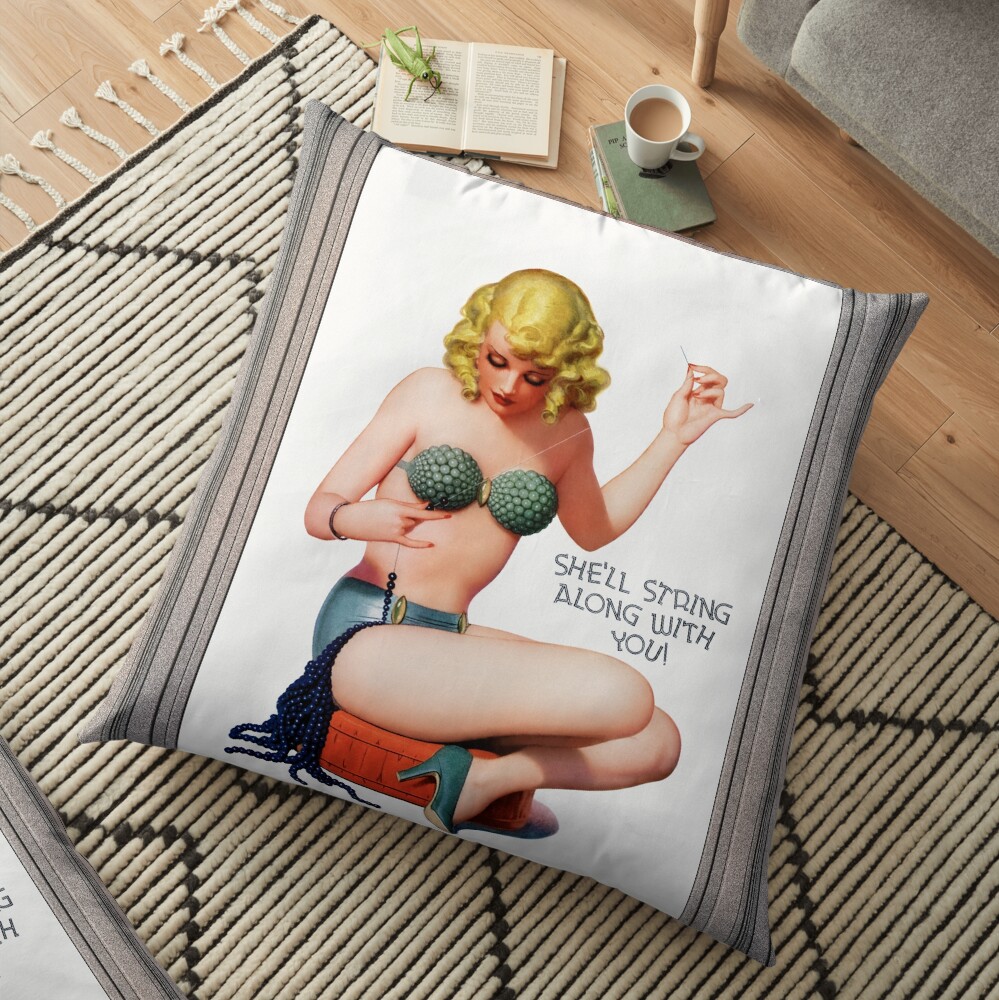
At the heart of the painting is a woman seated on a plush, red cushion, gazing down at the string of beads she is threading through a needle. Her expression is one of focused concentration, yet there is an undercurrent of playful engagement, as if she’s aware of the viewer’s attention. The subject is rendered in soft, warm tones that accentuate her beauty—her blonde curls cascade around her shoulders, framing a face that is both serene and inviting. Ее поза, хотя и изящный, is casual, lending a sense of naturalness to her poise.
She is dressed in a revealing outfit made up of large, spherical beads that cover her breasts and a matching belt made of beads that encircle her waist. This design enhances the sensuality of the figure without over-exposing the subject, maintaining a playful yet tasteful aura.
The composition cleverly balances the boldness of her attire with the softness of her demeanor, suggesting a juxtaposition between allure and innocence. The bright colors used in the beads create a vivid contrast against her fair skin and the soft whites and creams of the background. The string of beads, being the object of her attention, links both the subject’s immediate actions and the overarching theme of the painting—engagement, очарование, and perhaps even a subtle invitation for interaction.
Объекты и символизм
The beads, central to the composition, are both a literal and metaphorical device in the artwork. As the woman threads the beads onto a string, the act becomes symbolic of connection and continuity. Beads, often associated with adornment and femininity, here take on the role of creating something new—a string that will eventually be completed. This act of creation mirrors the viewer’s construction of meaning, linking the viewer’s eye with the subject’s sensual motion and inviting them to be a part of the process.
The background is a pristine white, which helps to isolate the subject in the foreground, giving the viewer no distractions other than her, the beads, and the quiet activity of sewing. This clean space around her brings a sense of purity and highlights the simplicity of the scene. Мягкий, almost ethereal quality of the background contrasts with the tactile, almost tangible texture of the beads, emphasizing the juxtaposition of material versus immaterial.
Thematic Exploration
Тема Она будет тянуться вместе с тобой can be interpreted as a playful yet suggestive invitation. The use of the phrase “She’ll String Along With You,” displayed in bold lettering across the bottom of the frame, is a direct engagement with the viewer. Срок “string along” can refer both to the literal activity of threading beads and to the colloquial expression of leading someone on in a flirtatious manner. Bolles masterfully plays on this double meaning, enhancing the work’s flirtatious and teasing nature.
The artwork’s flirtation is understated yet undeniable. The figure’s semi-nude posture is not overtly sexual but instead rendered in a manner that suggests allure through subtlety. The woman’s modesty in her pose and attire invites curiosity without being crude, echoing the sophisticated yet liberated sexuality of the 1920s. Этот период, which was marked by significant social change, embraced a new form of womanhood, one that was confident, independent, and playful, as reflected in Bolles’ artwork.
Художественный стиль и влияние
Bolles’ style in Она будет тянуться вместе с тобой is grounded in the Art Deco movement, a popular visual style of the 1920s and 1930s. His use of clean lines, яркие цвета, and stylized forms aligns with the elegance and modernity of the period.
The smoothness of the figure’s curves and the minimalistic backdrop are reminiscent of the streamlined aesthetic associated with Art Deco, which prized both beauty and efficiency in design. Мягкий, flat colors and the focus on the woman’s figure exemplify Bolles’ ability to combine commercial art with fine art principles.
Bolles was known for his pin-up art, a genre that often combined commercial advertisement with artistic technique. В этой работе, there is a clear sense of both, as the woman appears poised for a product advertisement, yet she is rendered with the grace of a fine art figure study. This intersection of commercial and artistic influence reflects Bolles’ contribution to both art and advertising, where the worlds of art, дизайн, and popular culture often collided.
Настроение и атмосфера
Общее настроение Она будет тянуться вместе с тобой is playful and inviting. The woman’s focused expression paired with the humor implied in the title creates a lighthearted, almost mischievous atmosphere. The interaction between the figure and the viewer is intimate but not confrontational.
There is a sense of whimsy in the way the woman is presented, she is not simply a subject to be gazed at, but an active participant in the creation of the scene. The work evokes a sense of casual allure, framed by the notion of invitation and flirtation, set against the larger cultural shift of the 1920s that celebrated more liberated and open expressions of femininity.
Заключение
В Она будет тянуться вместе с тобой, Enoch Bolles captures a moment of delicate sensuality and playful charm. Through the use of vivid colors, smooth lines, and a simple yet suggestive composition, he invites the viewer into a world where beauty and humor coexist. Женщина в центре картины, engaged in the quiet act of threading beads, represents the fusion of art and advertisement, femininity and power, all wrapped in the glamorous aesthetic of the 1920s. Bolles’ ability to capture both innocence and allure within the same frame speaks to the dual nature of the period itself, one marked by both a sense of freedom and the tensions inherent in modern life.
Это обновленная цифровая репродукция старых мастеров изображения, являющегося общественным достоянием, которое доступно в качестве Все эти ремастерированные изображения старых мастеров цифрового искусства, являющиеся общественным достоянием, доступны как.
Биография художника
Информация ниже получена из Wikipedia.org
Енох родился у парфюмера Эноха Боллеса., Младший и Кэтрин Кип в округе Мэрион, Флорида в марте 3, 1883.
Учился в Нью-Йоркской национальной академии дизайна. (является. 1825), и опубликовал свою первую иллюстрацию на обложках юмористических журналов.; Судья и Пак 1914; стал наиболее известен благодаря иллюстрированию журнала Film Fun..
Затем в 1923 он стал эксклюзивным художником обложки журнала Film Magazine и оставался на этой должности до тех пор, пока 1943, когда журнал стал жертвой кампании тогдашнего генерального почтмейстера против непристойных материалов.
Во время работы Еноха в журнале Film Fun Magazine он создал 200 обложка, и по крайней мере 300 дополнительные обложки для других журналов о пряной мякоти, в том числе свежие истории, Пеп и нью-йоркские ночи.
Ежемесячная подборка Всеамериканской красавицы Еноха, точно позированная в причудливых костюмах, отвечает за определение искусства американской иллюстрации в стиле пин-ап.. Он также был разносторонним иллюстратором, создававшим рекламные изображения для многих продуктов того времени, таких как изюм Sun-Maid и зажигалки Zippo..
В возрасте 60, в 1943 Еноху пришлось завершить профессиональную карьеру из-за психологических проблем, и был помещен в психиатрическую больницу Грейстон-Парк в Нью-Джерси на большую часть оставшейся жизни.; но он продолжал писать портреты на заказ и для личного удовольствия..
В конце концов он был выписан из психиатрической больницы Грейстон-Парк в г. 1969 и он скончался семь лет спустя от сердечной недостаточности в возрасте 93.