

Idylle des bergers
Idylle des bergers c1768 par le peintre français François Boucher (1703 – 1770), qui était aussi un dessinateur et graveur accompli. Il a travaillé dans le style rococo et est connu pour ses thèmes classiques idylliques, scènes pastorales et allégories décoratives.
François Boucher, l'un des peintres rococo français les plus influents du XVIIIe siècle, a créé l'œuvre exquise “Idylle du berger” autour 1768. Ce tableau résume l'esprit léger et pastoral de la période rococo, connu pour son caractère ludique, sensuel, et représentation idéalisée de la nature et de la vie rurale. Avec doux, des lignes fluides et une atmosphère romantique, L’approche de Boucher fait ressortir un mélange harmonieux de beauté naturelle, innocence, et l'intimité.
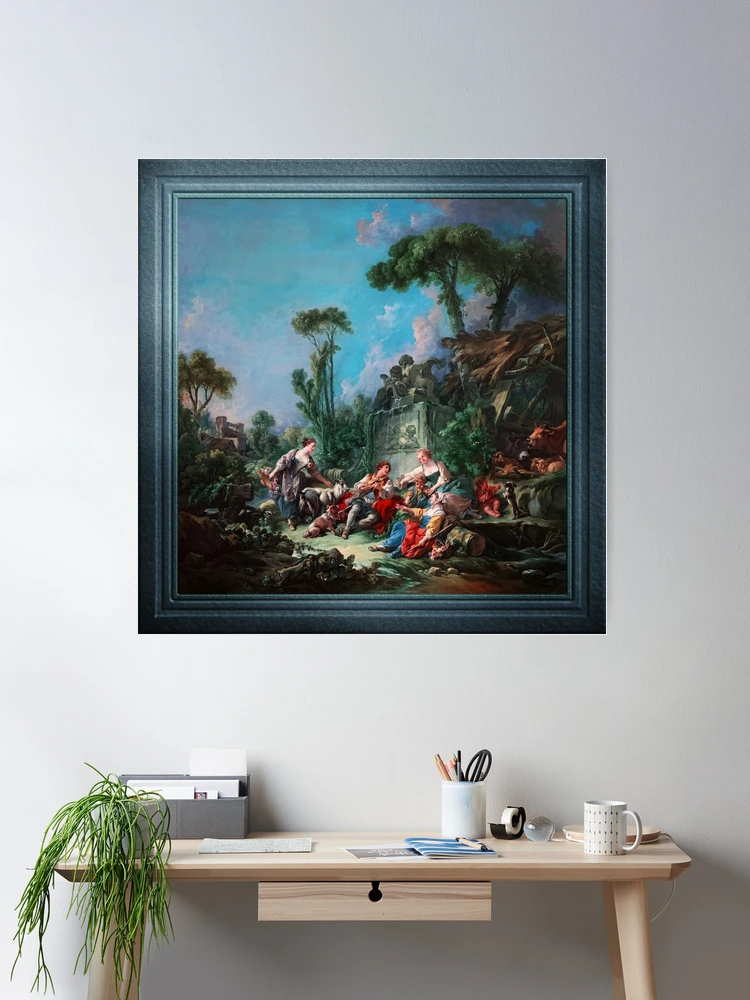
Table des matières
Le sujet principal et la composition
Au coeur de “Idylle des bergers” se trouve un groupe de bergers et de bergères capturés dans un cadre idyllique, scène pastorale. La composition est soigneusement structurée, mettant en valeur l'innocence de la vie rurale d'une manière qui l'élève de la simple rusticité à un royaume d'élégance artistique. La scène se déroule dans un environnement luxuriant, paysage vallonné avec un ruisseau qui coule doucement. Les bergers, habillé en vibrant, des costumes aux couleurs douces et typiques de l'époque, sont assis ou allongés sans soucis. Il existe un moyen facile, posture détendue parmi les personnages, créer un sentiment de tranquillité et de facilité.
Le groupe est principalement engagé dans des activités légères – certains jouent de la musique, tandis que d'autres interagissent avec des animaux. Une jeune femme au regard gracieux, l'aspect presque éthéré est au premier plan, jouer de la flûte, alors qu'un homme, vêtu d'une veste rouge et or richement colorée, est assis à proximité, tenant une houlette de berger. Certains personnages sont en conversation étroite, d'autres semblent regarder au loin, tandis que quelques-uns sont tout simplement perdus dans leur plaisir de profiter de la nature environnante.
En arrière-plan, deux chevaux paissent près d’une fontaine, tandis qu'une chèvre et un chien sont positionnés autour du groupe de personnages, enrichir davantage la scène pastorale avec la vitalité de la vie. Les chiffres eux-mêmes, tout en étant jeune, sont imprégnés d’un air de sophistication, ce qui fait que le cadre pastoral ressemble presque à une scène pour un rassemblement social privé entre la noblesse de la campagne.
Objets et symboles
Une caractéristique frappante de la peinture sont les éléments naturels, qui sont traités avec un respect délicat. Le feuillage entourant le groupe est luxuriant et abondant, avec grand, des arbres imposants qui remplissent la partie supérieure de la toile. Les personnages semblent presque éclipsés par les troncs massifs et les branches larges qui procurent un sentiment à la fois de protection et de sérénité.. Their presence also speaks to the Rococo love of nature as a decorative and idealized space, meant to reflect human grace and beauty.
The fountain in the background, designed with classical motifs, symbolizes the theme of purity and the eternal flow of life. The gentle stream that flows from it winds its way through the scene, adding to the tranquil atmosphere. The animals, especially the goat and the cows on the right side of the painting, lend a touch of realism to the otherwise idealized scene. They are almost anthropomorphized, existing in harmony with the human figures. The goat, en particulier, is a common symbol of fertility, while the dog signifies loyalty and companionship, subtle yet deliberate symbols that further enhance the narrative of simplicity and pastoral bliss.
La houlette du berger, un outil de la vie pastorale, est un autre symbole dans la scène, symbolisant le lien de l’humanité avec la nature. Dans ce contexte, la vie pastorale n'est pas seulement une expérience esthétique mais solidement enracinée dans les traditions et les travaux de la campagne..
Détails du terrain et de l'arrière-plan
L'arrière-plan du tableau est dominé par un mélange de verts luxuriants et de bleus profonds.. Le ciel est peint d'une douce, bleu pastel qui se fond parfaitement dans les collines et les arbres au loin. La lumière se diffuse doucement à travers le paysage, donnant à toute la scène une ambiance chaleureuse, lueur harmonieuse. Les personnages au premier plan profitent de cette lumière, ce qui crée un doux halo autour d'eux.
The trees and foliage are painted with a sense of romantic idealism, where nature is exaggerated to appear in its most serene and refined form. There are no sharp, harsh angles or barren spaces in the landscape. Au lieu, the rolling hills, expansive sky, and dotted animals create a lush, fertile environment.
In contrast to the vibrancy of the figures and natural elements, the architecture in the background remains modest but significant. The distant ruins of a classical structure — perhaps a Roman-style temple or an overgrown villa — add a touch of antiquity to the work. Les bâtiments, though not the central focus, provide historical context to the otherwise timeless nature of the landscape, indicating that the scene could exist in any golden age of human civilization.
Le style rococo
Boucher “Idylle du berger” is quintessentially Rococo, a style that arose in France in the early 18th century. Rococo is known for its lightness, grâce, and delicate ornamentation, and these characteristics are evident throughout the work. Le doux, pastel palette employed by Boucher enhances the dreamlike, almost fairy-tale quality of the scene. The figures are depicted with soft, formes arrondies, and the fluid brushstrokes give a sense of movement and fluidity to the scene.
The sensuality that pervades the Rococo style is also present in this painting, though it is more understated. Les chiffres, although idealized, exude a softness and grace that suggests the easy pleasures of rural life — where love, musique, and beauty coexist in a world free of societal constraints. À bien des égards, Boucher’s use of light, Couleur, and subject matter elevates the pastoral to an art of fantasy, ce qui en fait une évasion des réalités rigides de la vie de cour.
Humeur et atmosphère
L'ambiance de “Idylle du berger” c'est celui de la sérénité, joie, et le contentement. Les chiffres’ les postures détendues et la douce interaction entre les humains et les animaux reflètent une existence idyllique où le lien humain avec la nature est à l'état pur.. Le monde naturel qui les entoure, luxuriant et vibrant, complète leur jeunesse, attitude insouciante. Il n'y a aucune urgence dans la peinture; plutôt, cela transmet un sentiment d'éternel, jouissance paisible.
Boucher’s use of light, Couleur, et le sujet invite le spectateur dans un monde onirique de bonheur pastoral, où le temps ralentit, et les préoccupations du monde extérieur semblent lointaines. L'environnement luxuriant et les interactions harmonieuses des personnages suggèrent une existence utopique, où la beauté de la nature et la camaraderie humaine créent un équilibre parfait.
Conclusion
François Boucher’s “Idylle du berger” encapsulates the charm and grace of the Rococo period through its serene portrayal of pastoral life. With its idyllic depiction of rural pleasures, the painting invites the viewer to escape into a world of beauty, simplicité, et sérénité. The rich colors, delicate figures, and romanticized landscape create a timeless piece that remains a hallmark of the Rococo style.
Shepherd's Idyll est une reproduction de maîtres anciens d'art numérique retouchée d'une image du domaine public.
À propos de l'artiste
Informations ci-dessous dérivées de Wikipedia.org
Originaire de Paris, Boucher était le fils d'un peintre moins connu Nicolas Boucher, qui lui a donné sa première formation artistique. À l'âge de dix-sept ans, un tableau de Boucher a été admiré par le peintre François Lemoyne. Lemoyne nomma plus tard Boucher son apprenti, mais après seulement trois mois, il est allé travailler pour le graveur Jean-François Cars.
Dans 1720, il a remporté le Grand Prix élite de Rome pour la peinture, mais n'a saisi l'occasion conséquente d'étudier en Italie que cinq ans plus tard, due to financial problems at the Académie royale de peinture et de sculpture.[1] À son retour des études en Italie, il a été admis à l'Académie de peinture et de sculpture refondée sur 24 novembre 1731. His morceau de réception (pièce de réception) était son Rinaldo et Armida de 1734.
Boucher a épousé Marie-Jeanne Buzeau en 1733. Le couple a eu trois enfants ensemble. Boucher est devenu membre du corps professoral en 1734 et sa carrière s'est accélérée à partir de ce moment, car il a été promu professeur puis recteur de l'Académie, devenir inspecteur à la Manufacture Royale des Gobelins et enfin Premier Peintre du Roi (Premier peintre du roi) dans 1765. Portrait de Marie-Louise O’Murphy c. 1752
Boucher est décédé le 30 Mai 1770 dans son Paris natal. Son nom, avec celle de sa patronne Madame de Pompadour, était devenu synonyme du style rococo français, amenant les frères Goncourt à écrire: “Boucher fait partie de ces hommes qui représentent le goût d'un siècle, qui expriment, personnifiez-le et incarnez-le.”
Boucher est célèbre pour dire que la nature est “trop verte et mal éclairée” (trop vert et mal éclairé).
Boucher était associé au graveur de pierres précieuses Jacques Guay, à qui il a appris à dessiner. Il a également encadré le peintre morave-autrichien Martin Ferdinand Quadal ainsi que le peintre néoclassique Jacques-Louis David dans 1767.[4] Plus tard, Boucher a réalisé une série de dessins d'œuvres de Guay que Madame de Pompadour a ensuite gravées et distribuées sous forme de volume joliment relié à des courtisans privilégiés.