

Still Life In The Atelier
Still Life In The Atelier c1868 by Finnish Painter Ferdinand von Wright (1822 – 1906); a landscape and animal painter of the 19th century
This is a beautiful richly colored still life painting of an artists studio that focuses just on a rich dark brown highly shellacked wooden desk with an ornately carved draw.
On the desk is a beautiful table oil lamp with copper base, brass top and porcelain dome made in the Victorian style; which forms the centerpiece of the scene; with great detail of the decorative features in the metal, oil in the glass reservoir with the included ribbon wick.
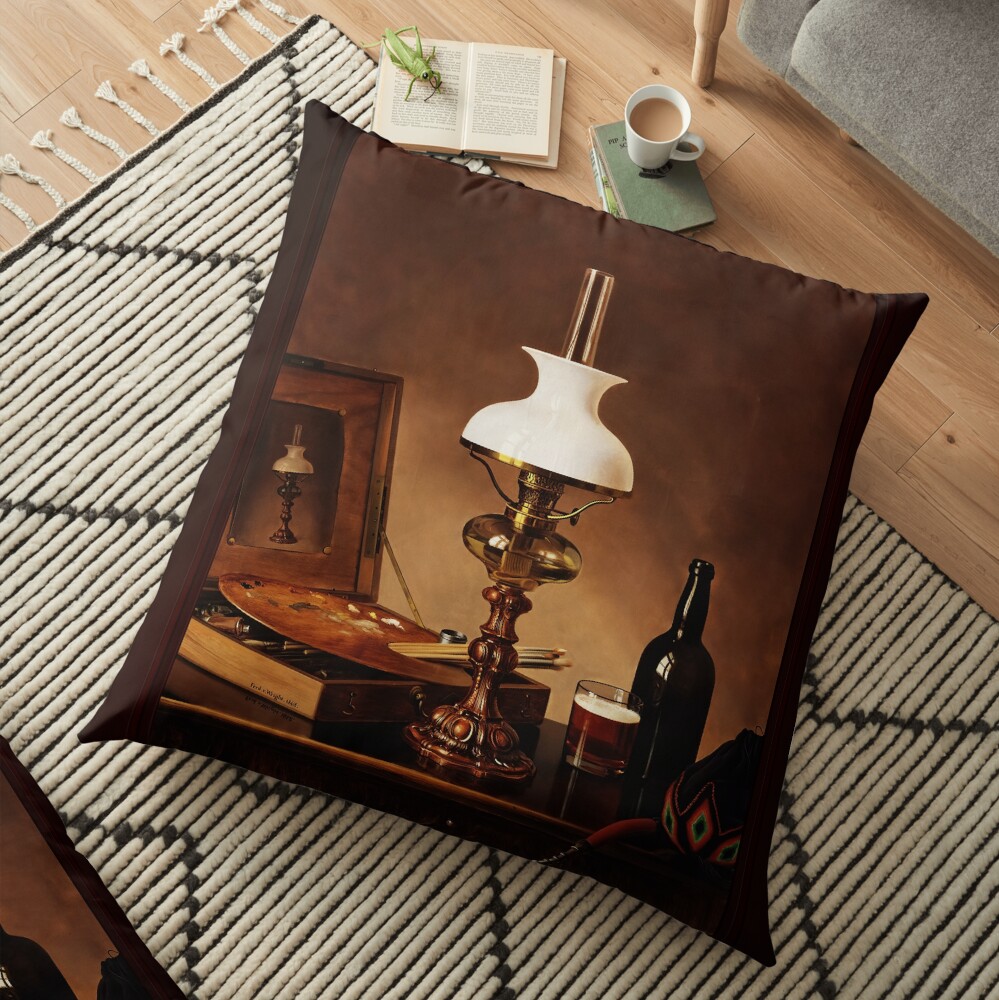
To the right is a black beer bottle and beside the bottle a short glass filled with freshly poured beer and beside that is a Nargile smoking pipe with with what may be a tobacco bag beside it.
To the left of the scene is a painters wooden palette that includes a metal cup on the lower portion, and that has dabs of white, gul, rød, grønn, blue and black paint around the outer perimeter with paint brushes sticking out of the hole that the artist places his thumb.
This is resting on an open artist storage supply box, that has more brushes underneath the palette as well as tubes of paint and other items; and on the inside lid of the box is a photograph of a similar oil lamp used as a reference for the scene.
Still Life In The Atelier is a remastered digital art old masters reproduction of a public domain image that is available as a lerretstrykk online.
bobler Wikipedia.org
Ferdinand var den siste av ni gjenlevende barn til den pensjonerte finske majoren Henrik Magnus von Wright; hans to eldre brødre Magnus von Wright (1805 – 1868) og Wilhelm von Wright (1810 – 1887) var malere og illustratører og han fulgte i deres fotspor, viser en tidlig evne til kunst, som ble utviklet i løpet av tiden han brukte på jakt og utforsking av naturen, registrere det han hadde observert i skissebøkene sine.
I 1837 han forlot Finland og reiste til Sverige sammen med sin nest eldste bror Wilhelm; som på den tiden jobbet som illustratør for den svenske zoologen Bengt Fredrik Fries (1799 – 1839); deretter inn 1838 he went back to Sweden to work for the Swedish amatuer Ornithologist Count Nils Bonde (1685 – 1760).
Etter å ha reist tilbake til Finland etter endt arbeid; han returnerte så til Sverige i 1842 og gikk en kort stund på Royal Swedish Academy of Arts og studerte under den svenske billedhuggeren Johan Niclas Byström (1783 – 1848); så to år senere hjem til Finland.
Deretter inn 1849 han reiste til Åbo, Finland hvor han tok ekstra maletimer fra den svenske romantiske maleren Robert Wilhelm Ekman (1808 – 1873); etter studiene, han og brødrene hans dro til Helsinki, hovedstaden i Finland og sette opp et studio; og seks år senere reiste han til Dresden, Tyskland for å studere under den kjente tyske dyremaleren Johann Siegwald Dahl (1827 – 1902).
I løpet av 1870-årene fikk han flere slag som holdt ham sengeliggende; men han fortsatte å male, og i 1881 tok sin siste tur til Orust for å besøke broren Wilhelm som også var syk.
Fra dette tidspunktet ble arbeidet hans mer kommersielt, og i 1886 han produserte sitt mest kjente maleri “De kjempende Capercailles” og bidro med artikler til forskjellige ornitologiske publikasjoner.
Omtrent på denne tiden mottok han en statlig kunstnerpensjon; og i løpet av 1890-årene kom mange av hans tidligere elever på besøk, mens på slutten av 90-tallet fuglemaler Matti Karppanen (1873 – 1953) ble hans elev og assistent.