

Sweet Dreams
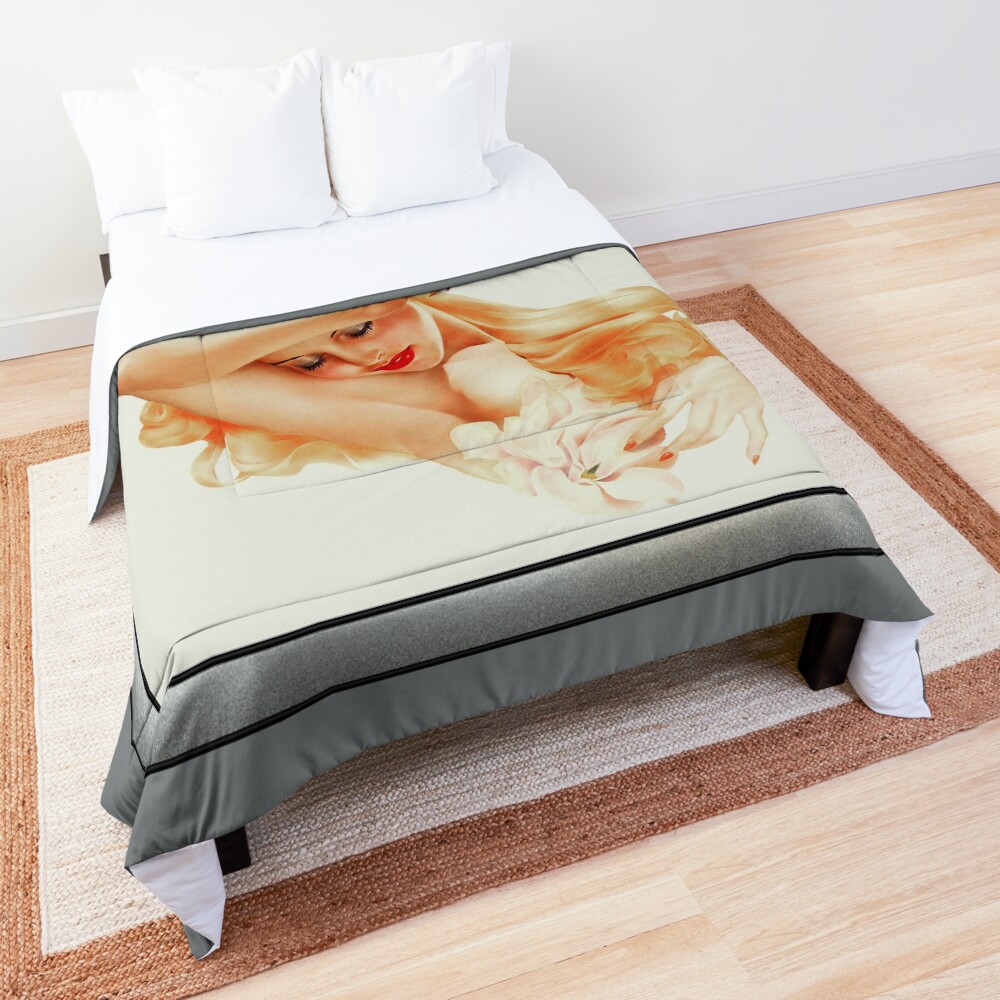
“Sweet Dreams,” created by the renowned Peruvian artist Alberto Vargas plassholderbilde (1896 – 1982), stands as an evocative masterpiece within the realm of pin-up art, blending sensuality with elegance. The artwork’s iconic composition features a female figure enveloped in a soft, almost dreamlike aura. It was produced during the mid-20th century, a period when Vargas’s unique style of blending femininity with fine art gained widespread recognition. Known for his precise depictions of the human form and his delicate treatment of light and shadow, Vargas captured the essence of beauty and allure in a manner that remains timeless.
Innholdsfortegnelse
Hovedemnet: The Seductive Beauty
At the center of the painting is a captivating woman, whose delicate features and sultry pose immediately draw the viewer’s attention. With her head tilted slightly downward, the woman’s gaze is inward, suggesting a moment of introspection or a quiet, private reverie. Her flawless skin, rendered with soft, almost translucent tones, appears luminous against the soft background. She is positioned in such a way that her exposed shoulder and neck convey an effortless sensuality without being overtly provocative.
Hennes uttrykk er et av ro, tinged with a subtle, yet alluring, expression that embodies both innocence and experience. This duality speaks to the idealized nature of Vargas’s work, where his female subjects often possess an ethereal, almost unattainable beauty. The model’s bright red lips further emphasize her sensuality, while her pale, porcelain-like complexion contrasts with the rich tones of her surroundings, adding to her ethereal quality.
Innstillingen og bakgrunnen
In contrast to the sharp detail of the central figure, the background of “Sweet Dreams” features soft, abstract washes of color that accentuate the dreamlike quality of the image. Den dempede, light tones suggest a soft, calming atmosphere, as if the viewer has entered a world of fantasy or quiet reverie. The lack of a definitive landscape or setting allows the subject to stand out, while still maintaining a sense of depth through the subtle gradient of colors behind her.
In this composition, the background’s colors subtly interact with the model’s blonde hair, making it appear as though she is emerging from the soft palette of the environment itself. This connection between the subject and the background enhances the painting’s air of timeless elegance. The flower tucked into her hair adds another layer of femininity and delicacy to the scene, as it seems to reflect her gentle nature, further heightening the dreamlike effect of the work.
The Materials and Technique
Vargas, renowned for his mastery in creating visually compelling and technically perfect works, demonstrates his skill through meticulous brushwork and the fluidity of his figure rendering. The materials used for this piece allow for a richness in color and texture, with each stroke contributing to the overall softness that defines the artwork.
His technique involved paying particular attention to the anatomical precision of the human form while maintaining an ethereal, almost surreal quality. Vargas’s use of light is striking; it highlights the smoothness of the woman’s skin and the gentle flow of her hair. There is a sense of controlled motion in the way her hair cascades, seemingly captured mid-flow, which speaks to the artist’s ability to combine realism with an almost otherworldly grace.
The technique of soft gradients, as well as the use of light and shadow, also allows the artist to create a strong sense of volume and depth, making the figure appear to emerge from the two-dimensional canvas. The sensuous curves of the woman’s body are rendered with an attention to detail that adds to her allure without objectifying her, striking a perfect balance between artistry and sensuality.
Stil, Tema, og humør
“Sweet Dreams” encapsulates the very essence of Vargas’s pin-up style, known for its glamorous, idealized depictions of women. His style was a celebration of beauty, emphasizing the graceful elegance of the female form. In contrast to other depictions of women in the mid-20th century, Vargas’s subjects were often portrayed as more refined and dignified, exuding strength alongside their sensuality.
Temaet for maleriet, which blends innocence with sensual allure, perfectly captures the duality of the feminine ideal. The softness of the woman’s pose and the dreamlike atmosphere of the background give the painting an ethereal quality, while the suggestiveness of her posture and gaze suggest a deeper, more intimate emotional resonance. This juxtaposition of innocence and seduction is a hallmark of Vargas’s work and is part of the reason his art continues to evoke such strong emotions in viewers.
Stemningen av “Sweet Dreams” is one of quiet contemplation and serene beauty. The model’s relaxed posture and the overall softness of the color palette suggest a peaceful, dreamlike state. The title itself, “Sweet Dreams,” invites the viewer to enter into this tranquil reverie, where beauty is at once a fleeting moment and a lasting presence.
Konklusjon
Alberto Vargas “Sweet Dreams” stands as a tribute to the art of capturing beauty in its most graceful and alluring form. Through his careful attention to detail, his use of soft light, and his graceful depictions of the female form, Vargas not only created an image of sensuality but also one of elegance and tranquility. This painting exemplifies the harmonious blending of art and femininity, a quality that has made Vargas’s work iconic in the world of pin-up art. His ability to evoke emotion through his mastery of light, farge, and form ensures that “Sweet Dreams” remains a captivating piece, both timeless and contemporary in its appeal.
Sweet Dreams er en retusjert digital kunst gamle mestere reproduksjon av et offentlig domene.
Artistbio fra Wikipedia.org
Født i Arequipa, Peru, han var sønn av den anerkjente peruanske fotografen Max T. Vargas. Alberto Vargas flyttet til USA i 1916 etter å ha studert kunst i Europa, Zürich, og Genève før første verdenskrig.
Mens han var i Europa, kom han over det franske magasinet La Vie Parisienne, med et omslag av Raphael Kirchner, som han sa var en stor innflytelse på arbeidet hans.
Hans tidlige karriere i New York inkluderte arbeid som kunstner for Ziegfeld Follies og for mange Hollywood -studioer. Ziegfeld hang sitt maleri av Olive Thomas på teatret, og hun ble tenkt på som en av de tidligste Vargas -jentene.
Vargas’ det mest kjente filmverket var for plakaten av 1933 film The Sin of Nora Moran, som viser en nesten naken Zita Johann i en posering av desperasjon. Plakaten blir ofte kåret til en av de største filmplakatene som noensinne er laget.
Han ble mye kjent på 1940-tallet som skaperen av ikoniske pin-ups fra andre verdenskrig-æra for Esquire magazine kjent som “Vargas Girls.” Mellom 1940 og 1946 Vargas produsert 180 malerier til bladet.
Nesekunsten til mange amerikanske og allierte andre verdenskrigs fly ble inspirert og tilpasset fra disse Esquire pin-ups, så vel som George Petty, og andre artister.