

Doves Tairisceana (Na doves; Tairiscint)
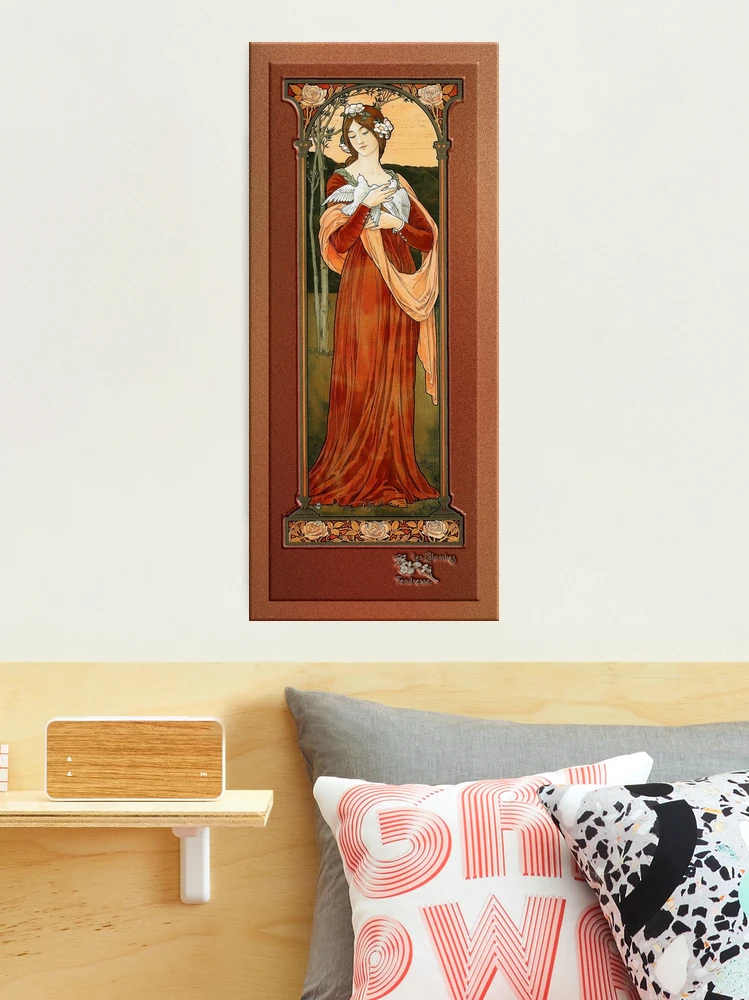
“Doves Tairisceana (Na doves; Tairiscint)” is a beautiful work by Elisabeth Sonrel, created around the turn of the 20th century. Sonrel, a French artist born in 1874 and who passed away in 1953, is renowned for her symbolic and highly decorative approach to painting. This particular piece exemplifies her delicate mastery of Art Nouveau and her affinity for portraying women in idealized, ethereal settings. The work features a woman holding two doves, a motif rich with symbolism, conveying themes of peace, neamhchiontacht, and tenderness.
Clár na nÁbhar
An Príomh-Ábhar agus Comhdhéanamh
The central subject of “Doves Tairisceana” is a graceful woman standing in a serene, slightly blurred landscape. She exudes a sense of tranquility, gazing downward as she gently holds two white doves in her arms. Her face is calm and introspective, radiating both innocence and grace. The woman’s long flowing red gown, which cascades dramatically down her body, is meticulously painted in rich, warm tones. The folds of the fabric are carefully rendered, highlighting the artist’s sensitivity to the nuances of texture and light. The gown is the focal point of her form, elegantly sweeping down to the ground, enhancing her ethereal presence.
Her pose and the way she holds the doves emphasize softness and fragility. The birds, symbols of peace and love, are cradled delicately in her arms, their white feathers providing a sharp contrast to the warm, earthy tones of her clothing and the background. The composition emphasizes the connection between the woman and the birds, evoking a sense of harmony and a bond with nature. The doves are not merely ornamental but serve as an integral part of the narrative, reinforcing the peaceful mood of the piece.
An Socrú agus Cúlra
In the background of the painting, the artist has chosen a soft and somewhat indistinct landscape, which allows the figure of the woman to dominate the scene. The soft colors of the sky and the trees in the distance create an almost dreamlike atmosphere, as though the figure exists in an idealized, otherworldly space. The muted tones of the environment, composed mainly of light greens, donn, agus buí, complement the warm tones of the woman’s gown, creating a sense of unity in the composition. This choice of background adds to the sense of serenity, offering the viewer a quiet, reflective space.
Na crainn, faintly visible in the background, stand tall but not imposing, blending into the soft, hazy light of the horizon. The use of nature as the setting is an integral part of the work, highlighting the peaceful, harmonious relationship between the human form and the natural world. The distant trees and rolling hills suggest a timeless, natural world, where the viewer can imagine the woman being one with the environment, adding to the calm and gentle mood of the piece.
The Symbolism of the Doves
The doves in the painting are a significant element in the overall composition. In Western art, doves are widely recognized as symbols of peace, íonachta, agus grá. Their presence in this piece is not only symbolic of the artist’s theme of tenderness but also reflects broader themes of femininity and grace. The fact that the woman is holding the doves so gently suggests a nurturing quality, reinforcing the motif of caring and peace. Doves are often associated with mythological and religious symbolism, and their presence here may also invoke ideas of spirituality and transcendence.
The white color of the doves further emphasizes purity and innocence, qualities often attributed to the feminine ideal. The doves in “Doves Tairisceana” act as a counterbalance to the earthy tones of the woman’s attire and the landscape, providing a moment of lightness and transcendence. This balance between the earthiness of the scene and the purity of the birds reinforces the peaceful, harmonious atmosphere that is central to the painting’s mood.
Art Nouveau Style and Influence
Sonrel’s work is a classic example of the Art Nouveau movement, which emerged in the late 19th century and reached its peak in the early 20th century. Art Nouveau is characterized by flowing lines, foirmeacha orgánacha, and a focus on the decorative and ornamental. “Doves Tairisceana” embraces these stylistic elements, particularly in the intricate design of the borders and the floral motifs surrounding the woman’s figure. The sinuous, curving lines of the composition, particularly in the background and in the woman’s gown, are hallmarks of Art Nouveau’s influence.
The elegant framing of the piece, with its decorative borders adorned with roses and tendrils, reflects the movement’s focus on integrating art into daily life and its reverence for nature. An bog, flowing forms and the rhythmic repetition of organic shapes also point to the influence of Art Nouveau, which often sought to harmonize the human figure with the natural world.
Giúmar agus Tionchar Mothúchánach
An giúmar de “Doves Tairisceana” is one of calmness, introspection, agus íonacht. The delicate handling of the subject matter, along with the soft color palette and harmonious composition, creates a serene atmosphere. The viewer is invited to pause and reflect upon the symbolic message of peace, déine, and harmony that the piece conveys. The emotional impact of the artwork is subtle but powerful, evoking feelings of peace, suaimhneas, and a connection to nature. There is an air of gentle reverence in the way the woman is depicted, as though she is a guardian of peace, holding the doves as symbols of the fragility and beauty of life itself.
Sonrel’s work captures a moment of serene beauty, ar fionraí in am. The attention to detail in the woman’s expression, the folds of her gown, and the delicate handling of the doves invites the viewer to engage with the artwork on a deeply emotional level. The piece conveys a sense of timelessness, allowing the viewer to experience a moment of peaceful contemplation, much like the woman herself, standing in quiet communion with nature and the symbols of love and peace.
Is éard atá i Tender Doves ná sean-mháistrí ealaíne digiteacha atá á n-atáirgeadh ar íomhá fearainn phoiblí.
Ealaíontóir Bio cúirtéise Wikipedia.org
Elisabeth Sonrel (1874 Turais - 1953 Séalaí) péintéir agus maisitheoir Francach i stíl Art Nouveau a bhí ann. I measc a cuid saothar bhí ábhair chomhréireacha, misteachas agus siombalachas, portráidí agus tírdhreacha.
Ba iníon í le Nicolas Stéphane Sonrel, péintéir ó Turais, agus fuair sí a luathoiliúint uaidh. Le haghaidh tuilleadh staidéir chuaigh sí ar aghaidh go Páras mar mhac léinn le Jules Lefebvre ag an Ecole des Beaux-Arts.
I 1892 phéinteáil sí a cuid oibre dioplóma, ‘Pax et Labour’, saothar le feiceáil ag an Musée des Beaux-Arts de Tours. As sin amach chuir sí taispeántas ag an Salon des Artistes Français idir 1893 agus 1941, uiscedhathanna móra a bhí ina píosaí sínithe ar bhealach Réamh-Raphaelite, a ghlac sí tar éis turas go Florence agus an Róimh, ag fáil amach péintéirí na hAthbheochana – cuid de a cuid oibre le huaireanta soiléire Botticelli. Ba mhinic a spreag a cuid pictiúr rómánsaíocht Airtéanach, Coiméide Dhiaga Dante Alighieri’ agus 'An Saol Nua', téamaí Bhíobla, agus finscéalta meánaoiseacha. I measc a cuid saothar mistéireach tá ‘Ames errantes’ (Salon de 1894) agus ‘Biotáille an Abyss’ (Salon de 1899) agus "Bean óg leis an taipéis".
Ag an Exposition Universelle de 1900, Art Nouveau an príomhthéama a bhí aige, léi 1895 ag péinteáil ‘Codladh na Maighdine’ (Codladh na Maighdine), bronnadh bonn cré-umha air, agus duais Henri Lehmann de 3000 franc le Acadamh na nEalaíon Mín.[3] Ó 1900 ar aghaidh chuir sí a péintéireacht teoranta do phortráidí, tírdhreacha áille sa Bhriotáin, agus an staidéar bláthanna ó am go chéile.
Thug sí turais phéintéireachta rialta go dtí an Bhriotáin, spreagtha ag foraois Brocéliande, agus ó 1910 chuig áiteanna éagsúla ar an gcósta mar Concarneau, Plougastel, Pont-l'Abbé agus Loctudy, go minic ag fanacht i dtithe ósta agus in éineacht le mac léinn nó dhó. Phéinteáil sí roinnt saothar i Le Faouët sular thóg sí Villa i La Baule sna 1930idí. Ag obair go príomha i uiscedhath agus gouache, fuair sí soláthar réidh samhlacha i measc cailíní óga an cheantair, agus fuair siad go raibh Bretons cairdiúil go ginearálta, macánta agus féinmhuiníneach.
Bhí a taispeántas deiridh ag an Salon i 1941 ag aois 67. Tá taifead ann freisin gur thaispeáin sí i Learpholl. Ina blianta tosaigh chuir Sonrel póstaeir ar fáil, cártaí poist agus léaráidí, i stíl Art Nouveau.