

Ausschreiwung Doves (D'Dauwen; Zidderheet)
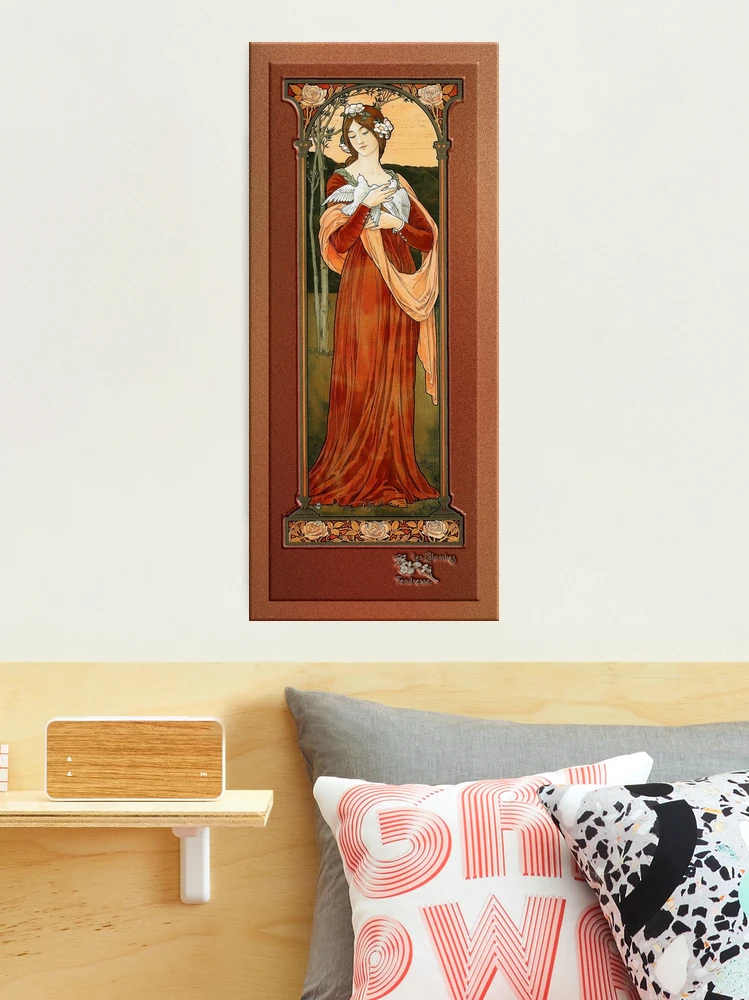
“Ausschreiwung Doves (D'Dauwen; Zidderheet)” is a beautiful work by Elisabeth Sonrel, created around the turn of the 20th century. Sonrel, a French artist born in 1874 and who passed away in 1953, is renowned for her symbolic and highly decorative approach to painting. This particular piece exemplifies her delicate mastery of Art Nouveau and her affinity for portraying women in idealized, ethereal settings. The work features a woman holding two doves, a motif rich with symbolism, conveying themes of peace, Onschëlleg, and tenderness.
Inhaltsverzeechnes
Den Haaptthema a Kompositioun
Den zentrale Sujet vun “Ausschreiwung Doves” is a graceful woman standing in a serene, slightly blurred landscape. She exudes a sense of tranquility, gazing downward as she gently holds two white doves in her arms. Her face is calm and introspective, radiating both innocence and grace. The woman’s long flowing red gown, which cascades dramatically down her body, is meticulously painted in rich, warm tones. The folds of the fabric are carefully rendered, highlighting the artist’s sensitivity to the nuances of texture and light. The gown is the focal point of her form, elegantly sweeping down to the ground, enhancing her ethereal presence.
Her pose and the way she holds the doves emphasize softness and fragility. The birds, symbols of peace and love, are cradled delicately in her arms, their white feathers providing a sharp contrast to the warm, earthy tones of her clothing and the background. The composition emphasizes the connection between the woman and the birds, evoking a sense of harmony and a bond with nature. The doves are not merely ornamental but serve as an integral part of the narrative, reinforcing the peaceful mood of the piece.
D'Astellung an den Hannergrond
Am Hannergrond vum Bild, the artist has chosen a soft and somewhat indistinct landscape, which allows the figure of the woman to dominate the scene. The soft colors of the sky and the trees in the distance create an almost dreamlike atmosphere, as though the figure exists in an idealized, soss Weltraum. Déi gedämpft Téin vun der Ëmwelt, composed mainly of light greens, Brobloseplanz, a giel, complement the warm tones of the woman’s gown, creating a sense of unity in the composition. This choice of background adds to the sense of serenity, offering the viewer a quiet, reflective space.
D'Beem, faintly visible in the background, stand tall but not imposing, blending into the soft, hazy light of the horizon. The use of nature as the setting is an integral part of the work, highlighting the peaceful, harmonious relationship between the human form and the natural world. The distant trees and rolling hills suggest a timeless, natural world, where the viewer can imagine the woman being one with the environment, adding to the calm and gentle mood of the piece.
The Symbolism of the Doves
The doves in the painting are a significant element in the overall composition. In Western art, doves are widely recognized as symbols of peace, Rengheet, and love. Their presence in this piece is not only symbolic of the artist’s theme of tenderness but also reflects broader themes of femininity and grace. The fact that the woman is holding the doves so gently suggests a nurturing quality, reinforcing the motif of caring and peace. Doves are often associated with mythological and religious symbolism, and their presence here may also invoke ideas of spirituality and transcendence.
The white color of the doves further emphasizes purity and innocence, qualities often attributed to the feminine ideal. The doves in “Ausschreiwung Doves” act as a counterbalance to the earthy tones of the woman’s attire and the landscape, providing a moment of lightness and transcendence. This balance between the earthiness of the scene and the purity of the birds reinforces the peaceful, harmonious atmosphere that is central to the painting’s mood.
Art Nouveau Style and Influence
Sonrel’s work is a classic example of the Art Nouveau movement, which emerged in the late 19th century and reached its peak in the early 20th century. Art Nouveau is characterized by flowing lines, organesch Formen, and a focus on the decorative and ornamental. “Ausschreiwung Doves” embraces these stylistic elements, particularly in the intricate design of the borders and the floral motifs surrounding the woman’s figure. The sinuous, curving lines of the composition, particularly in the background and in the woman’s gown, are hallmarks of Art Nouveau’s influence.
The elegant framing of the piece, with its decorative borders adorned with roses and tendrils, reflects the movement’s focus on integrating art into daily life and its reverence for nature. Der mëller, flowing forms and the rhythmic repetition of organic shapes also point to the influence of Art Nouveau, which often sought to harmonize the human figure with the natural world.
Stëmmung an emotionalen Impakt
D'Stëmmung vum “Ausschreiwung Doves” is one of calmness, Introspektioun, a Rengheet. The delicate handling of the subject matter, along with the soft color palette and harmonious composition, creates a serene atmosphere. The viewer is invited to pause and reflect upon the symbolic message of peace, tenderness, and harmony that the piece conveys. The emotional impact of the artwork is subtle but powerful, Gefiller vu Fridden opruffen, Rou, an eng Verbindung mat der Natur. There is an air of gentle reverence in the way the woman is depicted, as though she is a guardian of peace, holding the doves as symbols of the fragility and beauty of life itself.
Sonrel’s work captures a moment of serene beauty, suspended in time. The attention to detail in the woman’s expression, the folds of her gown, and the delicate handling of the doves invites the viewer to engage with the artwork on a deeply emotional level. The piece conveys a sense of timelessness, erlaabt dem Zuschauer e Moment vu friddlecher Iwwerleeung ze erliewen, vill wéi d'Fra selwer, an enger roueger Gemeinschaft mat der Natur an de Symboler vu Léift a Fridden ze stoen.
Tender Doves ass eng retouchéiert digital Konscht al Masters Reproduktioun vun engem Public Domain Bild.
Kënschtler Bio Ugedriwwe Wikipedia.org
Elisabeth Sonrel (1874 Tours - 1953 Seals) war e franséische Moler an Illustrator am Art Nouveau Stil. Hir Wierker enthalen allegoresch Themen, Mystik a Symbolik, Portraiten a Landschaften.
Si war d'Duechter vum Nicolas Stéphane Sonrel, e Moler vun Tours, a krut hir fréi Ausbildung vun him. Fir weider Studie goung si op Paräis als Student vum Jules Lefebvre an der Ecole des Beaux-Arts.
An 1892 si huet hir Diplomaarbecht gemoolt, 'Pax et Labour', e Wierk am Musée des Beaux-Arts de Tours ze gesinn. Vun do aus huet si am Salon des Artistes Français tëscht ausgestallt 1893 an 1941, hir Ënnerschrëftstécker si grouss Aquarelle op enger Pre-Raphaelit Manéier, déi si no enger Rees op Florenz a Roum adoptéiert huet, entdeckt d'Renaissance Moler – e puer vun hire Wierker mat kloren Iwwerzeeche vu Botticelli. Hir Biller goufen dacks vun der Arthurescher Romantik inspiréiert, Dem Dante Alighieri seng 'Göttlech Komedie’ an 'Dat neit Liewen', biblesch Themen, a mëttelalterlech Legenden. Hir mystesch Wierker enthalen 'Ames errantes’ (Salon vun 1894) an 'Geeschter vum Abyss’ (Salon vun 1899) an "Jonk Fra mat der Tapisserie".
Op der Exposition Universelle vun 1900, den Haaptthema vun deem war Art Nouveau, hirem 1895 Molerei 'De Schlof vun der Jongfra’ (Schlof vun der Jongfra), krut eng Bronzemedail, an den Henri Lehmann Präis vum 3000 Frang vun der Academy of Fine Arts.[3] Vun 1900 weider huet si hir Molerei a Portraite beschränkt, scenesch Bretagne Landschaften, an heiansdo Blummenstudie.
Si huet reegelméisseg Molereesen an d'Bretagne gemaach, inspiréiert vum Bësch vu Brocéliande, a vun 1910 op verschidde Plazen op der Küst wéi Concarneau, Plougastel, Pont-l'Abbé a Loctudy, bleiwen dacks an de Wiertschaften a begleeden vun engem oder zwee Studenten. Si huet verschidde Wierker zu Le Faouët gemoolt ier si eng Villa zu La Baule an den 1930er Jore baut. Schafft haaptsächlech an Aquarell a Gouache, si entdeckt eng prett Versuergung vu Modeller ënner jonke Meedercher an der Regioun, a fonnt Bretonen allgemeng frëndlech ze sinn, éierlech a selbstvertrauen.
Hir lescht Ausstellung am Salon war am 1941 am Alter vun 67. Et gëtt och e Rekord vun hirer Ausstellung zu Liverpool. An hire fréie Joere produzéiert Sonrel Plakater, Postkaarten an Illustratiounen, am Art Nouveau Stil.