

Malse duiven (de duiven; Tederheid)
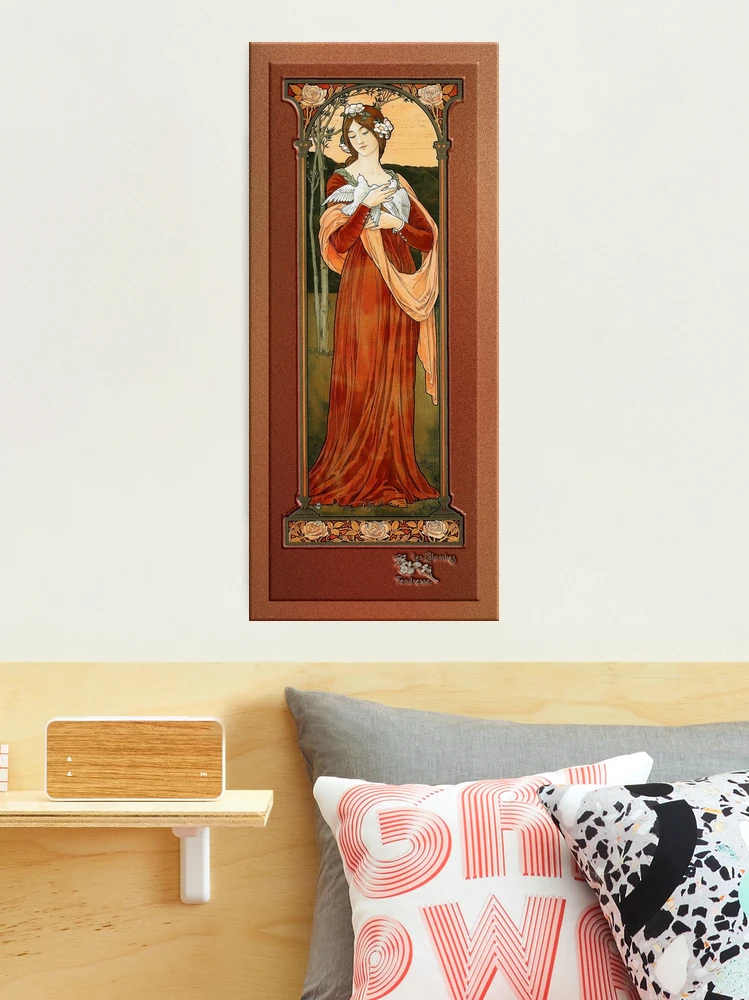
“Malse duiven (de duiven; Tederheid)” is a beautiful work by Elisabeth Sonrel, created around the turn of the 20th century. Sonrel, a French artist born in 1874 and who passed away in 1953, is renowned for her symbolic and highly decorative approach to painting. This particular piece exemplifies her delicate mastery of Art Nouveau and her affinity for portraying women in idealized, ethereal settings. The work features a woman holding two doves, a motif rich with symbolism, conveying themes of peace, onschuld, and tenderness.
Inhoudsopgave
Het hoofdonderwerp en de compositie
The central subject of “Malse duiven” is a graceful woman standing in a serene, slightly blurred landscape. She exudes a sense of tranquility, gazing downward as she gently holds two white doves in her arms. Her face is calm and introspective, radiating both innocence and grace. The woman’s long flowing red gown, which cascades dramatically down her body, is meticulously painted in rich, warm tones. The folds of the fabric are carefully rendered, highlighting the artist’s sensitivity to the nuances of texture and light. The gown is the focal point of her form, elegantly sweeping down to the ground, enhancing her ethereal presence.
Her pose and the way she holds the doves emphasize softness and fragility. The birds, symbols of peace and love, are cradled delicately in her arms, their white feathers providing a sharp contrast to the warm, earthy tones of her clothing and the background. The composition emphasizes the connection between the woman and the birds, evoking a sense of harmony and a bond with nature. The doves are not merely ornamental but serve as an integral part of the narrative, reinforcing the peaceful mood of the piece.
The Setting and Background
In the background of the painting, the artist has chosen a soft and somewhat indistinct landscape, which allows the figure of the woman to dominate the scene. The soft colors of the sky and the trees in the distance create an almost dreamlike atmosphere, as though the figure exists in an idealized, otherworldly space. The muted tones of the environment, composed mainly of light greens, bruin, en geel, complement the warm tones of the woman’s gown, creating a sense of unity in the composition. This choice of background adds to the sense of serenity, offering the viewer a quiet, reflective space.
De bomen, faintly visible in the background, stand tall but not imposing, blending into the soft, hazy light of the horizon. The use of nature as the setting is an integral part of the work, highlighting the peaceful, harmonious relationship between the human form and the natural world. The distant trees and rolling hills suggest a timeless, natural world, where the viewer can imagine the woman being one with the environment, adding to the calm and gentle mood of the piece.
The Symbolism of the Doves
The doves in the painting are a significant element in the overall composition. In Western art, doves are widely recognized as symbols of peace, zuiverheid, and love. Their presence in this piece is not only symbolic of the artist’s theme of tenderness but also reflects broader themes of femininity and grace. The fact that the woman is holding the doves so gently suggests a nurturing quality, reinforcing the motif of caring and peace. Doves are often associated with mythological and religious symbolism, and their presence here may also invoke ideas of spirituality and transcendence.
The white color of the doves further emphasizes purity and innocence, qualities often attributed to the feminine ideal. The doves in “Malse duiven” act as a counterbalance to the earthy tones of the woman’s attire and the landscape, providing a moment of lightness and transcendence. This balance between the earthiness of the scene and the purity of the birds reinforces the peaceful, harmonious atmosphere that is central to the painting’s mood.
Art Nouveau Style and Influence
Sonrel’s work is a classic example of the Art Nouveau movement, which emerged in the late 19th century and reached its peak in the early 20th century. Art Nouveau is characterized by flowing lines, organische vormen, and a focus on the decorative and ornamental. “Malse duiven” embraces these stylistic elements, particularly in the intricate design of the borders and the floral motifs surrounding the woman’s figure. The sinuous, curving lines of the composition, particularly in the background and in the woman’s gown, are hallmarks of Art Nouveau’s influence.
The elegant framing of the piece, with its decorative borders adorned with roses and tendrils, reflects the movement’s focus on integrating art into daily life and its reverence for nature. De zachte, flowing forms and the rhythmic repetition of organic shapes also point to the influence of Art Nouveau, which often sought to harmonize the human figure with the natural world.
Stemming en emotionele impact
De stemming van “Malse duiven” is one of calmness, introspectie, and purity. The delicate handling of the subject matter, along with the soft color palette and harmonious composition, creates a serene atmosphere. The viewer is invited to pause and reflect upon the symbolic message of peace, tenderness, and harmony that the piece conveys. The emotional impact of the artwork is subtle but powerful, evoking feelings of peace, rust, and a connection to nature. There is an air of gentle reverence in the way the woman is depicted, as though she is a guardian of peace, holding the doves as symbols of the fragility and beauty of life itself.
Sonrel’s work captures a moment of serene beauty, suspended in time. The attention to detail in the woman’s expression, the folds of her gown, and the delicate handling of the doves invites the viewer to engage with the artwork on a deeply emotional level. The piece conveys a sense of timelessness, allowing the viewer to experience a moment of peaceful contemplation, much like the woman herself, standing in quiet communion with nature and the symbols of love and peace.
Tender Doves is een geretoucheerde digitale kunst oude meesters reproductie van een afbeelding uit het publieke domein.
Artist Bio Courtesy Wikipedia.org
Elisabeth Sonrel (1874 Rondleidingen – 1953 zeehonden) was een Franse schilder en illustrator in de Art Nouveau-stijl. Haar werken omvatten allegorische onderwerpen, mystiek en symboliek, portretten en landschappen.
Zij was de dochter van Nicolas Stéphane Sonrel, een schilder uit Tours, en kreeg haar vroege training van hem. Voor verdere studie ging ze naar Parijs als leerling van Jules Lefebvre aan de Ecole des Beaux-Arts.
In 1892 ze schilderde haar diplomawerk, 'Pax en Arbeid', een werk te zien in het Musée des Beaux-Arts de Tours. Vanaf dat moment exposeerde ze op de Salon des Artistes Français tussen 1893 en 1941, haar kenmerkende stukken zijn grote aquarellen op een prerafaëlitische manier, die ze adopteerde na een reis naar Florence en Rome, de renaissanceschilders ontdekken – een deel van haar werk heeft een duidelijke ondertoon van Botticelli. Haar schilderijen waren vaak geïnspireerd door Arthuriaanse romantiek, De goddelijke komedie van Dante Alighieri’ en 'Het nieuwe leven', bijbelse thema's, en middeleeuwse legendes. Haar mystieke werken omvatten 'Ames errantes'’ (Salon van 1894) en 'Spirits of the Abyss'’ (Salon van 1899) en "Jonge vrouw met het tapijt".
Op de Wereldtentoonstelling van 1900, het hoofdthema was Art Nouveau, haar 1895 schilderij 'De slaap van de Maagd'’ (Slaap van de Maagd), kreeg een bronzen medaille, en de Henri Lehmann-prijs van 3000 frank door de Academie voor Schone Kunsten.[3] Van 1900 vanaf dat moment beperkte ze haar schilderij tot portretten, schilderachtige Bretagne landschappen, en af en toe een bloemenstudie.
Ze maakte regelmatig schilderreizen naar Bretagne, geïnspireerd door het bos van Brocéliande, en van 1910 naar verschillende plaatsen aan de kust zoals Concarneau, Plougastel, Pont-l'Abbé en Loctudy, vaak logeren in herbergen en begeleid door één of twee studenten. Ze schilderde verschillende werken in Le Faouët voordat ze in de jaren dertig een villa in La Baule bouwde. Werkt voornamelijk met aquarel en gouache, ze ontdekte een klaar aanbod van modellen onder jonge meisjes in het gebied, en vonden Bretons over het algemeen vriendelijk?, eerlijk en zelfverzekerd.
Haar laatste tentoonstelling in de Salon was binnen 1941 op de leeftijd van 67. Er is ook een verslag dat ze in Liverpool heeft geëxposeerd. In haar vroege jaren maakte Sonrel posters, ansichtkaarten en illustraties, in Art Nouveau-stijl.