

Tender Doves (Duvorna; Ömhet)
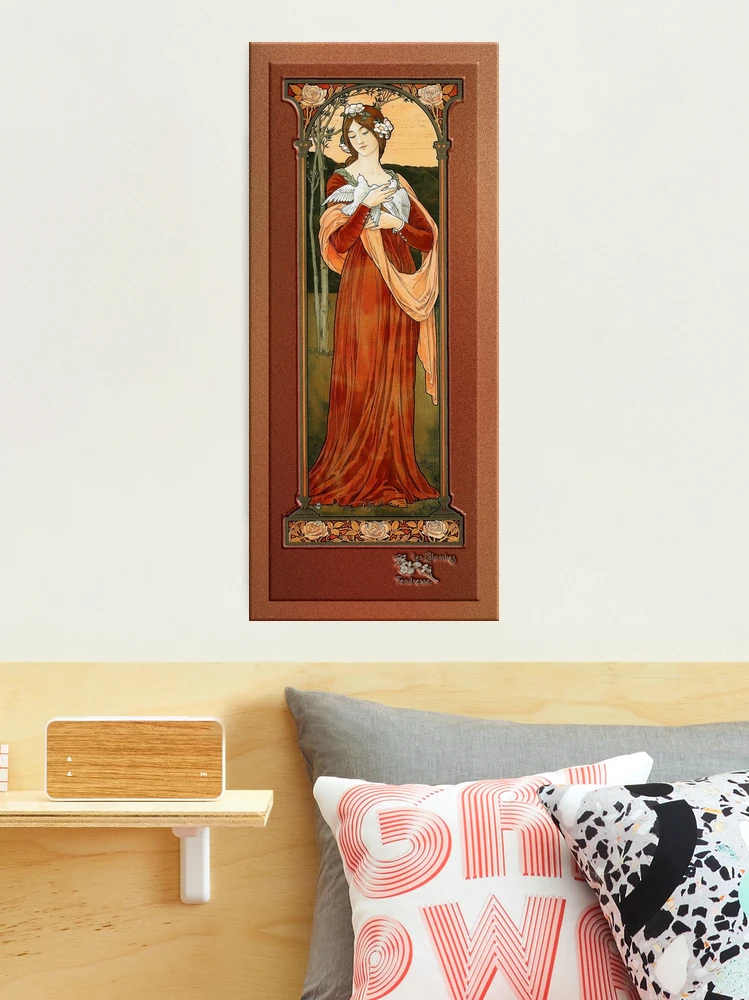
“Tender Doves (Duvorna; Ömhet)” is a beautiful work by Elisabeth Sonrel, created around the turn of the 20th century. Sonrel, a French artist born in 1874 and who passed away in 1953, is renowned for her symbolic and highly decorative approach to painting. This particular piece exemplifies her delicate mastery of Art Nouveau and her affinity for portraying women in idealized, ethereal settings. The work features a woman holding two doves, a motif rich with symbolism, conveying themes of peace, oskuld, and tenderness.
Innehållsförteckning
Huvudämnet och kompositionen
The central subject of “Tender Doves” is a graceful woman standing in a serene, slightly blurred landscape. She exudes a sense of tranquility, gazing downward as she gently holds two white doves in her arms. Her face is calm and introspective, radiating both innocence and grace. The woman’s long flowing red gown, which cascades dramatically down her body, is meticulously painted in rich, warm tones. The folds of the fabric are carefully rendered, highlighting the artist’s sensitivity to the nuances of texture and light. The gown is the focal point of her form, elegantly sweeping down to the ground, enhancing her ethereal presence.
Her pose and the way she holds the doves emphasize softness and fragility. The birds, symbols of peace and love, are cradled delicately in her arms, their white feathers providing a sharp contrast to the warm, earthy tones of her clothing and the background. The composition emphasizes the connection between the woman and the birds, evoking a sense of harmony and a bond with nature. The doves are not merely ornamental but serve as an integral part of the narrative, reinforcing the peaceful mood of the piece.
Inställningen och bakgrunden
In the background of the painting, the artist has chosen a soft and somewhat indistinct landscape, which allows the figure of the woman to dominate the scene. The soft colors of the sky and the trees in the distance create an almost dreamlike atmosphere, as though the figure exists in an idealized, otherworldly space. The muted tones of the environment, composed mainly of light greens, bruna, och gula, complement the warm tones of the woman’s gown, creating a sense of unity in the composition. This choice of background adds to the sense of serenity, offering the viewer a quiet, reflective space.
Träden, faintly visible in the background, stand tall but not imposing, blending into the soft, hazy light of the horizon. The use of nature as the setting is an integral part of the work, highlighting the peaceful, harmonious relationship between the human form and the natural world. The distant trees and rolling hills suggest a timeless, natural world, where the viewer can imagine the woman being one with the environment, adding to the calm and gentle mood of the piece.
The Symbolism of the Doves
The doves in the painting are a significant element in the overall composition. In Western art, doves are widely recognized as symbols of peace, renhet, and love. Their presence in this piece is not only symbolic of the artist’s theme of tenderness but also reflects broader themes of femininity and grace. The fact that the woman is holding the doves so gently suggests a nurturing quality, reinforcing the motif of caring and peace. Doves are often associated with mythological and religious symbolism, and their presence here may also invoke ideas of spirituality and transcendence.
The white color of the doves further emphasizes purity and innocence, qualities often attributed to the feminine ideal. The doves in “Tender Doves” act as a counterbalance to the earthy tones of the woman’s attire and the landscape, providing a moment of lightness and transcendence. This balance between the earthiness of the scene and the purity of the birds reinforces the peaceful, harmonious atmosphere that is central to the painting’s mood.
Art Nouveau Style and Influence
Sonrel’s work is a classic example of the Art Nouveau movement, which emerged in the late 19th century and reached its peak in the early 20th century. Art Nouveau is characterized by flowing lines, organiska former, and a focus on the decorative and ornamental. “Tender Doves” embraces these stylistic elements, particularly in the intricate design of the borders and the floral motifs surrounding the woman’s figure. The sinuous, curving lines of the composition, particularly in the background and in the woman’s gown, are hallmarks of Art Nouveau’s influence.
The elegant framing of the piece, with its decorative borders adorned with roses and tendrils, reflects the movement’s focus on integrating art into daily life and its reverence for nature. Den mjuka, flowing forms and the rhythmic repetition of organic shapes also point to the influence of Art Nouveau, which often sought to harmonize the human figure with the natural world.
Humör och känslomässig inverkan
Stämningen av “Tender Doves” is one of calmness, introspektion, och renhet. The delicate handling of the subject matter, along with the soft color palette and harmonious composition, creates a serene atmosphere. The viewer is invited to pause and reflect upon the symbolic message of peace, tenderness, and harmony that the piece conveys. The emotional impact of the artwork is subtle but powerful, evoking feelings of peace, lugn, och en koppling till naturen. There is an air of gentle reverence in the way the woman is depicted, as though she is a guardian of peace, holding the doves as symbols of the fragility and beauty of life itself.
Sonrel’s work captures a moment of serene beauty, suspended in time. The attention to detail in the woman’s expression, the folds of her gown, and the delicate handling of the doves invites the viewer to engage with the artwork on a deeply emotional level. The piece conveys a sense of timelessness, allowing the viewer to experience a moment of peaceful contemplation, much like the woman herself, standing in quiet communion with nature and the symbols of love and peace.
Tender Doves is a retouched digital art old masters reproduction of a public domain image.
Artistbio med tillstånd Wikipedia.org
Elisabeth Sonrel (1874 Rundturer - 1953 Sälar) var en fransk målare och illustratör i jugendstil. Hennes verk inkluderade allegoriska ämnen, mysticism och symbolism, porträtt och landskap.
Hon var dotter till Nicolas Stéphane Sonrel, en målare från Tours, och fick hennes tidiga utbildning av honom. För vidare studier fortsatte hon till Paris som student vid Jules Lefebvre vid Ecole des Beaux-Arts.
I 1892 hon målade sitt diplomarbete, "Pax et Labor", ett verk att se på Musée des Beaux-Arts de Tours. Från och med då ställde hon ut på Salon des Artistes Français mellan 1893 och 1941, hennes signaturstycken är stora akvareller på ett pre-Raphaelite-sätt, som hon antog efter en resa till Florens och Rom, upptäcka renässansmålarna – några av hennes verk har tydliga övertoner av Botticelli. Hennes målningar inspirerades ofta av Arthurian romans, Dante Alighieris gudomliga komedi’ och "Det nya livet", bibliska teman, och medeltida legender. Hennes mystiska verk inkluderar "Ames errantes’ (Salong av 1894) och "Avgrundens andar’ (Salong av 1899) och "Ung kvinna med gobelängen".
Vid Exposition Universelle of 1900, vars huvudsakliga tema var jugendstil, henne 1895 målning "Jungfruns sömn’ (Jungfruens sömn), fick en bronsmedalj, och Henri Lehmann -priset av 3000 franc av The Academy of Fine Arts.[3] Från 1900 framåt begränsade hon sin målning till porträtt, natursköna Bretagne landskap, och en och annan blomsterstudie.
Hon gjorde regelbundna måleresor till Bretagne, inspirerad av skogen Brocéliande, och från 1910 till olika platser på kusten som Concarneau, Plougastel, Pont-l'Abbé och Loctudy, vistas ofta på värdshus och åtföljs av en eller två studenter. Hon målade flera verk i Le Faouët innan hon byggde en villa i La Baule på 1930 -talet. Arbetar främst i akvarell och gouache, hon upptäckte ett klart utbud av modeller bland unga tjejer i området, och tyckte att bretoner i allmänhet var vänliga, ärlig och självsäker.
Hennes sista utställning på salongen var i 1941 vid en ålder av 67. Det finns också ett register över att hon hade ställt ut i Liverpool. Under sina första år producerade Sonrel affischer, vykort och illustrationer, i jugendstil.