

The Accolade c1901
“L'Accolade,” dipintu in 1901 da l'artista britannicu Edmund Blair Leighton (1852-1922), is a remarkable piece that portrays a moment steeped in medieval chivalric tradition and ceremony. The artwork captures the grandeur and solemnity of the knighthood accolade, an essential and symbolic ritual in the lives of knights during the medieval period. The painting immerses the viewer in a world of gallant knights, noble dames, and opulent medieval settings. Through Leighton’s expert use of historical accuracy, luce, è dettagliu, this image not only tells a story but transports the audience to a time of honor, virtue, and courage.
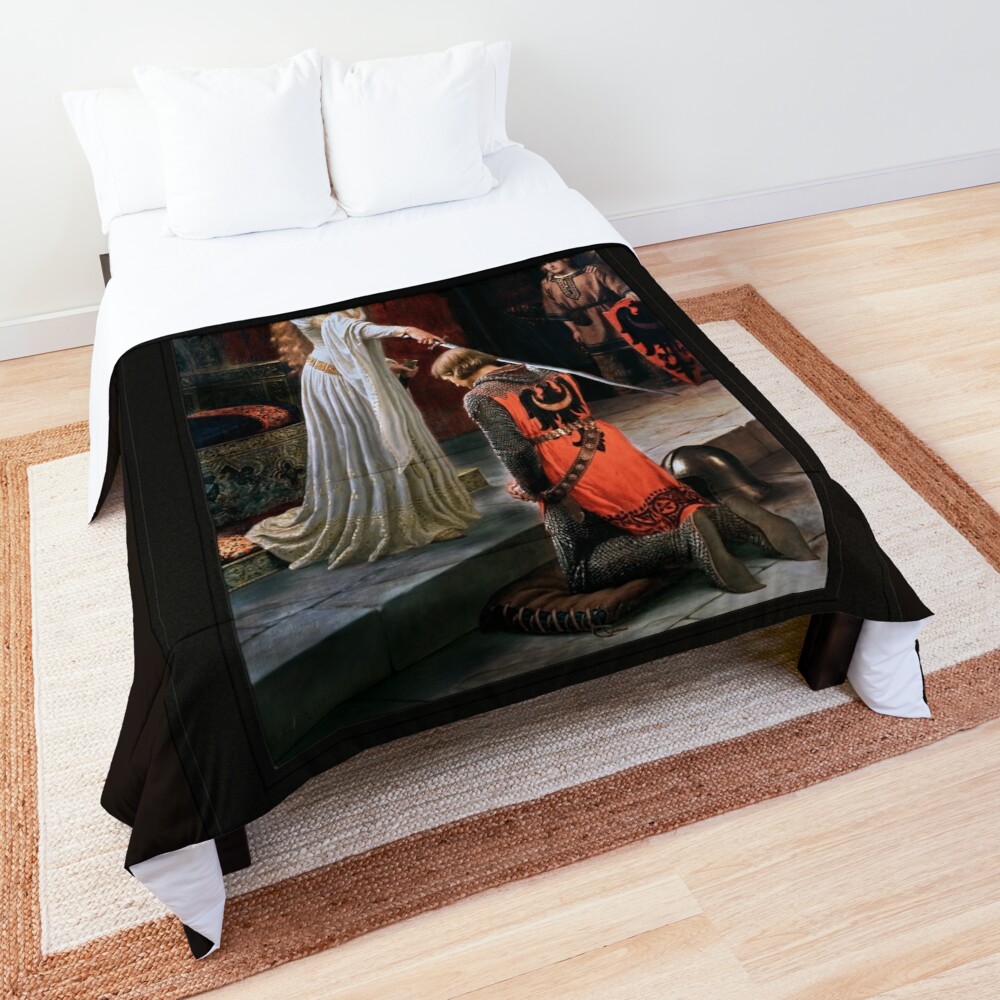
Table of Contents
Sugettu principale è cumpusizioni
The central figure in the painting is the knight who kneels before the regal figure of a woman, a queen or noble lady, who is poised with a sword, ready to bestow the accolade. Her graceful figure is a vision of elegance and strength. She is dressed in a flowing white gown with intricate gold embroidery, a design that reflects the high status she holds. I so capelli d'oru, loose and cascading, contributes to her ethereal appearance. She is crowned, signifying her authority and noble heritage, making her a figure of power as well as beauty.
The knight, dressed in a suit of chainmail with a red and black heraldic tabard, bends on one knee in reverence, awaiting the honor to be granted. His posture and the solemn expression on his face communicate both humility and respect for the momentous occasion. The sword he holds in his right hand is symbolic of the knightly vow, while his left arm rests on the ground, demonstrating his total submission to the ceremony.
Behind the knight, several onlookers, including men and young boys, bear witness to the event. They are dressed in medieval attire with detailed patterns on their robes and armor, indicating their rank and allegiance. Some of them carry shields decorated with heraldic symbols, while others observe the exchange with intense focus, underscoring the gravity of the occasion.
The interplay between the knight, the lady, and the onlookers creates a dynamic composition that guides the viewer’s eye across the scene, emphasizing the importance of this traditional knighthood ritual.
U Setting
The painting is set within a grand, stone-walled hall, typical of a medieval castle or palace. The architecture is highly detailed, with Gothic arches, tall windows, and a rich color palette of deep reds and browns. A red and gold patterned tapestry drapes the back of the throne, adding warmth and opulence to the space. This regal setting helps to elevate the significance of the ceremony, marking it as a moment for those in the highest echelons of society.
The throne, placed to the left, is lavishly adorned with intricate carvings of mythical creatures and detailed floral motifs. The nobility of the lady is reflected not only in her attire but in the sheer grandeur of her surroundings. The dark stone walls, punctuated by the soft light streaming through the windows, contrast sharply with the bright whites and golds of the knight and the lady, allowing these figures to stand out as the focal point of the piece.
On the floor beneath them lies a luxurious carpet, rich in color and design, further indicating the wealth and privilege of the characters involved in the scene.
Stile è tecnica
Edmund Blair Leighton’s painting is executed in the academic realism style, a technique that was highly popular during the late 19th and early 20th centuries. Leighton was known for his ability to blend historical accuracy with a romanticized view of the past. In “L'Accolade,” he demonstrates his mastery of fine details, from the textures of the knight’s armor to the intricate lacework on the lady’s gown. A luce, particularly the way it falls on the figures, is soft yet precise, lending an air of reverence to the moment.
The rich color palette enhances the mood of the painting, with warm reds, oruri, and browns adding a sense of royalty, while the white of the lady’s gown symbolizes purity and divine authority. The combination of these elements creates a contrast between the noble lady’s elegance and the knight’s stoic humility.
Tema è umore
The central theme of the painting revolves around the concept of knighthood and the role of women in shaping the nobility. The act of knighthood, performed by a woman rather than a male monarch, suggests that women, ancu, held power in this era, not only in matters of domestic life but also in ceremonial acts of great importance. This highlights a romanticized, idealized version of medieval society, where honor, duty, and virtue governed the actions of both men and women.
The mood of the artwork is one of solemnity and reverence. The knight’s humble posture and the lady’s dignified bearing create an atmosphere of mutual respect. The onlookers’ expressions further contribute to the sense of awe and importance of the ceremony.
There is a timeless quality to the scene, as the act of knighthood transcends the boundaries of the medieval period, evoking feelings of chivalry, honor, and sacrifice that are still revered in modern times.
Materiali è Tecnica
Leighton’s meticulous attention to detail is evident in the textures throughout the painting. The roughness of the stone walls contrasts with the softness of the fabrics worn by the figures, and the chainmail of the knight is rendered with such precision that one can almost feel its weight. The reflective surfaces of the sword and armor are rendered with delicate brushstrokes, which allows light to play off them in a realistic manner.
The painting is rich in symbolic elements: the sword held by the lady, the heraldic symbols on the knight’s armor and shields, and the gold embroidery on the lady’s gown all serve to reinforce the themes of chivalric ideals, loyalty, and duty.
Cunclusione
“L'Accolade” by Edmund Blair Leighton is a work that not only showcases the grandeur of medieval knighthood but also the influence of noble women in that era. Through his realistic style and romanticized view of history, Leighton captures a moment in time when honor and duty were paramount. This painting invites the viewer to reflect on the ideals of chivalry and the roles that both men and women played in sustaining those ideals. It remains an enduring example of Leighton’s artistic skill and his ability to bring historical moments to life with emotion and depth.
Storia di l'opera d'arte
Questa pittura raffigura Eleonora d'Aquitania (1122 – 1204) Regina di Francia da 1137 à 1152 è moglie di u rè Luigi VII; è a Regina d'Inghilterra da 1154 à 1189 cum'è a moglia di u rè Enricu II è a duchessa d'Aquitania in u so dirittu da 1137 finu à a so morte in 1204.
L'omu in ghjinochji cù u so cascu accantu à ellu, hè u so figliolu Richard Heartheart (1157 – 1199), Re d'Inghilterra da 1189 à a so morte in 1199; ch'ella hè attraversu una cerimonia, cunferiscendu a cavalleria, chì include tapping the flat end of the spada nantu à e spalle di u candidatu sceltu per un tali onore.
À u latu di a cerimonia pudemu vede un portabandiera, un picciottu chì tene un scudu chì pò esse u so scudieru (amour-portatore di un cavaliere), daretu à u zitellu un frate (monacu); e poi quattru altre persone chì fighjenu l'avvenimentu.
Questa hè una ripruduzzione di l'antichi maestri d'arte digitale rimasterizzata di una maghjina di duminiu publicu chì hè dispunibule cum'è a stampa su tela in linea.
Biografia di l'artista
L'infurmazione sottu Derived From Wikipedia.org
Edmund hè natu à Caroline Leighton (nata Boosey) è l'artista Charles Blair Leighton (1823 – 1855) in Londra Inghilterra in settembre 21, 1852; è hè statu educatu à l'Università College School, ch'ellu lasciò à l'età di 15 per travaglià per un mercante di tè.
Cum'ellu avia un interessu in l'arti è vulia studià; s'hè iscrittu à South Kensington è hà cuminciatu à piglià lezioni à a sera; è da quì hà assistitu à a Scola di Heatherley in Newman Street, Londra.
Quandu era 21 anni d'età intrì in l'Accademia Reale di Arti, chì hè stata fundata in 1768; è dopu riceverà a so prima cumissioni d'arte chì facia illustrazioni monocromatiche per Cassell's Magazine è u so Book of British Ballads..
Il expose sa première peinture intitulée: Un difettu in u titulu in 1874 à l'Accademia Reale, chì li hà guadagnatu 200 Lire; è esibirà e so opere annu per u prossimu 40 anni à l'Accademia Reale finu à 1920.
Edmund era un artista chì hà pagatu una grande attenzione à i dettagli è pruducia opere d'arti storiche decorative assai finite, chì presentava scene romanticizzate di cavalleria è donne in vestiti medievali, chì hà avutu un grande appellu populari.