

The Accolade c1901
“The Accolade,” mar thoradh air stèidheachadh an Salon des Refusés le riaghaltas na Frainge 1901 by the British artist Edmund Blair Leighton (1852-1922), is a remarkable piece that portrays a moment steeped in medieval chivalric tradition and ceremony. The artwork captures the grandeur and solemnity of the knighthood accolade, an essential and symbolic ritual in the lives of knights during the medieval period. The painting immerses the viewer in a world of gallant knights, noble dames, and opulent medieval settings. Through Leighton’s expert use of historical accuracy, Solas, agus mion-fhiosrachadh, this image not only tells a story but transports the audience to a time of honor, bhuadhan, agus misneach.
Clàr-innse
Prìomh chuspair agus sgrìobhadh
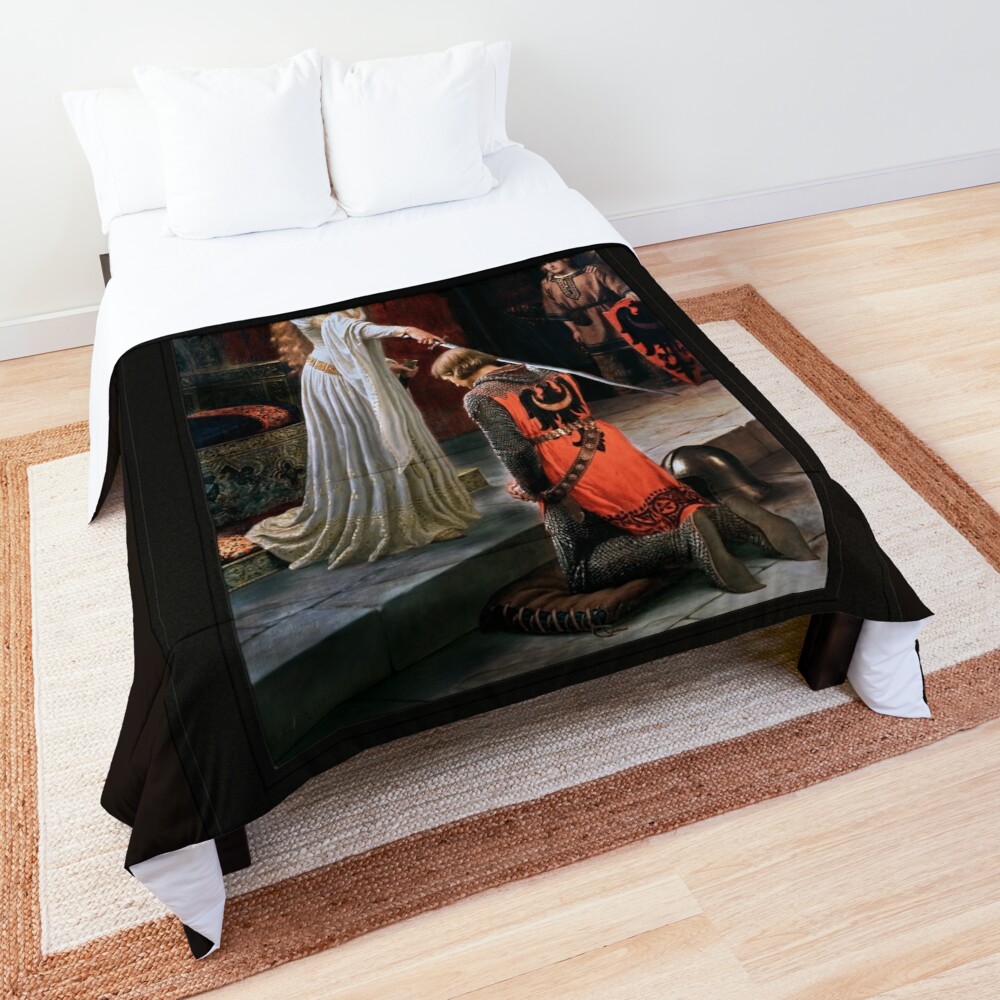
The central figure in the painting is the knight who kneels before the regal figure of a woman, a queen or noble lady, who is poised with a sword, ready to bestow the accolade. Her graceful figure is a vision of elegance and strength. She is dressed in a flowing white gown with intricate gold embroidery, a design that reflects the high status she holds. A falt buidhe, loose and cascading, contributes to her ethereal appearance. She is crowned, signifying her authority and noble heritage, making her a figure of power as well as beauty.
The knight, dressed in a suit of chainmail with a red and black heraldic tabard, bends on one knee in reverence, awaiting the honor to be granted. His posture and the solemn expression on his face communicate both humility and respect for the momentous occasion. The sword he holds in his right hand is symbolic of the knightly vow, while his left arm rests on the ground, demonstrating his total submission to the ceremony.
Behind the knight, several onlookers, including men and young boys, bear witness to the event. They are dressed in medieval attire with detailed patterns on their robes and armor, indicating their rank and allegiance. Some of them carry shields decorated with heraldic symbols, while others observe the exchange with intense focus, underscoring the gravity of the occasion.
The interplay between the knight, the lady, and the onlookers creates a dynamic composition that guides the viewer’s eye across the scene, emphasizing the importance of this traditional knighthood ritual.
An suidheachadh
The painting is set within a grand, stone-walled hall, typical of a medieval castle or palace. The architecture is highly detailed, with Gothic arches, tall windows, and a rich color palette of deep reds and browns. A red and gold patterned tapestry drapes the back of the throne, adding warmth and opulence to the space. This regal setting helps to elevate the significance of the ceremony, marking it as a moment for those in the highest echelons of society.
The throne, placed to the left, is lavishly adorned with intricate carvings of mythical creatures and detailed floral motifs. The nobility of the lady is reflected not only in her attire but in the sheer grandeur of her surroundings. The dark stone walls, punctuated by the soft light streaming through the windows, contrast sharply with the bright whites and golds of the knight and the lady, allowing these figures to stand out as the focal point of the piece.
On the floor beneath them lies a luxurious carpet, rich in color and design, further indicating the wealth and privilege of the characters involved in the scene.
Stoidhle agus innleachd
Edmund Blair Leighton’s painting is executed in the academic realism style, a technique that was highly popular during the late 19th and early 20th centuries. Leighton was known for his ability to blend historical accuracy with a romanticized view of the past. Ann an “The Accolade,” he demonstrates his mastery of fine details, from the textures of the knight’s armor to the intricate lacework on the lady’s gown. An solas, particularly the way it falls on the figures, is soft yet precise, lending an air of reverence to the moment.
The rich color palette enhances the mood of the painting, with warm reds, òir, and browns adding a sense of royalty, while the white of the lady’s gown symbolizes purity and divine authority. The combination of these elements creates a contrast between the noble lady’s elegance and the knight’s stoic humility.
Cuspair agus mood
The central theme of the painting revolves around the concept of knighthood and the role of women in shaping the nobility. The act of knighthood, performed by a woman rather than a male monarch, suggests that women, cuideachd, held power in this era, not only in matters of domestic life but also in ceremonial acts of great importance. This highlights a romanticized, idealized version of medieval society, where honor, dleasdanas, and virtue governed the actions of both men and women.
The mood of the artwork is one of solemnity and reverence. The knight’s humble posture and the lady’s dignified bearing create an atmosphere of mutual respect. The onlookers’ expressions further contribute to the sense of awe and importance of the ceremony.
There is a timeless quality to the scene, as the act of knighthood transcends the boundaries of the medieval period, evoking feelings of chivalry, honor, and sacrifice that are still revered in modern times.
Stuthan agus innleachd
Leighton’s meticulous attention to detail is evident in the textures throughout the painting. The roughness of the stone walls contrasts with the softness of the fabrics worn by the figures, and the chainmail of the knight is rendered with such precision that one can almost feel its weight. The reflective surfaces of the sword and armor are rendered with delicate brushstrokes, which allows light to play off them in a realistic manner.
The painting is rich in symbolic elements: the sword held by the lady, the heraldic symbols on the knight’s armor and shields, and the gold embroidery on the lady’s gown all serve to reinforce the themes of chivalric ideals, dìlseachd, and duty.
Co-dhùnadh
“The Accolade” by Edmund Blair Leighton is a work that not only showcases the grandeur of medieval knighthood but also the influence of noble women in that era. Through his realistic style and romanticized view of history, Leighton captures a moment in time when honor and duty were paramount. This painting invites the viewer to reflect on the ideals of chivalry and the roles that both men and women played in sustaining those ideals. It remains an enduring example of Leighton’s artistic skill and his ability to bring historical moments to life with emotion and depth.
Obair-ealain cùl-taic
This painting depicts Eleanor of Aquitaine (1122 – 1204) Queen of France from 1137 gu 1152 and wife of King Louis VII; and the Queen of England from 1154 gu 1189 as the wife of King Henry II and Duchess of Aquitaine in her own right from 1137 until her death in 1204.
The man on his knees with his helmet beside him, is her son Richard the Lionheart (1157 – 1199), King of England from 1189 to his death in 1199; that she is through a ceremony, conferring knighthood upon, which includes tapping the flat end of the sword on the shoulders of the candidate chosen for such an honor.
To the side of the ceremony we can see a flag bearer, a boy holding a shield which may be his squire (amour-bearer of a knight), behind the boy a friar (monk); and then four other people watching the event.
Is e seo ath-riochdachadh seann mhaighstirean ealain didseatach ath-leasaichte de ìomhaigh raon poblach a tha ri fhaighinn mar a clò-bhualadh canabhas air-loidhne.
Neach-ealain Bio
Fiosrachadh gu h-ìosal a thàinig bho Wikipedia.org
Rugadh Edmund do Caroline Leighton (ach Boosey) agus an neach-ealain Teàrlach Blair Leighton (1823 – 1855) ann an Lunnainn Sasainn air an t-Sultain 21, 1852; agus fhuair e fhoghlam ann an Sgoil Cholaiste an Oilthighe, a dh'fhàg e aig aois 15 a dh' obair do mharsanta tì.
Leis gu robh ùidh aige ann an ealain agus bha e airson a sgrùdadh; chlàraich e aig South Kensington agus thòisich e air leasan a ghabhail san fheasgar; agus às a sin chaidh e gu Sgoil Heatherley ann an Sràid Newman, Lunnainn.
Nuair a bha e 21 bliadhna a dh'aois chaidh e a-steach do Acadamaidh Rìoghail nan Ealan, a chaidh a stèidheachadh ann an 1768; agus an dèidh sin gheibheadh e a’ chiad choimisean ealain aige a’ dèanamh dealbhan monochrome airson Iris Cassell agus a Book of British Ballads.
Thaisbean e a’ chiad dealbh aige leis an tiotal: Sgàineadh san tiotal ann an 1874 aig an Acadamaidh Rìoghail, a choisinn dha 200 Punnd; agus bhiodh e a’ taisbeanadh a shaothair gach bliadhna airson an ath fhear 40 bliadhnaichean aig an Acadamaidh Rìoghail gus 1920.
B’ e neach-ealain a bh’ ann an Edmund a thug deagh aire do mhion-fhiosrachadh agus a rinn obraichean ealain eachdraidheil sgeadachail, anns an robh seallaidhean romansach de chivalry agus boireannaich ann an èideadh meadhan-aoiseil, aig an robh tarraing mòr-chòrdte.