

Le modèle de l'artiste
Luis Ricardo Falero, a renowned Spanish painter active in the 19th century, created his masterpiece “Le modèle de l'artiste” in the late 1800s. Né dans 1851 et décéder dans 1896, Falero was known for his skillful depiction of women, often set against rich backgrounds that blended classical themes with sensual undertones. Cette peinture, comme beaucoup de ses œuvres, portrays a female model who exudes both elegance and allure, capturing the essence of the classical and romantic ideals of beauty. The subject is presented as the epitome of grace, pouvoir, and ethereal presence. Falero’s intricate understanding of human anatomy and his nuanced use of light and shadow bring the subject of the artwork to life in an almost tangible way.
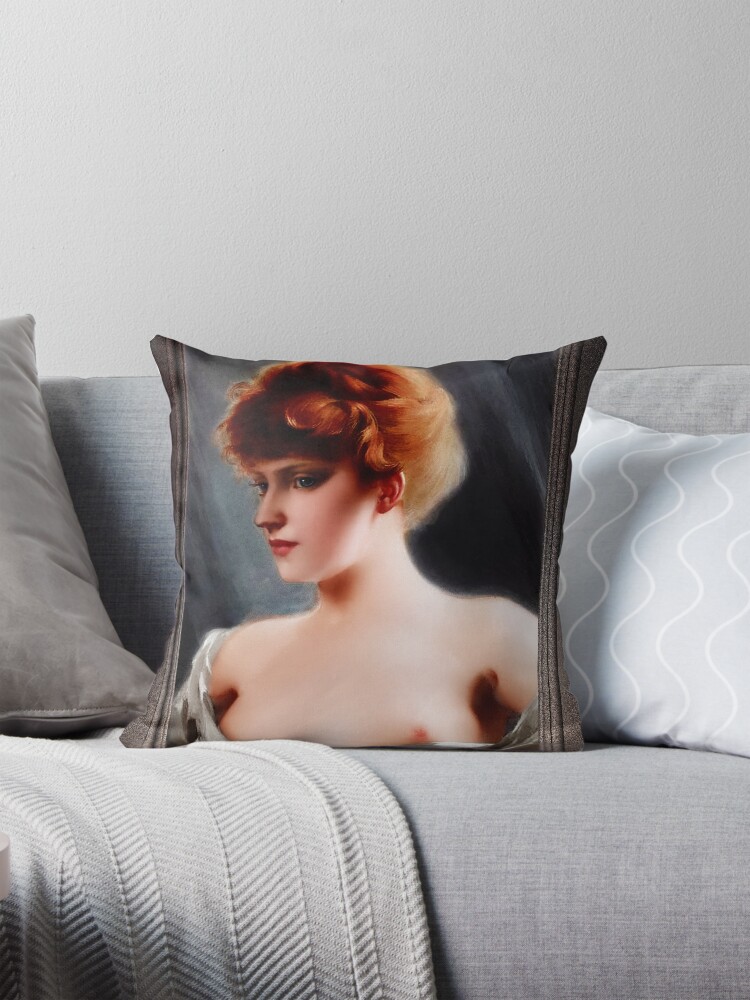
Table des matières
The Subject and Her Presentation
Le sujet central de “Le modèle de l'artiste” is a woman who gazes slightly off to the side, her expression one of quiet contemplation. She is positioned in profile, offering an intimate yet restrained portrait of her beauty. Her face is delicate and composed, with strikingly detailed features. The artist’s depiction of her hair, a rich reddish hue, is meticulously styled with soft, voluminous curls that frame her face and cascade down her back. This attention to her hair is not only an artistic choice but also an ode to the idealized beauty standards of the time.
The woman’s attire is minimal, focusing primarily on her figure. The fabric that she wears drapes over her body in an almost fluid manner, its softness contributing to the tactile sensation of the painting. The semi-transparent fabric allows for the graceful curve of her shoulder and the outline of her chest to be visible, subtly hinting at her form while maintaining an aura of modesty. The choice of soft whites and grays for the cloth contrasts with her skin tone, which is radiant and smooth, lending her an almost otherworldly appearance.
The Composition and Mood
The composition of the painting is deliberate and composed, emphasizing the delicate balance between the subject and her surroundings. The backdrop is somewhat muted, rendu en douceur, indistinct tones that allow the model to be the focal point. There is a play of light and shadow on her face and shoulders, suggesting a warm light source from the left. This light serves to highlight her features in a soft glow, giving her an almost ethereal presence. The use of shadow is also significant; it gently outlines her profile, adding depth to the overall composition and guiding the viewer’s gaze from her delicate face down to the curves of her body.
Falero’s ability to convey a sense of quiet sensuality is central to the mood of the painting. There is an air of mystery in her gaze, as though she is both the object of desire and yet removed from it. The contemplative nature of her expression, combined with the softness of her figure, evokes a sense of timeless beauty and purity. The mood of the painting can be described as serene, intimate, and slightly melancholic, as if the subject is both a muse and a woman trapped in a moment of stillness.
Matériaux et techniques
Falero’s technique is evident in his masterful application of oil paint. The colors used in the painting are warm and muted, with a predominance of earth tones and soft highlights. The richness of the hues, particularly in the woman’s red hair, contrasts with the darker shadows and the neutral tones of her skin and background. The fluidity of the fabric and the softness of her skin are rendered in exquisite detail, showcasing the artist’s expertise in handling light and texture. The contrast between the smoothness of her skin and the textured brushwork used for the fabric creates a dynamic visual interest.
One of the key features of Falero’s work is his use of light to highlight specific aspects of his subjects. Dans ce tableau, the subtle play of light across the model’s skin and hair gives a sense of volume and depth. The artist has captured the sheen of her skin and the fine texture of her hair with a technique that enhances their lifelike quality, making them seem almost tangible. The interplay of light and shadow on the fabric further enriches the painting, giving it an added layer of realism.
Thematic Elements and Style
The thematic elements of “Le modèle de l'artiste” are rooted in the classical tradition, yet there is also an evident sensuality that Falero often imbued in his works. The depiction of the female form was central to many academic painters of the time, and in this piece, the model can be seen as both a subject of admiration and a symbol of beauty. There is a tension between the model’s modest pose and the visible sensuality of her form. This delicate balance speaks to the theme of the objectification of women in art, while simultaneously celebrating their strength and grace.
Falero’s style, which combined elements of realism with romanticism, is evident in the finely executed details of the model’s face and figure. The artist’s deep understanding of classical art and his ability to blend it with a romantic, almost dreamlike quality results in a painting that feels both grounded in the real world and elevated to an almost mythic realm. Le modèle, despite her seemingly modest presentation, embodies the ideal of beauty that was so prominent in the 19th century, yet she is presented in a way that also evokes contemplation of her humanity.
Conclusion
En conclusion, “Le modèle de l'artiste” by Luis Ricardo Falero captures the duality of the female form as both an object of desire and a figure of grace. Through his meticulous technique and understanding of human anatomy, Falero imbues the subject with a sense of elegance and timeless beauty. L'éclairage tamisé, delicate fabrics, and contemplative expression all contribute to the mood of the painting, which remains one of quiet allure and sensuality. By merging classical ideals with romantic elements, Falero creates a work that is both a celebration of beauty and a reflection on the nature of artistic representation.
Il s'agit d'une reproduction de maîtres anciens d'art numérique retouchée d'une image du domaine public.
Biographie de l'artiste dérivée Wikipedia.org
Falero est né à Grenade et a d'abord poursuivi une carrière dans la marine espagnole, mais a abandonné à la déception de ses parents; comme il a décidé de voyager à Paris, où il a étudié l'art, chimie et génie mécanique.
Pendant ses études en chimie et génie mécanique; il considérait les expériences qu'il devait mener trop dangereuses, l'amenant ainsi à concentrer son attention sur la peinture seule.
En conséquence, il est devenu un élève du portraitiste et orientaliste français Gabriel-Joseph-Marie-Augustin Ferrier (1847 – 1914). Après Paris, il a déménagé à Londres, où il a poursuivi ses études, et finalement réglé.
Falero avait un intérêt particulier pour l'astronomie et a incorporé des constellations célestes dans plusieurs de ses œuvres, tel que “Le mariage d'une comète” et “Étoiles jumelles”. Son intérêt et sa connaissance de l'astronomie l'ont également amené à illustrer les œuvres de Camille Flammarion.
Dans 1896, l'année de sa mort, Maud Harvey a poursuivi Falero pour paternité. La poursuite alléguait que Falero avait séduit Harvey alors qu'elle était 17, servant d'abord de femme de chambre, puis son modèle. Quand il a découvert qu'elle était enceinte, il l'a renvoyée.
Elle a gagné l'affaire et a reçu cinq shillings par semaine pour soutenir leur enfant. Falero est décédé au University College Hospital, Londres, à l'âge de 45